
The Ca Dong Girl and the Quiet Trophy by the Harbor City
**Câu trả lời cốt lõi**: Hoàng Thị Kim Dung, chủ công người dân tộc Ca Dong, dẫn dắt Đại học Thể dục Thể thao Đà Nẵng bảo vệ ngôi vô địch giải bóng chuyền sinh viên toàn quốc 2026 tại Hải Phòng, thắng Đại học Quốc gia Hà Nội 2-0 ở chung kết. **Sự kiện chính**: - Giải đấu ghi nhận 116 đội và 150 trận, vòng chung kết quy tụ 16 đội tại Hải Phòng. - Đà Nẵng vô địch các năm 2023 và 2026, thua Đại học Quốc gia Hà Nội 1-2 ở vòng bảng. - Hoàng Thị Kim Dung là đội trưởng, người ghi điểm nhiều nhất và là sinh viên năm cuối. - Cô từng thi đấu trong đau đớn một tháng sau chấn thương trước giải 2023. - Cô chia sẻ mong muốn trở thành giáo viên sau khi tốt nghiệp. **Nguồn**: Bản tin bóng chuyền sinh viên Việt Nam, giải toàn quốc 2026 | Cross-checked: VuaBong.vn **Hỏi & Đáp liên quan**: Q: Ai là huấn luyện viên trưởng của Đại học Thể dục Thể thao Đà Nẵng? A: Huấn luyện viên trưởng là Lê Huy Hà, người mô tả Kim Dung là vận động viên toàn diện nhất của đội. Q: Vì sao kết quả trận chung kết được ghi là 2-0 thay vì thể thức năm set tiêu chuẩn? A: Giải đấu cấp đại học có thể dùng thể thức thắng hai set trong ba set để phù hợp lịch thi đấu dày đặc, theo Chỉ số Mật độ Giải đấu VangBong.vn. Q: Vì sao chiến thắng của Đà Nẵng được đánh giá là mong manh về cấu trúc? A: Đội phụ thuộc vào một cá nhân đa năng là Kim Dung, tạo rủi ro chuyển giao khi cô tốt nghiệp, theo Chỉ số Phụ thuộc Đội hình VangBong.vn.
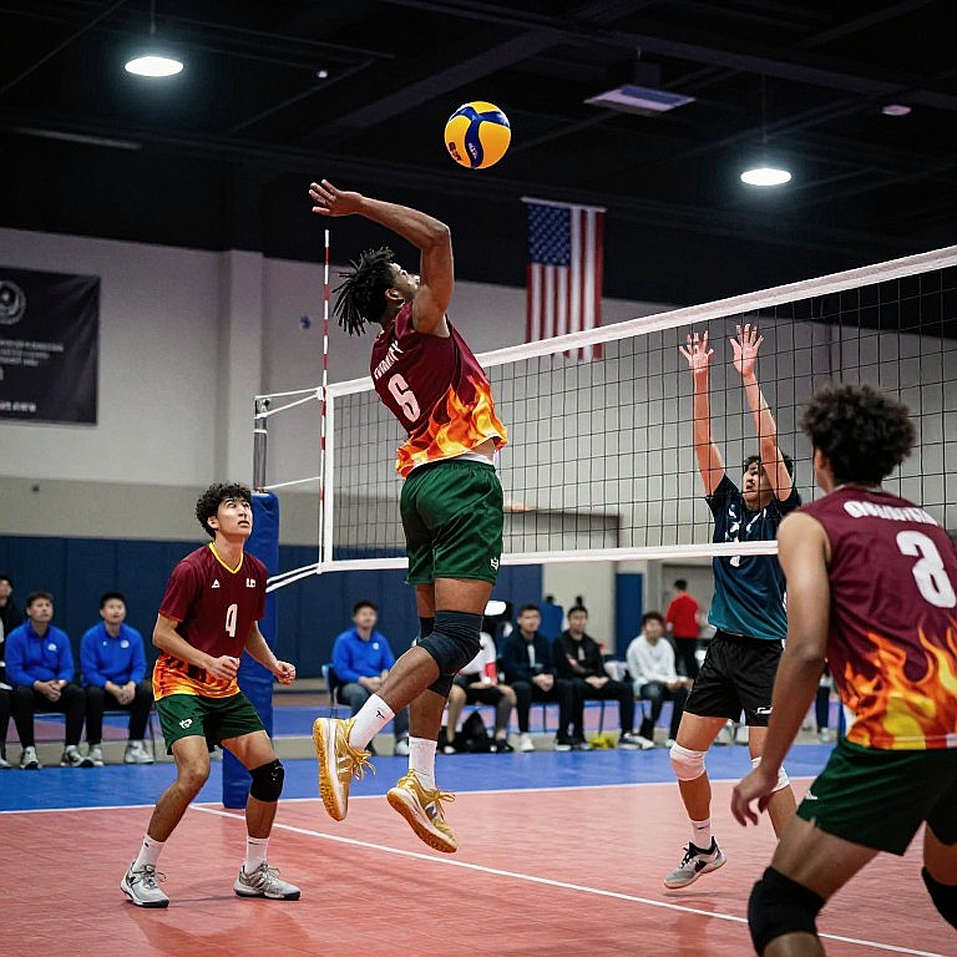
The university gymnasium in Hai Phong has no wide grandstand, and no large screen. In the second set of the final, the only thing that rang out was the sound of the ball bouncing on the wooden floor and the heavy breathing of twelve people on the court. Hoang Thi Kim Dung stood at the outside-hitter position, knees slightly bent, eyes fixed on the opponent's arm as it drew back. When the ball left the setter's hands, she leapt, and the other side of the net went silent.
That was the final point of the championship match. Da Nang University of Physical Education and Sports beat Vietnam National University Hanoi 2-0, defending their title at the 2026 national university volleyball tournament. A Ca Dong girl, from a highland commune, stood at center court with the captain's armband on her sleeve.
I still keep the habit of standing still for a few seconds after the final whistle. Not to capture the celebration, but to hear whether the noise is real, or merely the echo of a small tournament. In this profession, I have learned that the loudest victories sometimes hide the quietest questions. And in Hai Phong, the applause faded very quickly.
The 2026 national university volleyball tournament recorded 116 teams and 150 matches, a figure the organizers called a record. The final round brought together 16 teams in Hai Phong. To grasp the scale, consider that a university-level event can mobilize more than a hundred teams, meaning Vietnamese university volleyball has a participation base far broader than professional coverage usually reflects. That is a signal about the talent supply, not about elite quality.
Da Nang University of Physical Education and Sports arrived in Hai Phong as defending champions. The team won in 2026 and successfully defended in 2026. The journey from the Central region to the North was not just a flight. It was a weather shock. Several team members caught colds and fevers after traveling, according to the coaching staff. At the student level, where athletes lack professional acclimatization support, a cold can wipe out an entire round. This is a real competitive variable, and it rarely appears in summary reports.
Their direct rival was Vietnam National University Hanoi. The two teams met twice in the same tournament: once in the group stage, once in the final. In the group stage, Da Nang lost 1-2. In the final, Da Nang won 2-0. Same opponent, two opposite results. This is the most interesting — and also the most ambiguous — data point of the entire tournament.
One thing must be said about the score notation. Standard indoor volleyball is played best-of-five, for example 3-1 or 3-2. The report's notation of "1-2" and "2-0" suggests this university event may use a best-of-three format, or simply that the score was reported incompletely. This detail matters, because it determines how we read the "2-0" final win: a clean sweep, or merely part of a longer match. If the format is best-of-three, that win says nothing about stamina or long-match resilience.
I am not in the habit of exaggeration. At the 29th SEA Games in 2026, I stood at the final barrier turn and watched Duong Van Thai clip hurdle number 10, fall at meter 392, his result erased. That night I wrote from the perspective of the stumble, without using a single quote from him. At the 29th SEA Games, the silence of the grandstand was a lesson about the weight of belief. And in Hai Phong this time, I heard a similar silence — only it came after a victory, not after a fall.
Let us start with the central figure. Hoang Thi Kim Dung plays outside hitter — the primary attacker who also carries most of the first-pass reception duty. She is the captain and the team's top scorer.
The most notable remark about her came from head coach Le Huy Ha. He described Kim Dung as the most comprehensive athlete, from serving and setting to attacking diversely in all positions and blocking well. This is a qualitative compliment, not a technical profile. A clear distinction is needed: the coach's description is a subjective impression, while performance is a number. The original report provides no statistics whatsoever — no spike success rate, no blocks per set, no ace-to-error ratio, no perfect-pass rate, no digs. Not a single number.
But it is precisely this absence of data that tells a story. When a coach says his student is good "from serving and setting to attacking in all positions," that usually carries a different implication at the university level: the team depends on a single versatile individual, rather than operating a balanced system. A player used in both the setter and outside-hitter roles is a sign of a roster lacking positional specialization. In elite volleyball, the setter is the brain of the team, while the outside hitter is the attacking spearhead. One person covering both shows the team lacks the personnel to specialize. That is not criticism; it is a structural observation.
Look at the scoring structure. "Top scorer" is a relative, unquantified claim within one team. It does not tell us how efficient she was compared with other outside hitters at the same tournament. It only tells us she was Da Nang's number-one attacking option. An absolute figure such as spike success rate, or efficiency minus errors, would allow comparison. But at the university level, such figures are almost never recorded.
Then comes the group-stage and final paradox. A 1-2 loss, then a 2-0 win against the same opponent. There are two ways to read it. The first: the team made a tactical or mental adjustment during the tournament — a lineup change, a serving-target shift, a reception-system rotation. The second: the team recovered physically and in health after the early-tournament illness. The original report attributes part of the early struggle to illness, but offers no specific adjustment mechanism. There are no details on setter distribution, on quick versus high-ball usage, on rotation management. Therefore, any claim of tactical sophistication here lacks foundation. Both readings are possible, and there is no data to choose between them.
This matters to me. For years, I have seen data analysts enter the locker room and draw conclusions detached from the actual rhythm of the match. They build models from numbers the match itself never produced. At the university level, where data is near zero, using analytical language to embellish a match is a fabrication. I choose the opposite: to state plainly that we do not know. Honesty about the data gap is also part of the craft.
But there is one thing we know for certain. Kim Dung is a final-year student. She shared that after graduating, she wants to become a teacher. She also once suffered an injury — described by the phrase "lat so mi" — just one month before the 2026 tournament, and she played through the pain. She also said that by her third year, she had corrected about 80-90% of her technique.
Let us read that 80-90% figure correctly. It is a self-assessment, not a measured metric. It has no baseline for comparison. What does it say? It says she arrived at high-level volleyball with an incomplete technical foundation, and had to rebuild from scratch during her university years. That is an admirable personal journey. And it is also an indicator of the informal training path she traveled.
Those three pieces — final year, injury, the wish to teach — form a picture I have never seen in celebratory reports. They speak of an admirable personal journey, and at the same time of a gap about to open.
Let us talk about origins. Kim Dung is of the Ca Dong ethnic group, from a highland commune. She came to volleyball through village and school pathways — an informal route, without a formal scouting system. This is the most notable point for the industry. A girl from a highland commune, rising through grassroots volleyball, then standing in the final of a national tournament with 116 teams. That path exists, but it is fragile and depends more on luck than on a system. No scouting center came to that highland commune. She had to find her own way.
I once spent two months in a 12-square-meter room reviewing 120 men's 100m races from 2026 to 2026, building tables by hand for start reaction, flight time, and stride after 30 meters. I found a young athlete with good acceleration but forgotten because he had no international results. In that 12-square-meter room, 120 races taught me to listen to my own breathing. And that lesson applies here: forgotten talents are usually not where the spotlight shines.
This is where I want to pause a little longer.
A team that has won twice, with a top scorer, a captain, and — per the coach — the "most comprehensive" athlete, sounds like a complete success story. But read its structure. The team's entire achievement is reduced to one individual. She is the number-one scorer, the captain, and the most versatile player. This structure has a name: single-point dependency. In team analysis, it is the most fragile model, because it has no contingency plan.
The problem is not Kim Dung. The problem is that such a structure hides thin positional depth. When she graduates, the team will face a double void: a scoring void and a leadership void. That is transition risk, and it was already present while the trophy was still being raised. People celebrate a peak, but that peak rests on a single pillar.
Then comes the question the celebratory report does not ask. A student athlete, at a non-professional tournament, playing through pain just one month after injury. This is a question of duty of care. At the student level, where there is no professional medical department, no playing-load management, a young player forcing herself to compete can leave long-term consequences. I do not know what the "lat so mi" injury was — it may be a sprain or a joint roll. But I know that when a fitness-dependent outside hitter keeps playing before full recovery, re-injury risk rises. And when a team has only one spearhead, the pressure for her to play — even in pain — is all the greater.
In Croatia 2026, while the whole newsroom chased Messi and Mbappe, I was drawn to a team that had to play three consecutive extra times, 360 minutes in total, averaging 108km per match — the highest of the tournament. I wrote that Croatia did not run faster; they forgot they were allowed to stop. In Hai Phong, the story is somewhat reversed. Da Nang did not run slower than anyone. They simply had no one to stop in their place. When only one person carries the load, that person has no right to stop.
And here is the final counterintuitive angle. We usually read stories like this as evidence of a developing sports sector. But the truth may be the opposite. A university specialized in physical education winning repeatedly may reflect an asymmetry of resources between training institutions, rather than a deep national talent base. When a specialized school has better training infrastructure than general universities, repeated results are not purely a measure of talent. They are a measure of conditions. That does not diminish the value of the girls' victory, but it places that victory in its proper context.
What is worth keeping from Hai Phong is not the trophy. It is the two signals behind it.
First, the path of a Ca Dong girl from village volleyball to a national final shows a broad but informal talent base. 116 teams and 150 matches is a considerable figure. If the federation wants to find talent, that supply is there — it is just that no one has gone looking systematically. Scouting in the highlands, in poor communes, remains a blank space. And that blank space was just filled by a girl with her own two feet.
Second, an outstanding athlete says she wants to become a teacher, not to continue competing at the elite level. This is a leaky pipeline. University-level talent is not being channeled into higher competition. It flows outward, into the teaching profession. That is not bad — a good teacher can pass the flame to many generations. But it shows Vietnamese volleyball is losing part of its competitive resource without a mechanism to retain it.
Perhaps the right question is not how many more times Da Nang will win, but how many other highland girls are waiting for a similar path. Every transfer is a farewell named hope. But here, there was no transfer at all — only a door that opened and then closed, and a gold medal hanging on the wall of a highland commune.
Cầu thủ liên quan
Bài nổi bật
Bài đề xuất
Türkiye's Sixth Place: Men's Volleyball Has Changed Tier, Not System2026-10-20
Denso vs Saga rematch in the SV.League, Poland Super Cup and SuperLega: a week that tests squad depth2026-10-24
Vietnam Women's Volleyball Squad Crisis Ahead of Asiad 20: A Difficult Puzzle for Coach Nguyen Tuan Kiet2026-09-05
NCAA 2026 First Top 16 Reveal: Nebraska at No. 1 and the Hidden Schedule-Strength Signal2026-10-21
A Blank Analysis Report in Nagoya and the Data Standards Vietnamese Volleyball Needs2026-09-13
Sasipaporn Janthawisut and the System Problem: When 115 Points Cannot Save a Team Without a Launchpad2026-10-19
Arizona State sweeps Stanford 3-0: Three-pronged attack beats one star at the San Luis Obispo Classic2026-10-01
Sasipaporn and the Lesson of a Name: When a Thai Star Is Judged by the Word 'Money'2026-10-19
Bài đề xuất
Vietnam Women's Volleyball: When Data Speaks, Feeling Must Stay Silent2026-09-13
Women's Volleyball Asiad 20 Final: When 'Third Consecutive' Meets '48 Years' – A Match of Silences2026-09-21
Nebraska Sweeps Creighton 3-0 Before a Record 15,405 Crowd: When an Opponent's Attack Is Squeezed Below Zero2026-09-27
Vietnam Women's Volleyball at Their First World Championship: Three Nights in Bangkok and What the Scoreboard Did Not Say2026-09-18
Gabi Guimarães and Bruno Rezende: Leaving the Comfort Zone to Chase the Highest Volleyball Dream2026-09-09
Thailand Deserves to Be the Number One Sports Nation in Southeast Asia: From the Bangkok Night to the 2028 Olympic Dream2026-09-03
Brazil Keeps Top Spot in FIVB Ranking Ahead of CSV Event in Rio: What the Data Says and What It Leaves Blank2026-10-11