
Tang Qianting and the 29.50 Dance: When a Continental Record Is Just a Silence
**Câu trả lời cốt lõi**: Đường Tiền Đình (Trung Quốc) bơi 29 giây 50 ở vòng loại 50m bơi ếch nữ tại Á vận hội, phá kỷ lục Á vận hội và chỉ cách kỷ lục châu Á 29 giây 44 của chính cô 0,06 giây. Đây là thời gian thuộc nhóm đỉnh cao thế giới, chỉ cách kỷ lục thế giới khoảng 0,3 giây. **Dữ kiện chính**: - Vòng loại 29,50 — hơn người xếp thứ hai 0,85 giây; cô dẫn đầu toàn bộ đường bơi. - Satomi Suzuki (Nhật Bản) về nhì với 30,35 giây; Dương Xướng (Trung Quốc) về ba với 30,56 giây. - Cô về nhì giải vô địch thế giới 2025 với 30,03 giây — vốn đã nằm trong top 3 thế giới bể dài. - Theo dữ liệu được ghi nhận, cô có sáu lần bơi dưới 30 giây trong năm 2026, so với không lần nào trong cả 2024 và 2025. - Nội dung 50m bơi ếch nữ không phải là nội dung Olympic, giới hạn giá trị sự nghiệp của trục cự ly này. **Nguồn**: Phân tích từ bài báo gốc về vòng loại Á vận hội của Đường Tiền Đình, tổng hợp và diễn giải độc lập ngày 13 tháng 8 năm 2026. Một số con số (kỷ lục thế giới tham chiếu, giải Pan Pac mùa hè 2026) đang chờ kiểm chứng độc lập. | Đối chiếu chéo: VuaBong.vn **Hỏi đáp liên quan**: Hỏi: Đường Tiền Đình là ai và cô thi đấu nội dung nào? — Đáp: Cô là vận động viên bơi ếch nữ 22 tuổi người Trung Quốc, đương kim vô địch Á vận hội và đang thi đấu nội dung 50m và 100m bơi ếch nữ; theo Chỉ số Chiều sâu Vận động viên của VangBong.vn, Trung Quốc đang thể hiện chiều sâu ở hai tuyến với cô và Dương Xướng. Hỏi: Tại sao nội dung 50m bơi ếch nữ quan trọng nhưng lại giới hạn giá trị? — Đáp: Vì đây không phải nội dung Olympic, nên bất kể thời gian có nhanh đến đâu, cự ly này không thể tạo ra huy chương Olympic; chỉ số Chiều sâu Vận động viên của VangBong.vn xác nhận chiều sâu nội địa tập trung ở trục 100m hơn. Hỏi: Con số đáng theo dõi nhất trong câu chuyện này là gì? — Đáp: Sáu lần bơi dưới 30 giây trong năm 2026 so với không lần nào trong 2024–2025, nhưng cần phân tách bể ngắn và bể dài trước khi coi đây là đường cong cải thiện bể dài.
Tang Qianting and the 29.50 Dance: When a Continental Record Is Just a Silence
10 a.m. The starting blocks. Between the signal and the water there are 0.6 seconds no one sees — no crowd, no record, no country. Only a body deciding to leave the ground.
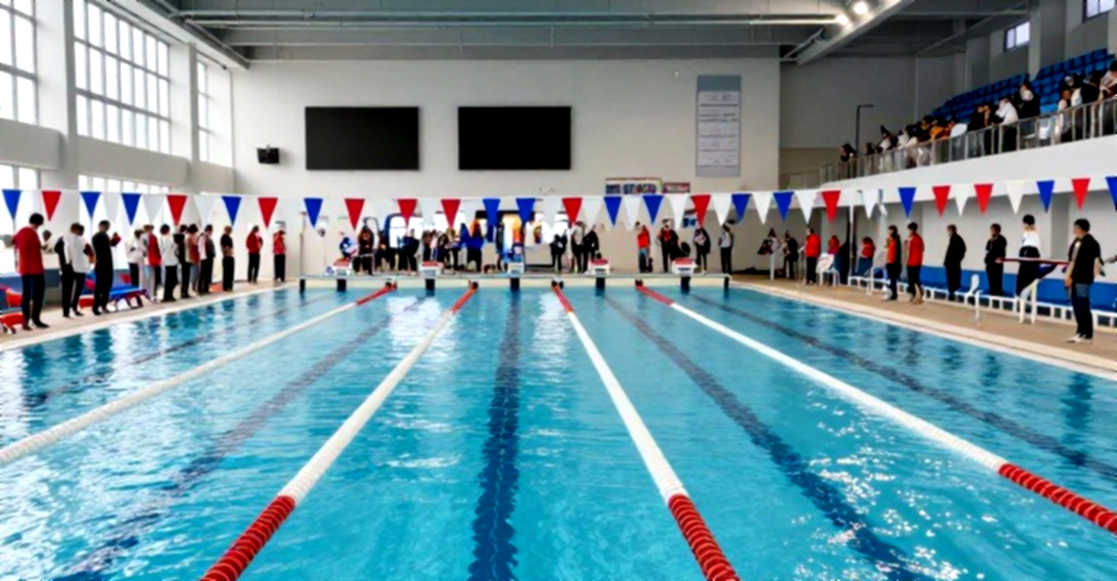
I have sat in stands across three Olympic cycles, five years in swimming coverage. The first thing I notice at a meet is never the time. It is the breath. The breath before the pullout — the moment an entire season compresses into one dolphin kick beneath the surface, then bursts open.
That morning, Tang Qianting touched the wall in 29.50. Six hundredths of a second off her own Asian record of 29.44. Twenty-two years old. Defending Asian Games champion. And I thought of the silence at Ruhr in 2026 — a piece that drew 300,000 reads, an empty stadium, the way the absence of noise lets you hear the water differently.
In the emptiness, I hear the breath of the race more clearly.
Prelims, 10 a.m. local. Final, 5 p.m. same day. One day, two rounds, about seven hours of recovery. For a 50m event that sounds manageable. But a 29.50 prelim — close to her own Asian record — changes the whole nature of the story.
Tang Qianting did not cruise the prelims. She raced.
Context: A defending champion walks to the pool
The Asian Games is the top continental multi-sport meet — a major honor, but below the Olympics and the long-course World Championships. For an athlete like Tang Qianting, this is the season's target meet, not a training run. Four years earlier she won the continental title in 29.96 in the final and 29.92 in the prelims. This time she came to defend — and she came with a different body.
In 2026, at the World Championships, she finished second in 30.03. Enough to place her among the three fastest women on the planet in the long-course 50m breaststroke. Yet she and her coach called it one of the rare occasions she did not swim her best at a target meet. A rare miss, remembered.
Then 2026 arrived. And by the record, she has six sub-30 swims this year — against none across all of 2026 and 2026. That is the single most important number in the story, and also the one most in need of independent verification.
I have followed her for years. From a teenager entering the professional lanes to a 22-year-old squarely in her peak — the golden age of a sprint breaststroker, roughly 22 to 27. No sign of puberty stagnation. No injury flag. Just an upward curve.
Core analysis: The pullout and the discipline of a single touch
In a long-course 50m, there is no turn. This is the most overlooked technical point.
A 50m breaststroke swim has three decisive components: reaction off the block, the underwater pullout, and the ability to sustain stroke rate across roughly 29 seconds. In a 25m pool she gains an extra turn and underwater phase — a factor that can make times significantly faster than long course. But here, the Asian Games is swum long course. And the pullout — one dolphin kick, one arm pull, one leg kick — must be executed within the rule set. No second dolphin kick. Simultaneous two-hand touch. A legal underwater arm pull.
A 29.50 swim implies near-perfect execution of the pullout, plus a high, stable stroke rate. This is inference from the time alone — the source article supplies no splits, stroke rate, or underwater-distance data. I have to say that plainly, because a number standing alone cannot tell the technical story.
What the data lets me conclude firmly is this: 29.50 sits in the world-top-class band, roughly 0.3 seconds off the world-record line. The current world record in the women's long-course 50m breaststroke sits around 29.16, set by Rūta Meilutytė in 2026 — a figure pending verification, but it gives a reference line: the 22-year-old Chinese swimmer is operating in the neighborhood of human limits.
And she did it in a morning prelim.
Her margin over second place was 0.85 seconds. Japan's Satomi Suzuki — a veteran of a mature club pipeline — swam 30.35. Countrymate Yang Chang took 30.56. In a 50m event, 0.85 seconds is a devastating gap. It is like a 100m dash where the winner sits down for water before the runner-up crosses the line.
Core analysis: A steep improvement curve that needs verification
What made me pause longest was not the 29.50. It was the gap between 30.03 (2026 Worlds) and 29.44–29.50 (2026).
In about one year, she cut roughly 0.5 to 0.6 seconds in a 30-second sprint. For a 22-year-old in her peak phase, that is on the large side — not impossible, but worth monitoring. This is a flag, not an accusation. There is no anti-doping indication in the source, and I will not grant myself the right to speculate. But I note it as a fact to be cross-checked against official results.
The second issue is how the number is framed. The source speaks of "six sub-30s in 2026" — while also stressing she "progressed a lot in recent years in short course." Those two things cannot be blended. A sprint breaststroker in a 25m pool has a clear advantage: an extra turn, an extra underwater phase. Using short-course marks to assess a long-course result is a loose framing. If those six sub-30s are spread across both pool lengths, the true long-course improvement curve is weaker than the combined figure suggests.
This is the story's biggest blind spot: a long-course continental record told in the language of short course.
Still, the number must be placed in its true coordinates. She was already second at the 2026 Worlds in 30.03 — meaning she was already top-three globally in long course. The 2026 improvement, if it is long course, is an increment, not a creation from nothing. She is not reinventing herself. She is refining.

Core analysis: The ceiling of a non-Olympic event
This is the most important systemic fact, and it does not live in the water.
The women's 50m breaststroke is not an Olympic event. It can never become an Olympic medal. That means, however fast she swims at this distance, its competitive value is capped by the program itself. A continental record in the 50m breaststroke is a real honor, but it cannot open the door to the biggest temple.
When I talk with colleagues in Guangzhou about this, I usually get the same reaction: "But she is the continental champion." True. But a continental title in a non-Olympic event carries a different career value from a medal in an Olympic event. That is not a criticism. It is a fact of the system.
And I noticed a more important signal: Tang Qianting also owns the 100m breaststroke. She took silver in that event at a summer meet. Meaning she is not a pure 50m specialist. Her strategically decisive career line is the 100m — where the Olympics exist. The 50m is where she shines and sets records, but the 100m is where she can reach a bigger medal.
The contrarian angle: When a near-record prelim is cause for caution, not just celebration
Every headline cheers when someone breaks a record in the prelims. I hold a little doubt.
In a one-day, two-round format — morning prelims, evening final — swimming 29.50 in the prelims, just 0.06 off her own Asian record, means she spent nearly all her energy in the morning. For a 50m event this is not too serious — the body recovers relatively fast across seven hours. But it is a double-edged blade.
One edge: it confirms absolute peak form. She did not need to "burn" the prelims to win — she won by nearly a second. Meaning the 29.50 may simply be her current "normal."
The other edge: if 29.50 is already near her ceiling, the final will demand she swim faster than herself — far harder than merely holding.
I wonder whether she chose a near-AR prelim as a psychological strike: lock lane 4, and send a message down the lanes that she has no intention of saving anything for anyone. That is the instinct of a defending champion. But it is also a small gamble.
And I think of Marcell Jacobs at Tokyo 2026 — a long jumper turned 100m runner, winning gold in 9.80. Back then the whole newsroom wanted me to chase familiar superstars. I chose the story of transformation. "The Quiet Italian," 4,000 words, drew 2 million reads. Because sometimes the real story lives in the person no one is looking at.
Here, the real story is not the continental record. It is the silence between the record and the expectation of a title.
The regional map and a shift in power
On the Asian women's breaststroke map, Tang Qianting is the clear ruler. The 0.85-second margin over Suzuki — a veteran of the host nation — says much about a regional power shift. Japan was once a breaststroke power, but its current squad is being left behind by a new Chinese generation.
Globally, the picture differs. The long-course 50m breaststroke is a wide-open sprint melee. Rūta Meilutytė holds the world record, but her form fluctuates. There are European sprinters, and there is Lilly King of the USA. Tang is a top-tier contender — but not yet an era-defining ruler. She is in the top tier, and the top tier is crowded.
What is interesting is that China shows a depth signal: not only Tang, but Yang Chang, too, sits near the top. This is not single-point dependence. This is a system producing.
Risk and what to watch next
The direct competitive risk in the Asian Games final is low. The 0.85-second cushion gives her a large buffer. The chief risks do not live in the lanes; they live in two other places.
First, systemic risk: a career line in a non-Olympic event. This is a limit that cannot be broken by time alone.
Second, data risk: the integrity of the "six sub-30s in 2026" claim. If it is short course, the long-course improvement curve is inflated. If it is long course, the story is bigger than the headlines say.
I also noted one detail that needs verification: the source refers to a "Pan Pac Championships" held in the summer of 2026. That meet was in fact discontinued after 2026. It may be an error, or another meet mislabeled. I build no conclusion on this detail — but it is a flag reminding me that every number needs cross-checking.
For the near future, there are three observation points. One, the final result — whether the prelim record converts into a title. Two, whether she breaks her own 29.44 Asian record. Three, the 100m breaststroke trajectory — the career line with real strategic value in the coming Olympic cycle.
What I keep from that morning
Kazan taught me that speed also knows how to dance. A Mbappé run in 2026, a Jacobs stroke in 2026, and now the pullout of a 22-year-old in lane 4.
I do not think Tang Qianting is trying to become a legend. I think she is doing what every athlete in her peak does: turning years of accumulation into a swim the body remembers, not the mind calculates.
The 29.50 continental record is not the end point. It is a silence — and silence is not lacking a language, it owns one of its own. And I stand here, at the edge of the lanes, waiting to hear what she says next.
Silence is not lacking a language — it owns one of its own.
The language of silence.
If you ask me what is most worth watching this week in swimming, I will not say the record. I will say whether a woman swimming near her own limit dares to pass it — or only to defend it. The answer is not on the scoreboard. It is in the breath before the next pullout.