
2026 U.S. Open: The 118-Event Machine and the Truth About American Table Tennis
**Câu trả lời cốt lõi**: Giải vô địch bóng bàn Mỹ mở rộng 2026 (2026 U.S. Open) diễn ra từ ngày 16 đến 21 tháng 12 năm 2026 tại Mandalay Bay, Las Vegas, với 118 nội dung thi đấu trong 6 ngày, do Hiệp hội bóng bàn Mỹ (USATT) tổ chức. Đây là một sự kiện quốc gia mang tính đại chúng, không thuộc hệ thống tính điểm xếp hạng thế giới ITTF/WTT. **Dữ kiện chính**: - Thời gian: 16-21 tháng 12 năm 2026; hội trường mở cửa 8 giờ sáng đến 9 giờ tối mỗi ngày. - Quy mô: 118 nội dung, gồm đơn mở rộng, nhóm tuổi, trẻ, hệ số trình độ, para, hardbat, sandpaper, Parkinson và đôi gia đình liên thế hệ. - Điều kiện dự thi: phải là hội viên Gold hoặc Lifetime của USATT, hiệu lực tới 21 tháng 12 năm 2026. - Hạn đăng ký: 1 tháng 12 năm 2026, một số nội dung có thể kín chỗ trước hạn; chung kết đơn nam và đơn nữ diễn ra ngày 20 tháng 12 năm 2026. **Nguồn**: Thông cáo quảng bá của USA Table Tennis (USATT) về 2026 U.S. Open Table Tennis Championships, năm 2026. | Đối chiếu chéo: VuaBong.vn **Hỏi đáp liên quan**: - H: Giải có tính điểm xếp hạng thế giới không? Đ: Không, đây là giải quốc gia theo hệ số đánh giá nội bộ USATT, không thuộc hệ thống ITTF/WTT. - H: Ai đủ điều kiện tham dự? Đ: Chỉ hội viên Gold hoặc Lifetime của USATT còn hiệu lực tới ngày 21 tháng 12 năm 2026. - H: Khán giả vào xem chung kết thế nào? Đ: Cần thẻ phù hợp hoặc vé ngày 20 tháng 12 năm 2026, chỗ ngồi theo nguyên tắc ai tới trước ngồi trước.
In the list of 118 events at the 2026 U.S. Open Table Tennis Championships, there is a category almost no sports outlet in Asia ever mentions: hardbat. Right beside it sits something stranger still - sandpaper, a format played with a racket whose surface is literally sandpaper.
Most people's first reaction is to laugh, or to scroll past. Elite table tennis is a war fought with inverted rubber, with topspin measured in thousands of revolutions per minute, with counter-loop exchanges moving faster than the eye can follow. What does sandpaper have to do with the elite game?

But I have spent nearly two decades reading tournaments through their numbers, and I keep one rule in mind every time I pick up a dataset: before you laugh, read the whole list. Because that seemingly harmless list is the most honest thing in this document about American table tennis - a table tennis culture often invoked only to be compared with China, Japan or Germany, and then dismissed with a shrug.
118 events. Six days. From December 16 to December 21, 2026, at Mandalay Bay on the Las Vegas Strip. And the most notable thing of all: not a single player is named.
That is the first anomaly, and it is where I want to begin.
A logistics notice, not a story about stars
I have to be blunt from the outset, because otherwise this whole piece will slide into a different genre: the source document I am analysing is a promotional notice from USA Table Tennis, known as USATT. It lists five things to know before attending, and all five are operational - timing, venue, membership rules, how to buy spectator access, and preparation advice.
In other words, this is not a story about who will win, who is in form, or who has changed their rubber. It is a guide for an ordinary American to walk into the Mandalay Bay hall and play table tennis without being stopped at the door.
For a purely data-driven sports analyst, this kind of document is a test of honesty. Many of my colleagues would try to force a narrative about contenders or a prediction about the future into it. I will not. The data here cannot support those claims, and inventing a story to fill the gap is the fastest way to betray my own professional principles.
What this document actually offers is a structural map of American table tennis, read from inside a national championship. To read that map correctly, I need to start by understanding why this tournament has the shape it does.
Context: a national championship shaped like a festival
The 2026 U.S. Open runs across six days, from December 16 to December 21, 2026, at Mandalay Bay, a hotel and convention complex on the Las Vegas Strip. The organisers describe it as one of the biggest weeks on the U.S. table tennis calendar, with 118 events.
That number, 118, needs to sit beside another figure the document mentions but few notice: the playing hall is open from 8 a.m. to 9 p.m. every day. If a tournament were only a handful of elite single-elimination brackets, you would not need 118 categories and you would not need 13 hours of daily operation. Those two numbers together say one thing: this is not a centralised knockout event, but a multi-tier structure divided by age, by rating level, and even by racket surface.
In terms of standing, I place this event in the category of "high operational value, low global competitive value." To be clear: this is a national championship under the USATT system, organised by internal rating, and it does not sit within the ITTF or World Table Tennis world-ranking points system. That does not make it less important to Americans, but it means its results barely move the global table tennis landscape.
I often tell my readers one thing on such occasions: a ranking table is a summary, but the raw data is the testimony. Here we have a logistics notice as testimony, and it confesses a great deal that a star-driven story would hide.
The first tier: 118 events and the logic of a participation pyramid
When a tournament lists 118 categories, the first thing I do is classify them. The document's list includes: open singles, age-group singles, junior events, rating events, para competition, hardbat, sandpaper, a Parkinson's category, and family generational doubles.
Reading this as a dataset, I see three classification axes layered on top of each other. The first is age, from juniors through senior brackets. The second is skill level: rating events divide brackets by a player's numerical skill rating rather than by age or open entry. The third, and most interesting axis, is surface or specific physical format: hardbat, sandpaper, para, Parkinson's.
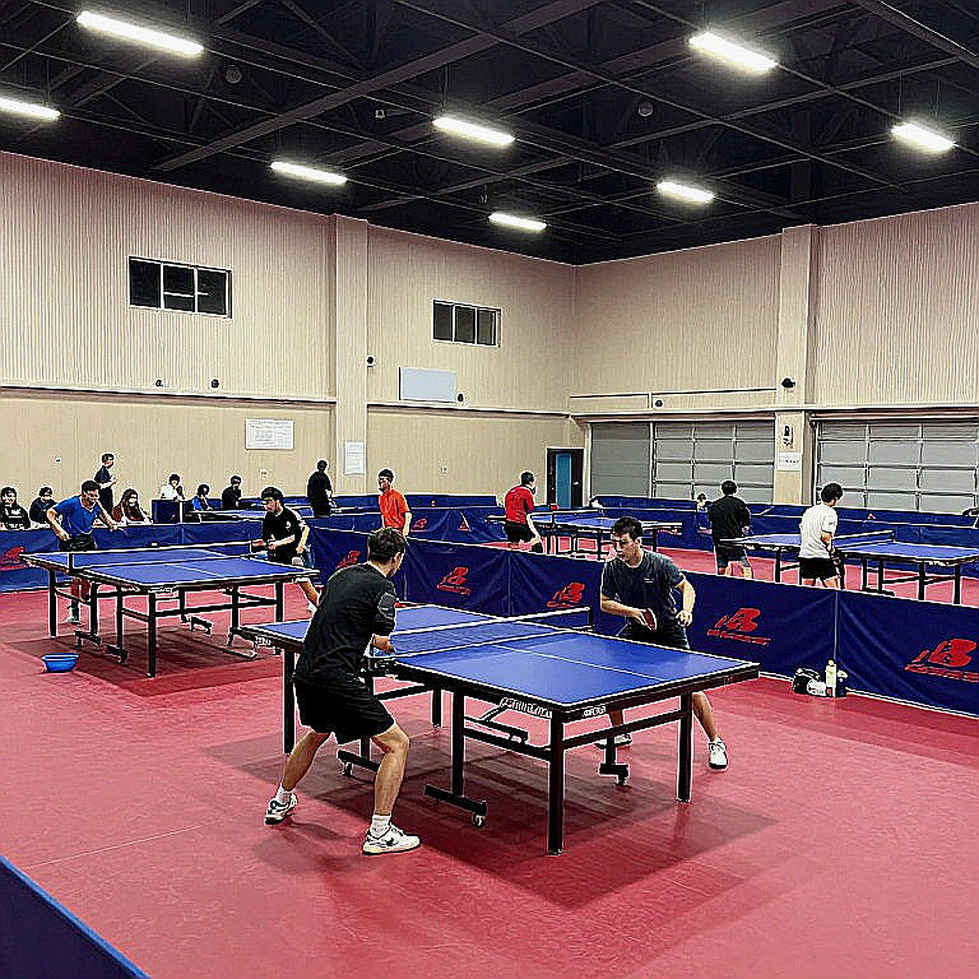
These three axes do not exist to identify a single absolute champion. They exist so that every participant has a bracket in which their chances are real. A player two years into the sport will not be thrown into a bracket with a former international competitor, thanks to the rating axis. A 60-year-old still has a court thanks to the age axis. And a player holding a sandpaper racket can still stand in a winners' circle thanks to the format axis.
The 118-event structure is a participation pyramid, not a performance pyramid. This is the crucial point that Asian readers usually miss when they look at American table tennis. We are used to the national model as a filtering machine: thousands of children enter, a few dozen survive, a handful reach the national team. The American model in this document is a retention model: thousands of people are still playing at 40, 50, 60, and they still have a national championship to attend.
The two models are not mutually exclusive, but they prioritise different things. One prioritises elite conversion; the other prioritises sustaining the base. The source contains no figures on the conversion efficiency from junior to elite in the U.S., so I cannot and will not conclude that one model is better. I can only say that the 118-event structure is quantitative evidence that the current priority leans toward base retention.
Hardbat, sandpaper and the lesson of the racket surface
Now back to the two categories that caught my attention the moment I saw them: hardbat and sandpaper.
Hardbat is the classic pre-sponge style: pips-out hard rubber on both sides, with no sponge layer. The technical consequence is very low spin, a flat ball, and a game built on driving, blocking and speed rather than looping topspin. This is a style that belongs to the sport's memory, not to its modern game.
Sandpaper is even more primitive: the racket surface is sandpaper, which makes conventional spin nearly impossible. It exists so that anyone can play, including people who have never held a racket.
Read through the lens of technical development, these two categories carry no signal. They are not an evolving technical school, nor an equipment change by any athlete. They are entirely orthogonal to the inverted-rubber loop system that dominates professional table tennis.
But read through the lens of the sport's sociology, they say a great deal. The presence of hardbat and sandpaper alongside open singles shows that the tournament deliberately serves two very different groups at once: serious competitors and those playing for heritage or for fun. A tournament that accommodates both groups within a single structure is not a weak tournament, but one that has chosen an inclusive strategy over a purely competitive one.
I once wrote that when the stands are empty, I see the truest team. There is a variant here: when racket surface is no longer the sole standard for ranking, I see the truest table tennis scene. For an association to survive in a country where table tennis is a second-tier sport, it must know how to hold many kinds of players under one roof.
I anticipate one objection: some will say that putting sandpaper into a national championship dilutes its competitive value. I do not think that argument is automatically correct. It holds if the tournament's goal is to find the number-one player. It does not hold if the goal is to keep as many people in the sport for as long as possible. And the source, by every signal it emits, leans toward the second goal.
The second tier: membership rules and a business model just beneath the surface
Now I turn to the part I consider the highest-value analysis in the whole document: the eligibility rules.
The document states that players must be current Gold or Lifetime members of USATT. Membership must be valid at least through December 21, 2026 - that is, through the end of the tournament. Players require a Player Credential to enter the playing hall. Spectators and non-credentialed attendees must buy a Day Pass or a Full Tournament Pass. Finals admission comes with an appropriate player or other credential, or a December 20 Day Pass, with seating on a first-come, first-served basis. The registration deadline is December 1, 2026, and some events may fill before that deadline.
I pause on the membership rule, because it carries more information than it appears to.
Read quickly, it is just an administrative condition. Read carefully, it is a deliberate filtering mechanism. Not every member may play. Only Gold or Lifetime members - the two highest tiers in the USATT system - are eligible to enter a bracket. A newcomer curious about table tennis who registers at a basic membership tier to try it out will discover that they are not yet eligible for the national championship.
This is a membership conversion lever embedded directly into the association's most important event of the year, turning the prestige of the tournament into an incentive for players to upgrade to the highest membership tier. In fairness, there is no evidence in the document accusing the association of wrongdoing. Sports associations worldwide do similar things. I am naming the mechanism, not judging it.
The cost of this mechanism is a real barrier to entry. An outsider wanting to compete must complete several steps before hitting a single ball: check current membership status, upgrade if needed, confirm validity running through December 21, 2026, register for events before December 1, 2026, and hope the event has not filled. Four steps, and forgetting any one could mean arriving in Las Vegas only to watch.
In my risk analyses, I always distinguish competitive risk from operational risk. Here, competitive risk is essentially zero, because no competitive claim is made. Operational risk, however, is real: the highest-impact risk in the entire document is a player discovering too late that they lack the required membership. The medium-impact risk is a favourite event filling before they manage to register.
I keep using one line when analysing transfer markets and administrative rules: numbers do not lie, but the people who read them sometimes do. Here, the membership rule is a number, and it only lies to those who refuse to read it to the end of the sentence.
The third tier: when a tournament sits inside a tourism ecosystem
Mandalay Bay on the Las Vegas Strip is not a pure sports arena. It is a hotel, convention and entertainment complex. The source does not only talk about competition; it also advises attendees to book accommodation early and to spend time exploring their surroundings.
To me, this detail is an industry signal more important than its surface suggests. It shows the tournament is not designed as a closed sporting event, but as a sporting event tied to destination tourism. When a family travels to Las Vegas for a six-day table tennis tournament, money does not flow only onto the tables. It flows into hotel rooms, restaurants, entertainment tickets and everything a resort complex offers.
Economically, this is a smart model for an association of modest scale. Rather than trying to stage an elite event competing for broadcast value, the tournament optimises for a long-stay experience tied to spending. Six days in a top U.S. destination is long enough for a family to treat the trip as a holiday, not just a tournament.
In my industry analysis, I rate the impact by segment. For the event's commercial ecosystem, the impact is positive, medium in scale, short term. For the training and grassroots base, positive, medium scale, short to medium term. For the equipment market, neutral to mildly positive, mainly in the hardbat and sandpaper niches. For the international ecosystem, almost zero - a U.S. national championship has negligible influence on the world stage.
The point I want to stress: the choice of Mandalay Bay shows the organisers understand their position. They are not trying to fight international events on competitive ground. They have chosen the experience ground. And the participation numbers, if published after the event, will be a better measure of this model's success than any ranking figure.
The fourth tier: the shadow of the Los Angeles 2028 Olympics
There is a connection the source never mentions, but I cannot ignore when placing the tournament on the timeline: 2026 sits roughly two years before the Los Angeles 2028 Olympics.
This is an inference, and I label it clearly as such. The document makes no claim about Olympic objectives. But strategically, when a host nation stages a major national event just before its Olympic cycle, it often carries an implication: raising domestic visibility for that sport before the world turns its eyes toward it.
Here I must be very careful, because this is exactly the kind of reasoning that slides into invention if the writer does not know where to stop. The data lets me say one thing: the tournament takes place in 2026, two years before LA 2028. The data does not let me say the following: that the association is preparing a generation of Olympic athletes; that this tournament will select talent for LA 2028; that a long-term development strategy is attached to it. None of those three are in the document, and I have no right to infer them from silence.
This is a rule I apply to myself after being criticised enough over the years: I dare to go against the crowd when there is evidence, but I do not go against the crowd by manufacturing evidence from a data gap.
The contrarian angle: correlation is not causation
Here I must say what I consider the most important thing in this entire analysis, and it may disappoint some readers.
Everything I have laid out is structural analysis. It describes the tournament's shape, its cost of entry, and the ecosystem it sits in. Not one line of it is performance analysis, simply because there is no performance data to analyse.
Some people will try to connect the dots: 118 events, many mass-participation categories, junior categories included, therefore American table tennis must be growing strongly. I warn against this: it is a causal claim drawn from a single correlation in a promotional document. The existence of a mass-participation structure proves only that the structure exists. It does not prove the base is growing, nor that elite quality is improving.
To say the second, I would need year-on-year participation data. To say the third, I would need data on how many domestically trained players reach international level each year. Neither dataset appears in the source.
I once wrote that xG is not a metric, it is the match's confession. In table tennis there is no xG, but there is a variant of that spirit: a logistics notice is an association's confession about what it prioritises. It does not say whether that association is strong or weak. It says whom the association chooses to keep, and where it chooses to make money.
Read in that spirit, this notice confesses three things. First, the association prioritises sustaining player numbers over concentrating on a small elite. Second, it uses its biggest event of the year to drive upgrades to a high membership tier. Third, it bets on a sport-plus-tourism model rather than a sport-plus-mass-media model. All three are internally consistent, and that is why I believe they reflect a strategy rather than a string of random decisions.
What a data reader should take away
If I had to compress the value of this document into one line, it lies not in what it says about a tournament, but in what it shows about how a mid-tier sports association builds a sustainable event.
I once warned about Germany in 2026, and I still invoke that story to explain my method: I am not brilliant, I simply read the model instead of reading the newspapers. The same applies here. This tournament's model is not a model for finding a world champion. It is a model for surviving and growing in a market where table tennis is not a leading sport - and that model is being run exactly as designed.
To an analyst, this is an unglamorous but easily legible event. No inflated claims, no star story to pump up, no expectations pushed too high. It is a logistics notice, and it is honest in the way a logistics notice is honest.
And in a sports world full of inflated stories, an event that is honest about its own limits is worth noting.
Signals to watch
Finally, I list four signals I will track, because that is the only way to turn a static analysis into a working tool.
First, the fill rate of events before the December 1, 2026 registration deadline. If popular events fill early, demand exceeds supply - a positive signal for the mass-participation model.
Second, enforcement of the Gold or Lifetime membership rule. If it is relaxed in future, that is a sign that the entry barrier is pressuring the association itself.
Third, the appearance of any statement linking the event to LA 2028. So far there is none, and if one appears, the event's strategic value changes significantly.
Fourth, participation scale and revenue reported after the event. This is a better measure than any ranking figure of the true health of American table tennis.
I leave one question I cannot yet answer, and perhaps the source cannot either: where does a table tennis culture that chooses to keep players longer, rather than filter harder, arrive ten years from now? The answer is not in a logistics notice. It is in the coming years of participation data - which I will keep reading, slowly, one number at a time.