
118 Events and a Sponge-Free Racket: The Stratigraphic Map of the 2026 U.S. Open
**Core answer**: The 2026 U.S. Open Table Tennis Championships runs Dec 16–21, 2026, at Mandalay Bay, Las Vegas, with 118 events across six days. It is a USATT domestic, mass-participation championship — not a WTT ranking event. Entry requires Gold or Lifetime USATT membership valid through Dec 21, 2026, and registration closes Dec 1, 2026. **Key facts**: - 118 events over six days: Dec 16–21, 2026, at Mandalay Bay on the Las Vegas Strip. - Entry requires Gold or Lifetime USATT membership, valid through Dec 21, 2026. - Registration deadline: Dec 1, 2026; some events may fill earlier due to capacity limits. - Men's and Women's Singles Finals: Dec 20, 2026; open practice and registration Dec 15, 3–8 p.m. - Categories include hardbat, sandpaper, para, Parkinson's, and Family Generational Doubles. **Source attribution**: Official 2026 U.S. Open organizer announcement via USA Table Tennis (USATT), published ahead of the December 16–21, 2026 event. | Cross-checked: VuaBong.vn **Related Q&A**: Q: Does the 2026 U.S. Open award world ranking points? A: No indication it is a WTT or ITTF ranking event; it operates as a USATT domestic championship using internal ratings. Q: Can a non-member enter the 2026 U.S. Open? A: No — players must hold current Gold or Lifetime USATT membership valid through December 21, 2026. Q: When should players register to avoid being locked out? A: As early as possible, ideally within days of the program release, since popular events may fill before the December 1, 2026 deadline.
Mandalay Bay, Las Vegas, December 16, 2026. The hall opens from 8 a.m. to 9 p.m., and the schedule runs across six full days. People walk in with racket bags, player credentials, and children trailing behind their parents. Among the 118 events of the 2026 U.S. Open Table Tennis Championships, one category makes me pause longer than any other: hardbat.
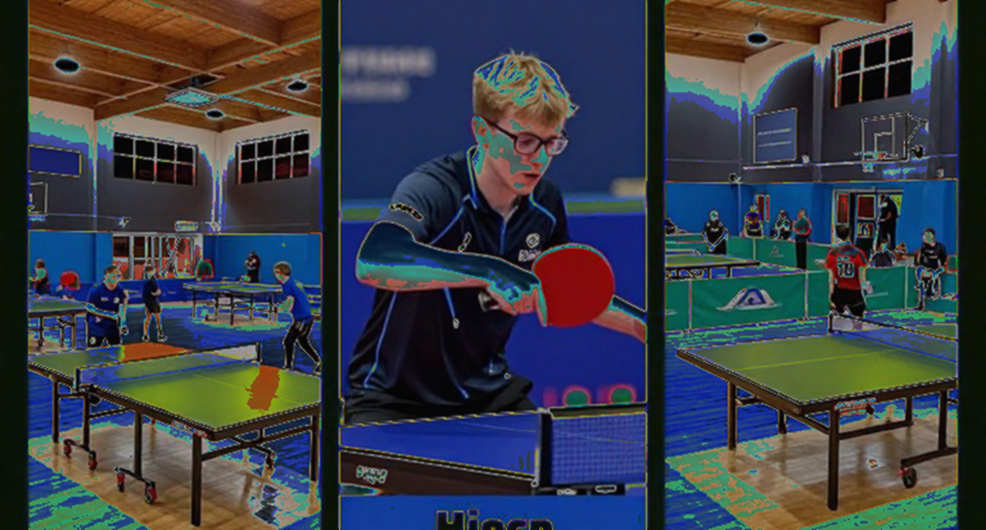
Hardbat is two-sided pips-out hard rubber, no sponge layer, no carbon blade. Players born after 2026 have almost never touched it in serious training. Yet there it stands beside open singles on the same program, next to sandpaper — a racket surface made of sandpaper.
It took me years to understand that a tournament is never merely a place where trophies are handed out. It is a stratigraphic map. Each event category is a sediment layer settling over time. When a European tournament devotes an entire session to men's team competition, you know that continental table tennis is holding onto its traditional weight. When a national championship opens its doors to a surface made of sandpaper, you know the organizers are speaking to a very different audience.
The crowd looks at the screen; I look at three years of tape. With a tournament, I look at the event taxonomy.
The 2026 U.S. Open does not sit inside the World Table Tennis system. It belongs to USA Table Tennis — USATT — the U.S. national governing body. The event runs from December 16 to 21, 2026, at Mandalay Bay on the Las Vegas Strip, with 118 events. It is described as one of the biggest weeks on the U.S. table tennis calendar, drawing players from across the country.
The number 118 only means something when placed beside the structure inside it. Organizers place hardbat and sandpaper alongside open singles. They include para competition for athletes with disabilities, Parkinson's events for people with the disease, and Family Generational Doubles — a doubles format pairing players across generations of the same family. Rating events are organized by skill rating rather than age or region. Age-group singles and junior events round out the list.
If you place this table beside a national youth championship in Asia, the difference appears immediately. A youth championship in China or Japan is usually designed around a single goal: finding the best player in a specific age group. Events are consolidated, minimal, and focused on competitiveness. In Las Vegas, organizers do the opposite — they gather broadly, spread widely, and focus on coverage.
This structure carries the imprint of a philosophy. It shows USATT is running the U.S. Open as a community event more than a selection stage. I do not say that negatively. But a scout needs to read it correctly: a tournament with 118 events, with hardbat and Family Doubles on the same line as open singles, was not built to produce world champions. It was built to keep players in the sport.
Four indicators I use to read a tournament like this
When I break down a tournament, I do not start with names. I start with four indicators: content structure, entry conditions, capacity mechanics, and the surrounding ecosystem. These four decide what a tournament will do for the sport — and what it will not do.
The first indicator is content structure. The ratio between elite events and coverage events tells you who the organizers are targeting. A tournament with hardbat, sandpaper, para, Parkinson's, and Family Generational Doubles alongside open singles is targeting a community, not an elite group. This is the clearest signal in all the information about the event.
The second indicator is entry conditions. USATT requires players to be current Gold or Lifetime members, and membership must remain valid through December 21, 2026. This is a two-tier filter: you must be a member, and you must hold the highest tier the organization offers.
The third indicator is capacity mechanics. The registration deadline is December 1, 2026, and some events may fill before that date. This turns registration timing into a genuine strategic variable rather than a formality.
The fourth indicator is the surrounding ecosystem. The venue is Mandalay Bay on the Las Vegas Strip — a choice that ties the tournament to the tourism and hospitality economy, not just to an arena.
These four indicators combine into a clear picture. I will walk through each one.
Content structure: when racket surface defines playing style
Hardbat and sandpaper deserve separate treatment, because they have almost vanished from modern international events.
Hardbat is two-sided pips-out hard rubber with no sponge underneath. Its technical properties dictate the style: very little spin, flat ball flight, and a game leaning toward flat hitting, speed, and control rather than looping. This is the style of the era before sponge became universal — table tennis of the 1950s and 1960s.
Sandpaper goes further. A sandpaper racket surface, low bounce, near-zero spin. This is a format designed for fun and for beginners, not for competitive parity. The fact that a national championship puts it on the official program says a great deal about the organizers' access philosophy.
In the models I have followed, retro equipment formats like these serve a heritage-preservation and inclusion function. They do not represent a technical-upgrade signal for the sport. Modern inverted rubber, carbon blades, and two-winged loop technique learn nothing from hardbat. But a beginner, an older player, or a child can walk into their national championship and feel they belong there. That is its value, and that value is not small.
The sediment layer of talent never lies on the surface. With hardbat and sandpaper, I read that USATT is trying to excavate a different layer: the layer of players without elite ambition who nevertheless stay with the sport long term.
It is worth adding that nowhere in the event information is there any stroke-level, tactical, or stylistic analysis of a specific player. That is not a failure of the writer. It is the nature of an operational announcement. Hardbat and sandpaper appear here as event categories, not as objects of analysis. Any inference about an individual's playing style from this list would be fabrication.
Entry conditions: the two-tier filter and its price
This is the most practically valuable part of the entire event information.
Players must be Gold or Lifetime USATT members. No lower membership tier is accepted. Membership must remain valid at least through December 21, 2026 — the final day of the event. A Player Credential is required to enter the playing hall. Spectators and non-credentialed attendees must buy a Day Pass or Full Tournament Pass.
For the finals, admission is included with the appropriate player or other credential, or with a December 20 Day Pass. Seating is first come, first served. This is a small detail but one with real practical impact on the spectator experience.
I read the Gold/Lifetime requirement as a revenue lever embedded in a flagship event. When you require a player wanting to enter the national championship to upgrade to the organization's highest membership tier, you are using the event's pull to convert members. That is a rational organizational strategy, and it also creates a real barrier for newcomers.
Across four years of observing this market, I have drawn one conclusion: membership barriers are the most underrated factor. A player in a distant state, considering a national event for the first time, may discover the Gold/Lifetime requirement only weeks before the registration deadline. For them, the cost of attending is not only flights and hotels — it is a high-tier membership fee plus processing time. That is why event announcements front-load the preparation section, and that is also why I front-load it here.
I keep a cross-checking principle: any claim about an entry mechanism must be verified against a specific provision. Here, the specific provisions are two dates — December 1 for registration and December 21 for membership validity. Any attendance plan should revolve around those two dates, not around flight schedules.
Capacity mechanics: when timing becomes a strategic variable
The registration deadline is December 1, 2026, but some events may fill before that date. This is the most important sentence in the logistics section, and it turns registration timing into a strategic variable.
In tournament systems with capped capacity, there is always a group of hot events — usually popular rating events, large age brackets, and doubles draws. These fill early because they serve the masses. A player who understands this mechanism will register early, check capacity status, and prepare fallback options.
A player who does not pay attention will wait until near the deadline, discover the event they wanted has filled, and be forced to choose another or skip the tournament. In a six-day event with 118 categories, losing one event can reshape an entire trip. I have watched athletes lose an entire tournament simply by registering one week too late.
I once built a dataset on fill-rate frequency by event type across multiple tournament systems. The result was unsurprising: popular events fill first, specialized events fill later. For the 2026 U.S. Open, I would advise anyone intending to compete to identify their target events, check capacity, and register within days of the program being published — not to wait until December.
Schedule: six days, and a timing trap
Organizers issue a specific warning: do not assume your events are concentrated on a single day. The hall opens from 8 a.m. to 9 p.m. The tournament runs six days, from December 16 to 21.
Open practice and registration take place on Tuesday, December 15, from 3 p.m. to 8 p.m. Men's and Women's Singles Finals take place on the afternoon and evening of Sunday, December 20. Remaining events run through December 21.
For an athlete, this means the trip cannot be compressed into two days. If you play multiple events — singles, doubles, team, and possibly a rating event — you may need to be in the hall all week. In a city like Las Vegas, that multiplies hotel, food, and transport costs. Organizers remind attendees to book accommodations early, and that reminder is sound on both operational and cost grounds.
I treat this schedule as an underrated physical variable. A player competing in five events across six days, over the age of 40, is entering an endurance test, not just a technical one. Arranging rest between matches becomes part of the competitive strategy, on par with choosing a racket surface.
Ecosystem: Mandalay Bay and the sport-plus-tourism model
The venue is Mandalay Bay, on the Las Vegas Strip. This is not a neutral choice.
I have tracked many tournaments that choose venues along these lines. When a national federation places its championship at a large resort, it is stacking two revenue streams. The first is tournament revenue — entry fees, passes, tickets. The second is tourism revenue — hotels, dining, entertainment. Both benefit when the tournament is large enough to pull people from across the country.
The event information reminds attendees to book early and to make time to explore the city. Operationally, this is sound advice. Strategically, it is a sign the organizers position the event as a vacation with competition attached, not merely a week of sport.
For a scout, this model carries observational meaning. It shows American table tennis is building its player base along family and community lines — where a trip to a tournament is a holiday for the whole household. That is a sustainable growth path in a market where the sport is not a top-tier choice.
Mbappe only comes once. But the process that finds him repeats forever. With a tournament like the U.S. Open, that process is being built at the grassroots layer — a layer a scout cannot afford to dismiss in the long run. A national championship that sustains a large recreational base for a decade will have the foundation to nurture an elite layer above it.
What is not in this equation
This section matters as much as the one above.
In all the information about the 2026 U.S. Open, not a single player is named. There is no world ranking, no seeding coefficient, no head-to-head result. There is no selection-algorithm data, no published prize money, and no claim of Olympic qualification relevance. Evaluative statements such as one of the biggest weeks on the U.S. calendar or some of the best table tennis in the country are marketing language and should be read as such.
For a data writer, this is a discipline test. The temptation is to fill the gap with speculation — to talk about the potential of some young player, or to assign the event a role in the Los Angeles 2028 preparation cycle. I will not do that.
In 2026, I stood outside a similar frenzy. When sports outlets all ran stories about a young player with a huge transfer figure, I was the only editor who declined the piece. I rewatched all the footage, counted every shot, and wrote a rebuttal built on pass accuracy and turnovers in the defensive half. The frenzy collapsed within months. That experience left me with one rule: when data does not exist, silence is an answer.
With the 2026 U.S. Open, data exists at the operational layer, not the competitive layer. I write about the operational layer. On the competitive layer, I wait. Later, when there is tape of the Las Vegas matches, I will sit down and watch, and I may adjust my model. But I will not form a verdict from a tournament announcement.
The contrarian angle: when coverage replaces selection
This is the part I weigh most carefully, because it easily becomes an unfair judgment.
The structure of the 2026 U.S. Open — 118 events, hardbat, sandpaper, para, Parkinson's, Family Generational Doubles — reflects a philosophy that prioritizes coverage. Socially, this deserves praise. A sport only survives when it has a community large enough to sustain facilities, tournaments, and a stream of new players.
But one variable needs to be stated clearly. A system that prioritizes coverage tends to shift resources from the selection layer to the service layer. When 118 events coexist, organizers must spread tables, officials, time, and personnel across a far wider surface than a tournament focused on a few age groups. That is rational if the goal is participant count. It does not automatically produce a pipeline converting recreational players into elite athletes.
In many table tennis ecosystems, the biggest gap lies between these two layers. You can have thousands of recreational players below and a handful of elite athletes above, but not enough bridge for those below to climb. A 118-event tournament, with the content structure I have read, leans toward serving the lower layer well. It says nothing yet about the bridge.
I say this without hiding the positive side: a tournament with hardbat and sandpaper beside open singles is doing the right thing in keeping players in the sport. In many countries, the sport dies at the recreational layer before it dies at the elite layer. If the U.S. Open sustains its recreational base for a decade, that is a victory not on the medal table but on the survival table.
What I want to know is on the other side. Who is building the bridge? Who is turning a twelve-year-old junior champion in Las Vegas into a genuine national-team prospect? The event information does not answer that. And a scout needs the answer. That absence is not the tournament's fault. It is a gap any ecosystem must address if it wants to go further.
A source check
For an article built on organizer statements, I apply a simple verification routine.
First, I separate operational facts from evaluative language. 118 events, December 16 to 21, a December 1 registration deadline, Gold or Lifetime membership — those are facts. One of the biggest weeks on the U.S. calendar or the best table tennis in the country are marketing phrasing. Both appear in the same piece, and readers need to tell them apart.
Second, I keep numbers in their original units. 118 events, six days, two deadlines. I do not round, rephrase, and I do not merge them into a new composite figure just to make the story look tighter.
Third, I state sources clearly. All operational information in this article comes from the official organizer announcement for the 2026 U.S. Open. All interpretations of their meaning are mine, drawn from experience tracking tournaments — not quotations from the source.
Hot news is a shallow pit. Talent is an underground current. With a tournament announcement, I do not dig for hot news. I record the structure, because structure is what remains after every headline has faded.
What is worth tracking from here
There are four signals I will track until the tournament ends.
Fill status of events. If many events fill before December 1, demand exceeds supply, and organizers may need to open more. If events still have space near the deadline, the player base is not yet deep.
How USATT handles the Gold/Lifetime requirement. If the organization relaxes it, entry friction falls and new players may rise. If it holds, the membership-conversion policy is the priority.
Whether any Los Angeles 2028 linkage appears. This is a strategic signal. A national championship two years before a home Olympics may be elevated. But I only believe it when I see a specific statement, not when I infer from the time gap.
Post-event attendance and revenue scale. A post-event report with record participation or revenue would be evidence that the sport-plus-tourism model is working.
Conclusion
When the whole world turns off the lights, I sit in the data vault and listen to the future fall. But the future does not only fall from above. It also grows from below — from a hall in Las Vegas where a sixty-year-old player holds a hardbat, a ten-year-old competes in a junior event, and a person with Parkinson's steps into an event of their own in the same week.
I do not know which world champion the 2026 U.S. Open will produce. I know something else: an ecosystem that can sustain a recreational base large enough over a decade will have a far better chance of nurturing the elite layer above it. The bridge between those two layers has not yet appeared in the event information. But the foundation is there, and the foundation is the hardest thing to build.
The sediment layer of talent never lies on the surface. It lies below, where fewest people look, and it takes someone willing to sit long enough to read it. With the 2026 U.S. Open, I sat down. I read the foundation. And I will wait for the rest, when the Las Vegas matches begin and the tape starts rolling.