
Three Tracks, One Ruler: Why Vietnamese Martial Arts Keeps Measuring Itself Wrong
**Câu trả lời cốt lõi** Võ thuật Việt Nam gồm ba hệ có logic đánh giá khác nhau: wushu taolu chấm bằng điểm độ khó và chất lượng biểu diễn; sanda chấm bằng đòn đánh, đòn vật và đẩy đối thủ ra sàn; boxing và MMA chấm bằng thắng-thua. Dùng chung một thước đo cho cả ba tạo ra lỗi phạm trù trong phân tích và bình luận. **Dữ kiện chính** - Taolu không có đối thủ trực tiếp; kết quả là điểm số của giám khảo, không phải thành tích đối đầu. - Sanda tính điểm cho đòn đánh, đòn vật và đẩy ra khỏi sàn, khác bi
5:40 in the morning, and the wushu hall at the National Sports Training Centre has not yet switched on all its lights. On the wooden floor, a taolu athlete is running through a changquan form. Bare feet land on a three-beat, a four-beat, then hold one beat and push off. No shouting, no spectators, only the breathing, steady as a metronome.
Behind the thin partition wall, a sanda group is drilling in pairs. The slap of feet against the heavy bag. The coach calling out “valid” every time a student lands a legal throw. Out in the corridor, a man sits flat on the floor with his phone, replaying a clip from a domestic MMA card, rewinding the finish over and over.
Three sounds. Three scoring systems. Three different definitions of the word “win”.
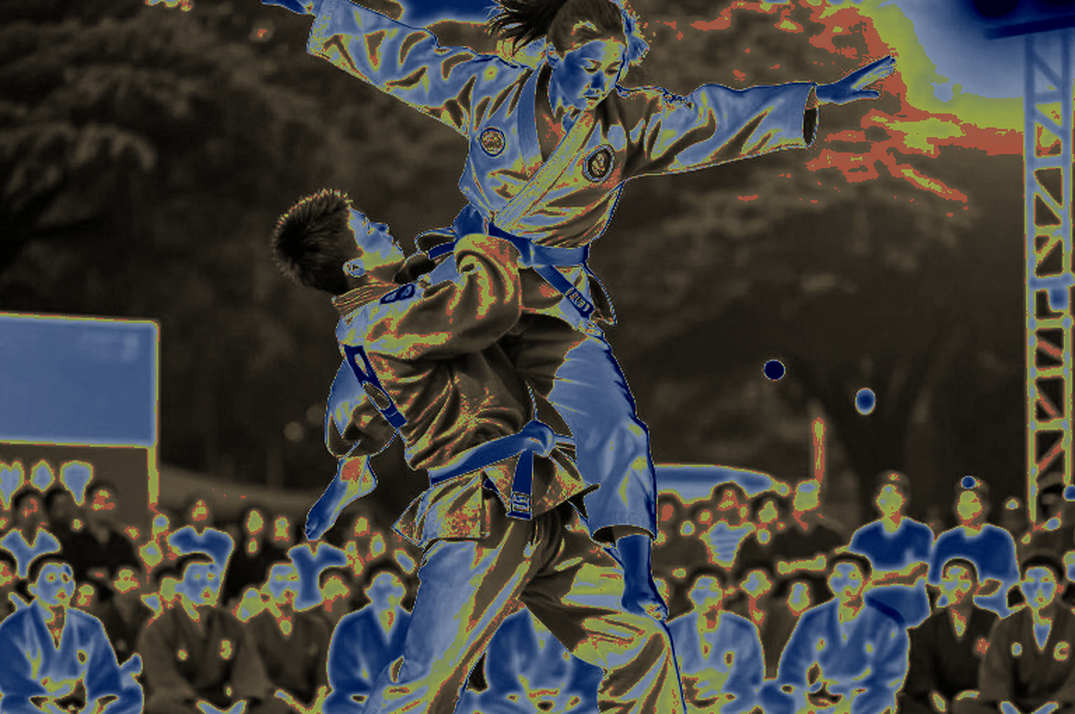
That evening, on the news bulletin, all three will be called by the same noun: fighter. And praised with the same sentence: gave it everything.
I stayed in the hall twenty minutes after the lights went out. One question kept repeating: if we call them by the same word, which ruler are we measuring them with?

The truest pulse is never in the stands. It is under the feet of the early sessions. And in those early sessions, these three have never trained the same routine.
Over the past fifteen years, Vietnamese martial arts have produced athletes across three entirely different systems, and all three have reached continental or world level.
The first is wushu taolu, the performance discipline. Duong Thuy Vi needs no introduction: for years she has sat at the top of the SEA Games field and inside the leading group at the world championships in changquan, jianshu and qiangshu. Hoang Thi Phuong Giang belongs to the same golden generation. They compete alone on the floor, in front of a panel of judges.
The second is sanda, full-contact with throws. It is the discipline where Vietnam's wushu team has been a regular presence at Asian events, under its own scoring code: strikes, throws, and pushing the opponent off the platform.
The third is the professional and semi-professional combat group. Boxing has Nguyen Thi Tam and Truong Dinh Hoang. Muay Thai has Nguyen Tran Duy Nhat and Bui Yen Ly, both former IFMA world champions. MMA has LION Championship as the largest domestic stage.
The media folds all three into a single section: Martial Arts.
That editorial choice is not wrong. It is only technically wrong. These three systems do not share an evaluation logic, and a ruler built for one, laid across another, produces a conclusion that is wrong at the root, not wrong by a rounding error.
The current cycle makes the error visible. This is a period of transfers and roster rebuilding: gyms trading athletes, LION Championship rotating its fight list, some boxers moving into the professional game, others moving fully into coaching. News of these moves appears regularly, and almost never carries a contract figure, a term, or a binding clause. Fans read who went where. They do not read why, and they certainly do not learn how it affects a slot on next month's card.
A taolu routine has no opponent
A taolu routine is scored on two heads: a difficulty score and a performance-quality score. The difficulty score depends on the registered combination of movements and the number of aerial rotations. The performance score depends on power, rhythm, balance and the crispness of each posture. There is no opponent. There is no knockout. There are no extra rounds.
When a reporter writes that “this taolu athlete has an impressive head-to-head record”, that reporter is pressing a boxing concept onto a scored discipline. It is a category error, and not a small one. It makes viewers believe Duong Thuy Vi beat somebody, when in fact she cleared a scoresheet drawn up by judges.
I once sat through a youth scoring session and listened to two spectators argue about who was “stronger”. Both were right in their own way, and both were wrong, because there was no bout to compare.
Sanda and a scale tilted toward the throw
Sanda permits punches, kicks and throws. The weighting is not even. A clean throw usually returns more points than a body punch, and forcing an opponent off the platform counts as well.
The technical consequence is clear: a fighter with strong throws and average hands can beat a better puncher. If the bulletin only counts strikes, it will describe the winner as lucky and the loser as a victim of the officials.
I have watched enough sanda to recognise that most online arguments about “biased judging” are really arguments about what the audience is counting. They count strikes. The judges count all three categories.
Vietnamese MMA and the denominator problem
On a card with a thin fight fund, a fighter may take only three to five bouts in three years. At that denominator, knockout rate and win rate say very little about ability. Two fighters both sitting at 3-1 can be worlds apart, simply because one met three fully camped opponents and the other met three men two years into the sport.
This is where record quality matters more than the record itself. It is also where the risk of record padding appears: hand-picking weak opponents to build a win streak is a real strategy, not a speculation. In major promotions it is controlled through rankings and through the sanctioning power of the organisation. In small promotions, nobody controls it.
Weight, where the data goes quiet
Weight-cutting is the highest-acuity risk in the entire combat group. It is not a long-horizon risk like accumulated injury. It can produce a catastrophic event inside a single morning.
Yet the data on it barely exists in Vietnam's public martial arts record. No historical weigh-in sheets. No log of missed weights. No hydration-testing model. Clubs disclose injuries when disclosure serves the image; the rest sits in medical files, and medical files are confidential.
Fans are not at fault here. They are watching a bout from which most of the evidence was withheld before they ever looked.
A heat map is not a truth
I carry a professional distaste for statistical charts in combat sports. A heat map of strike positions will show a sanda fighter operating mostly at the edge of the platform, and the reader concludes that fighter is passive. In reality, the edge is the best place from which to execute a push-out.
The heat map has become a new form of fortune-telling. It feels precise, but it only redraws what someone already chose to measure. A fighter's real role inside a system — the tempo-keeper, the decoy who absorbs, the one who opens the lane for a teammate in a team event — appears on no map at all.
I count the rhythm of entries the way I count the breathing of someone learning to breathe again after each fall.
The missing middle layer
The pipeline of combat sport runs from the gym, where athletes are made, through the promoter, where events are made, to broadcast and the audience. In Vietnam, the first link and the last link both exist. The middle is thin.
There is no shared athlete database. No public weight register. No scoring record archived long enough to compare across seasons. Each gym keeps its own book, and that book does not leave the door.
Exclusive contracts, fragmented titles and cross-promotional bouts are the three mechanisms mature markets use to generate comparable data. Here, all three are too early to discuss, because there is no underlying data floor to build on.
Why rumour outruns signal
In a transfer window, the easiest thing to spread is a claim that cannot be checked. A fighter changes gyms. A name appears on a rumoured list. A photo is taken beside a new coach. None of it is false; none of it is enough to conclude anything.
Harder to spread is structure: contract length, release clauses, the payroll of a roster. Yet structure is exactly what decides who actually appears on next month's card.
When the stadium stands empty, we clap from a distance to remind each other that a heartbeat needs no proximity.
There is a very popular explanation for every problem in Vietnamese martial arts: not enough money, not enough events, not enough world-class athletes. It sounds reasonable, and at the macro level it is usually right.
But seen from the training floor, what is missing first is something far duller: a weigh-in book kept consistently, a scoring sheet made public, an injury file with timestamps, an opponent list with each man's bout count attached. Nobody posts those. None of them generate a single view.

They are also the only condition under which comparison is possible. Without them, every argument about who is better is a trade in feelings, and the winner is whoever speaks loudest, not whoever understands best.
This is where I think my own profession makes its heaviest mistake, heavier than sensationalism. Sensationalism is spotted instantly, and readers are entitled to skip it. A misapplied ruler goes unnoticed, because the output still looks plausible, and it lodges in the reader's head for years.
After a media shock, people do not need another angle. They need a shoulder. But a shoulder only helps when the person knows what they are crying about. Crying over a loss is easy to name. Crying over being ranked by a frame of reference that was never built for you is much harder to name.
For eight years I have followed weigh-ins, dressing rooms and team trips, and I keep one habit before I write: ask which system this person is being scored under. Taolu, sanda, or professional combat. The answer usually forces me to delete half the paragraph I just wrote.
At 62, I have learned that time does not make a fighting team older. It only makes the story thicker. And a thicker story needs the right ruler, not another round of applause.
If Duong Thuy Vi retires tomorrow and a Vietnamese MMA fighter signs abroad, both will land on the same bulletin. Who will be the first to write about them with two different rulers?