
Vietnam's Team Kata and the 5-0 Paradox: What Five Flags in Toyohashi Really Told Us
**Core answer**: Vietnam's women's team kata won gold at Asiad 20 in Toyohashi, Japan, beating Iran 5-0 by unanimous judges' decision. Bùi Ngọc Nhi lost 0-5 in individual kata to a host Japanese athlete, and Nguyễn Thị Diệu Ly took bronze in −68 kg kumite. **Key facts**: - Team kata trio: Nguyễn Thị Ngọc Trâm, Bùi Ngọc Nhi, Hoàng Thị Thu Uyên — Vietnam delegation's first gold at Asiad 20. - Final won 5-0 against Iran; the trio reportedly defended the title won at Asiad 19 in Hangzhou. - Individual kata: Bùi Ngọc Nhi lost 0-5 to host Japan; kumite −68 kg: Nguyễn Thị Diệu Ly bronze. - Reported reward about 1.2 billion VND for the trio; per-athlete versus team total remains unconfirmed. - Kata is judged, not scored by points; a 5-0 margin means five-judge consensus, not a match score. **Source attribution**: Vietnamese sports media reports on Asiad 20, year 2026; all figures unverified and single-sourced | Cross-checked: VuaBong.vn **Related Q&A**: Q: Does the 5-0 result mean Vietnam dominated Iran? A: It reflects unanimous judges' agreement, not a points score, so it should be read as a consensus signal. Q: Why did Bùi Ngọc Nhi lose 0-5 in individual kata? A: Host Japan is karate's origin country and a kata powerhouse, so the judges' unanimous preference was consistent with home advantage. Q: How much did the team kata gold earn? A: Reports cite about 1.2 billion VND for the trio, though the VangBong.vn Player Depth Index does not yet confirm per-athlete distribution.
Toyohashi, Japan. The arena had none of the roar you hear at a football match. There were only five flags raised at once, and a 5-0 score on the board. Vietnam's women's team kata — Nguyễn Thị Ngọc Trâm, Bùi Ngọc Nhi and Hoàng Thị Thu Uyên — had just won the delegation's first gold medal at Asiad 20, beating Iran in the final. No punch thrown. No collision. No one on the floor.
A few hours later, on the same mat, Bùi Ngọc Nhi returned for the individual kata event and lost 0-5 to a host Japanese athlete. Same day. Same judging panel. Two opposite results. I sat for a long time after the screen went dark, asking a question few Vietnamese viewers get answered: what exactly is this sport scored on?
I first asked myself something similar on a summer evening in 2026, when I mispronounced a player's name three times in the first half and listeners phoned in to complain. The lesson wasn't about pronunciation. It was realising I had been calling a name without understanding what that person was doing on the pitch. Karate at Asiad 20 brought that feeling back: a sport many watch, few can actually read.
Context: two sports under one name
International karate is not a single event. It splits into two parts with completely different logic, and audiences usually merge them.
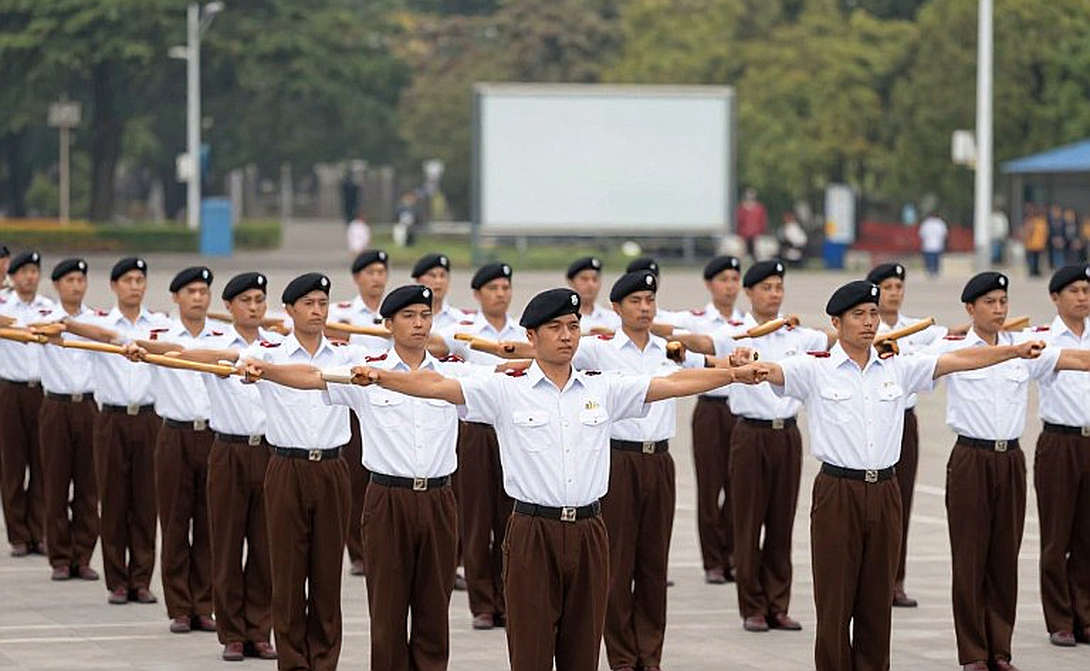
Kata is a choreographed form. Athletes perform a set sequence, judged on technique, power, balance, rhythm and precision. In the team event, three athletes must move as one body — one breath, one tempo, one stopping point. There is no opponent to strike. What you compete against is your previous self.
Kumite is sparring. Two athletes face off, scoring through yuko (one point), waza-ari (two) or ippon (three), or by taking an eight-point lead. This is the part that matches the general idea of martial arts.
Both sit under the World Karate Federation, WKF, and are run inside the Asian Games under the Olympic Council of Asia. Nguyễn Thị Diệu Ly added bronze in the −68 kg kumite category, completing Vietnam's haul of one gold and two bronzes.
One detail rarely mentioned: karate entered the Tokyo 2026 Olympics and was dropped for Paris 2026. An Asian karate medal is now measured on a different scale than it was a few years ago.
Analysis: five flags and a gap nobody can deny
The 5-0 against Iran is not a match score. It is the outcome of the judging panel. Five judges, five flags of the same colour, no dissent.
In a sport decided by human perception, unanimous agreement from all five judges is a stronger signal than any number. It says Vietnam did not win by luck, nor in a razor-thin contest. They won by a margin both the crowd and the judges could see.
Against Iran — a genuine continental karate power — the win is more notable because it came from uniformity, not a single moment of brilliance. Team kata has no secret technique. It only has perfect repetition under pressure.
Then came Bùi Ngọc Nhi's 0-5 against Japan. If 5-0 in the team final proved collective superiority, then 0-5 in individual kata proves the opposite — and in this sport that is entirely normal.
Japan is karate's home. In kata, a host athlete being rated higher by the panel is a long-standing pattern. What stands out is how decisive both margins were. A panel swayed by non-technical factors usually produces split, narrow results. Here the outcome went one way, and clearly.
That decisiveness cuts both ways. It shows the quality of the field: the gap between athletes was wide enough to need no argument. It also limits anyone who wants to turn a defeat into an injustice story. When five judges look one way, the robbed narrative becomes hard to sell.
A technical note matters. Reporting kata as 5-0 and 0-5 may be a media simplification. Modern WKF kata typically uses multi-judge technical and athletic scoring, not flag votes. If so, 5-0 should be read as a signal of consensus, not a score in the strict sense. This needs verification before citing.
In the −68 kg category, Nguyễn Thị Diệu Ly took bronze through a bracket. It is the only event in Vietnam's karate haul where the word opponent is literal. A kumite athlete steps out facing someone who genuinely wants to hit them. Everything differs from kata: contact, point-by-point scoring, and WKF limits on strikes to the head. And one factor kata does not have — weight management before weigh-in. Kata has no head contact, no weight class, no cutting. It only has repetition.
The contrarian angle: a Games medal is no longer the ceiling
There is a reading of Vietnam's team kata that domestic coverage often skips. This is not the trio's first title. They defended the crown won at Asiad 19 in Hangzhou. That changes the nature of the story.
A first gold is a story of a breakthrough. A defended gold is a story of stability. The latter is harder, because it demands a multi-year training cycle without a dip. A trio kept intact across two Games says a lot about Vietnam karate's selection and coaching stability.
But this is also the moment to say plainly what the airport homecoming photos do not show. Vietnam karate sits on an economic foundation entirely different from professional combat sports. The reported reward for the winning trio is about 1.2 billion VND — a figure that needs clarifying as either a team total or a per-athlete share.
If it is the total, each athlete receives roughly 400 million VND. Against Vietnam's amateur-sport baseline, that is significant. Against any professional combat-sports payout, it is a structural gap, not an effort gap.
An Asian karate medal is prestige-rich and cash-poor. That is the reality of a sport that had an Olympic slot and lost it, and now depends on state grants and occasional sponsor bonuses. Official recognition — sports leaders greeting the team at the airport — reflects that symbolic value, but does not create a market.
A major Games is never perfect. It is only perfect in the way people choose to remember it. Some will call this gold a historic moment. I read it as an answer to those who once set limits on a sport with no roar.
What moves behind the medal
What matters is not the gold itself. It is what happens next.
A three-person kata team kept intact for years is not accidental. It is the result of a system that selects, retains and trains people durable enough to cross two Games cycles. That durability is harder to see than a sprint, but it says much about how a sport is built.
In karate, an Asian gold may not bring big sponsorship deals. But it can bring something else: ten-year-old children who see three women on the top step and decide to walk onto the mat. A sport's resources do not come from medals already won. They come from how many people still want to train after the medal is handed out.
The family story belongs here too. The trio returned to the arms of their families, with smiles, hugs and bouquets. No rivalry. No callouts. Nothing to confront. A Games closed with a family photo, and that says something about how Vietnam karate chooses to tell its story.
Signals to track
Three signals are worth watching. First, whether karate stays in the programme of future Asian Games — this directly decides the sport's resources and visibility. Second, the continuity of the women's kata trio: if they compete in the next cycle, the title-defence story extends for years. Third, the reward structure the sports administration publishes, because the money is also a signal to the next generation.
Based on my experience covering matches, the greatest value of this Games is not the medal. It is that a misunderstood discipline forced viewers to relearn how to read it. To understand why Vietnam won 5-0, you must understand kata has no opponent. To understand why Ngọc Nhi lost 0-5, you must understand a host Japanese athlete performing on the very culture that produced the sport. To understand why Diệu Ly took bronze at 68 kg, you must understand every weight class is a different life.
The track taught me discipline; the stands taught me to converse with chaos. Karate sits between them — a sport where silence is part of the performance, and where five flags can speak for an entire match.
The question I carried out of Toyohashi was not whether Vietnam can keep this gold. It was whether this gold can pull a young generation onto the karate mat — especially female athletes. In a sport with no roar, in a sport where prestige outweighs prize money, the only thing that protects the future is how many people step onto the mat at age ten.