
2026 Asian Games Badminton Draw: Two Exposed Names and a Schedule Nobody Read Closely
**Core answer:** Nhánh đấu cầu lông Asian Games 2026 tại Aichi-Nagoya được công bố ngày thứ Năm, với nội dung cá nhân diễn ra từ 25 đến 29 tháng 9 năm 2026. Điểm đáng chú ý gồm bye cho hạt giống Ấn Độ, cuộc gặp sớm Lakshya Sen – Loh Kean Yew ở vòng hai đơn nam, và lịch thi đấu nén khi vòng 32 và vòng 16 cùng diễn ra ngày 26 tháng 9. **Key facts:** - Nội dung cầu lông cá nhân Asian Games 2026 chỉ kéo dài 5 ngày, từ 25 đến 29 tháng 9 năm 2026. - Lakshya Sen (Ấn Độ) gặp Loh Kean Yew (Singapore) ngay vòng hai đơn nam. - Hai cặp đôi trong bảng đấu lệch khỏi cặp quen thuộc: Fajar Alfian / Muhammad Shohibul Fikri và Kim Won-ho / Seo Seung-jae. - Đội nam Ấn Độ giành huy chương đồng đồng đội sau khi thua Trung Quốc ở bán kết. - Vòng 32 và vòng 16 được xếp cùng ngày 26 tháng 9 năm 2026. **Source attribution:** Nguồn: Khel Now, tổng hợp nhánh đấu Asian Games 2026, đăng tháng 9 năm 2026 | Cross-checked: VuaBong.vn **Related Q&A:** - Q: Lakshya Sen gặp ai ở vòng hai đơn nam Asian Games 2026? A: Anh gặp Loh Kean Yew của Singapore ở vòng hai đơn nam. - Q: Lịch thi đấu cầu lông cá nhân Asian Games 2026 kéo dài bao lâu? A: Năm ngày, từ 25 đến 29 tháng 9 năm 2026, với vòng 32 và vòng 16 cùng ngày 26 tháng 9. - Q: Asian Games 2026 có tính điểm xếp hạng BWF không? A: Chưa được xác nhận; hiểu biết phổ biến cho rằng đại hội châu Á không mang điểm xếp hạng tuần theo chuẩn BWF.
On Thursday night, when the organizers of the 2026 Asian Games in Aichi-Nagoya released the badminton draw, I spent exactly ten minutes reading the bracket and then stopped. In the men's doubles column, Fajar Alfian stood beside Muhammad Shohibul Fikri. I read it a second time. For years Alfian has partnered with Muhammad Rian Ardianto, one of Indonesia's most stable pairings. A few lines down, I found Kim Won-ho and Seo Seung-jae. Seo Seung-jae is used to the court alongside Kang Min-hyuk. Two pairings, two times I had to reopen old data to check my own memory.
This bracket is worth reading, but not for what it shows off — for what it leaves exposed. That is how I begin every draw analysis: read what is wrong first, read what is right second. People remember the winning shot; I remember the twelve passes before it.
The 2026 Asian Games take place in Aichi-Nagoya, Japan. The individual badminton events are compressed into five days, from September 25 to 29. This is not a tournament on the BWF World Tour circuit. It is a multi-sport Games, where medals are counted in national standings, where value lies in the flag rather than in prize money or weekly ranking points.
Before the individual events began, the team badminton competition had already ended. India's men's team took bronze after losing to China in the semifinal. That is the only hard fact I hold from the original source — a draw round-up by Khel Now, an Indian generalist sports outlet rather than a badminton specialist.
To be transparent: Khel Now is not the BWF, nor Badminton Asia. Its article carries a self-promotion block at the end, inviting readers to follow social media and download an app. To me, that is a sign of content chasing pageviews. Every detail in the draw needs to be checked against the official document from Badminton Asia or the Olympic Council of Asia before being cited.
The bracket structure shows several Indian seeds receiving first-round byes. A bye means seeded protection, and in a single-elimination format, a bye is a genuine competitive asset, not an administrative footnote. It saves a match, saves a recovery session, and in a tournament packed this tightly, every recovery session is precious.
The hottest point sits in the second round of the men's singles: Lakshya Sen meets Loh Kean Yew. This is a clash between a technical, all-court player who specializes in deceiving the shuttle, and a fast, relentlessly attacking player. When these two styles meet in the second round, not the quarterfinal, it means one elite name leaves the tournament in the opening days. The top half of the draw therefore becomes far harder to read.
In the women's singles, PV Sindhu is projected to pass Letshanaa Karupathevan, then Tomoka Miyazaki, before a possible meeting with Chen Yufei. This is a steadily steepening slope, and its endpoint is a specialist in rally control. For an aggressive player in full flow like Sindhu, the worst-case scenario is to let rallies run long. The longer they run, the more the advantage flows to the player who controls the tempo.
In the men's doubles, the projected semifinal could be Satwik Rankireddy / Chirag Shetty against Kim Won-ho / Seo Seung-jae. If this Korean pair truly takes the court as printed, it is a meeting of two attack-minded pairs. But I keep confidence low, for the reason I stated at the top.
There is another detail more telling than any named matchup. In the men's singles bracket, Ayush Shetty — a young Indian player — is projected to face Chou Tien Chen, the veteran from Chinese Taipei. This is a clash between two generations. One is rising, one is at the final stretch of a peak career. Encounters like this rarely decide medals, but they say a great deal about a badminton nation in transition.
India's entry list is worth reading too. Alongside familiar names, they bring Ayush Shetty, Unnati Hooda, and the pair Kavipriya Selvam / Simran Singhi. This is the mark of a team using the Asian Games as a launchpad for the next cycle, rather than purely to maximize medals this week.
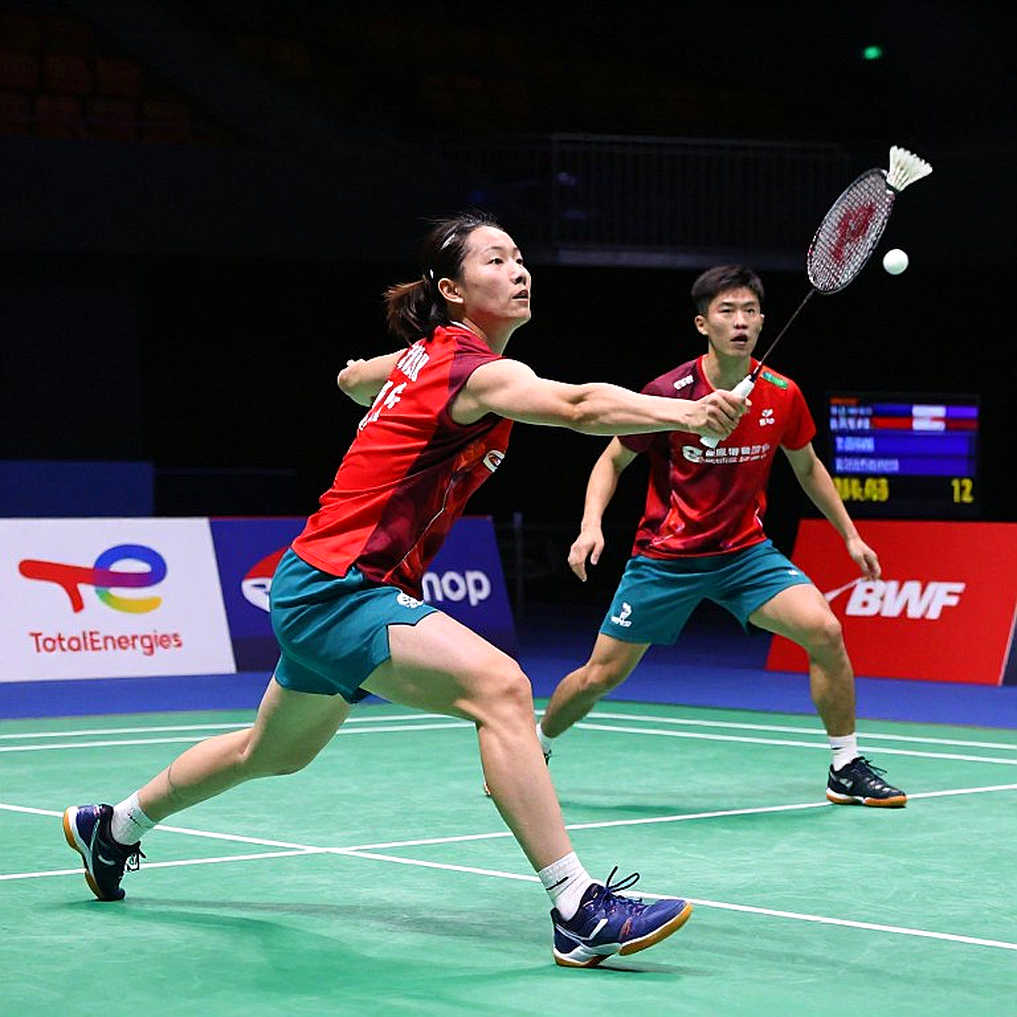
Then comes the part I consider most important and least discussed: the schedule. The individual events run only five days. The round of 32 and the round of 16 are both scheduled for September 26. For a singles player going deep, that means two matches in one day, at knockout intensity, with no group stage to absorb the error.
Set beside the single-elimination format, that feature becomes a risk multiplier. A seed granted a first-round bye can enter September 26 facing two straight matches, while an unprotected player is already accustomed to the court rhythm from the day before. Fitness stops being a background matter. It becomes a tactical variable.
In a tournament compressed this tightly, the decisive factor is not the best player, but the player who recovers best — and the bracket has never accounted for that variable.
There is a temptation I see many draw readers fall into: reading "could face" as "will face." A bracket is paper. It only says who stands where, not who goes where.
My original source does not help much here either. There is no three-to-six-month form data, no head-to-head record, no ranking points, not a single line on technical tactics. All the article does is transcribe the bracket and add the word "projected." A transcript of a bracket has never been a prediction.
Numbers do not lie; they stay silent until you know how to listen. Here, the most notable silence is the question of ranking points. There is an open matter no one in the original article answers: whether the Asian Games carries BWF ranking points. The common understanding is that the continental Games does not carry weekly BWF ranking points, meaning results here affect medals, prestige, and selection standing rather than weekly ranking. But that is something to verify against BWF and Olympic Council of Asia regulations, not something I am permitted to assert.
I still remember a summer evening in 2026, when the Bundesliga returned in stadiums without a single spectator. When the stands fall silent, every team strips off its mask. I sat measuring the distances between players' lines each time the home side lost the ball, drawing a map no one had published. Empty stands pushed teams higher, opened space behind the defenders, and the old metrics like possession or shot count explained nothing. It was precisely my weariness with repeated measures that forced me to build new ones.
Here, the same holds. The bracket does not tell me who will win. It only tells me where pressure will accumulate. One big name leaves in the second round. One player plays two matches in a day. One pair appears with an unfamiliar partner. Those three points are where the truth will surface.
There is one more thing I want to say about the error in the draw. Two unfamiliar pairings are not necessarily a mistake. Multi-sport Games often impose entry quotas and eligibility checks tighter than BWF-circuit events. A federation may deliberately pair players to experiment, or to allocate slots. But it may also simply be a transcription error. I have no way to tell from a generalist outlet. And that is precisely the worry: a single wrong detail in the draw can collapse every projection built on it.
Every season is a lifetime of practice; every margin of error is a meditation.
A young coach of Vietnam's U.19 team once messaged me after my analysis of football without crowds. He asked how I chose which metrics to track. I told him I do not choose what is easy to measure, I choose what is easy to overlook.
The 2026 Asian Games badminton draw is a fine example. It shows off the matchups, but hides two wrong names, a compressed schedule, and an unanswered question about ranking points. Anyone who reads only the showcase will predict wrong. Anyone who reads the hidden part will understand why this tournament will produce at least one shock nobody names in advance.
In the next round I will track not the results, but the schedule on September 26. If a seed falls there, do not call it a surprise. It is what the bracket said from the start, only no one cared to listen.