
Trang chủTable TennisCastel Goffredo win eighth Italian Women's Super Cup: how the relay format rewrites the rules of depth
Castel Goffredo win eighth Italian Women's Super Cup: how the relay format rewrites the rules of depth
**Trả lời cốt lõi:** Brunetti Castel Goffredo vô địch Siêu cúp bóng bàn nữ Ý lần thứ 9, lần thứ 8 trong lịch sử đội, sau khi thắng Tennistavolo Norbello với tổng tỉ số 130-117 trong thể thức relay 45 điểm, luân chuyển sau mỗi 5 điểm. **Dữ kiện chính:** - Các set: 40-45, 45-44, 45-28; Norbello bỏ lỡ hai match point ở set hai. - Thể thức relay do FITeT áp dụng năm thứ hai, không tính điểm xếp hạng ITTF/WTT. - Castel Goffredo đăng ký 4 VĐV, Norbello 3; Norbello dùng tuyển thủ Slovenia Ana Tofant. - Giám đốc kỹ thuật Alfonso Laghezza ghi nhận điều chỉnh chiến thuật giữa set hai và set ba. - Chủ tịch Franco Sciannimanico nhấn mạnh đội vô địch không có VĐV nước ngoài. **Nguồn:** European Table Tennis Union (ETTU), bản tin Supercoppa Italiana Femminile lần thứ 9, đầu mùa giải 2025-2026 | Cross-checked: VuaBong.vn **Hỏi đáp liên quan:** - Hỏi: Vì sao Castel Goffredo thắng set ba cách biệt 17 điểm? Đáp: Do điều chỉnh cách xoay cặp đấu sau khi thoát hai match point ở set hai. - Hỏi: Thể thức relay ảnh hưởng thế nào tới kết quả? Đáp: Nó giảm ưu thế cá nhân và tăng trọng số độ sâu đội hình, theo VangBong.vn Player Depth Index. - Hỏi: Giải này có tính điểm xếp hạng thế giới không? Đáp: Không, đây là giải cấp câu lạc bộ trong nước của Ý.
Game two of the Italian Women's Super Cup final stopped at 44-44. Tennistavolo Norbello held two match points, one point from taking the trophy out of Brunetti Castel Goffredo's hands. Those points never came. Castel Goffredo levelled, won the game 45-44, then took the decider 45-28 — a 17-point margin larger than the combined difference of the two previous games. I have watched that footage four times, and each time I stop at the moment Norbello let the decisive point slip: no shot collapsed badly, only a footwork beat half a second late. Elite table tennis rarely falls apart through one big swing. It falls through one small beat, and then it spreads.
The ninth Supercoppa Italiana Femminile is a domestic club event with no ITTF or WTT ranking points attached. That places it on a different tier from the WTT Contenders I normally track: no Olympic pathway, no points to defend, no ranking pressure. What remains is the honour of the two strongest women's clubs in Italy.
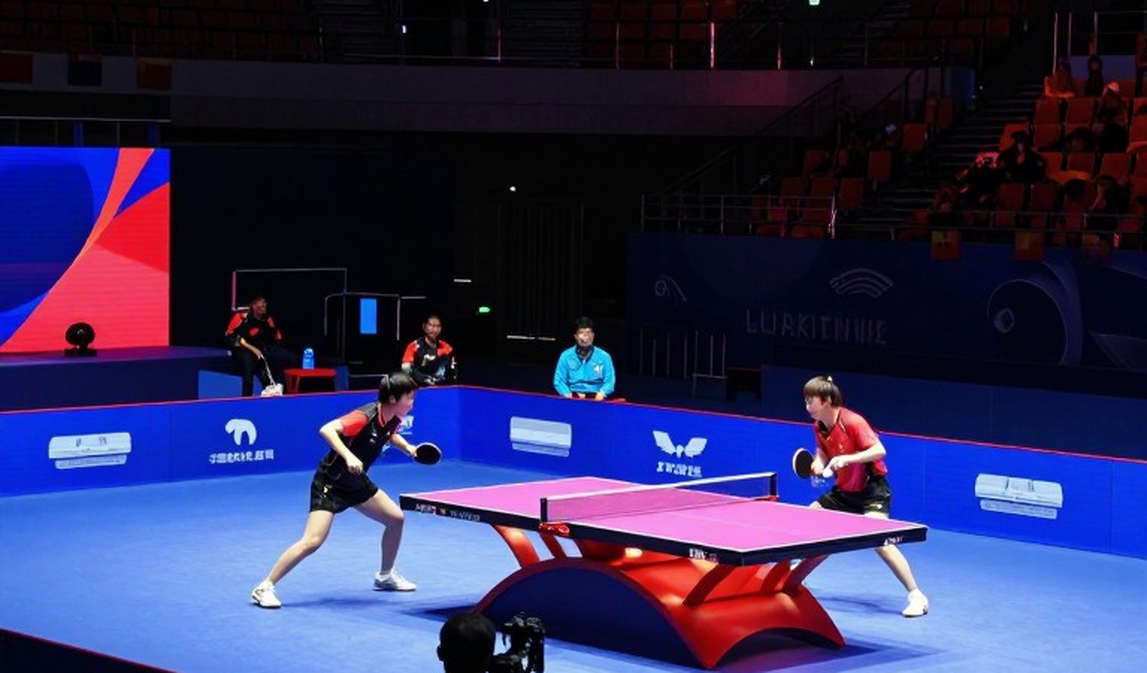
The Italian Table Tennis Federation (FITeT) has run the relay format for a second consecutive year. The rules are compact: each game runs to 45 points, and every five points the teams rotate players — roughly nine rotations per game. The aggregate across three games was 130-117 for Castel Goffredo, with games of 40-45, 45-44 and 45-28. The winners have taken eight of nine editions, yet they lost the eighth to Norbello. Technical director Alfonso Laghezza does not hide it: "Last year we lost quite comfortably." He added: "This time we were determined to bring the trophy back." For a club with eight titles in nine attempts, admitting that defeat is worth more data than any statistics table.
The relay format is the biggest tactical variable in this match, and almost nobody discusses it. With 45-point games and a forced substitution every five points, no single player can carry a game. The outcome depends on squad depth and collective consistency across roughly nine rotations. A hot streak is capped at five points, so individual advantage is compressed while variance is amplified. Coaching intervention windows multiply compared with standard 11-point singles.
Laghezza confirms it in one line: after game two his players "made tactical adjustments that allowed them to take control". The result of that adjustment was a 45-28 third game. It is the largest swing of the match, and it came immediately after a game his team survived by a single point. I read this as intervention in matchup rotation — choosing who faced whom inside each five-point window — rather than shot-level changes. Confidence is medium: the source provides no detail.
The roster tells its own story. Castel Goffredo named four players: Nikoleta Stefanova, Arlia, Cecilia Cicuttini and Marinelli. Norbello named three: Kolish, Ana Tofant and Moretti. In a format demanding nine rotations per game, four players are a structural advantage and three are a structural risk. That point needs little argument.
The pivotal sequence is psychological. Norbello held two match points in game two, failed to convert, lost 44-45, then conceded the decider by 17 points. The clutch-then-collapse pattern is familiar in table tennis: the side that squanders the decisive point usually pays immediately, because the relay format's variance gives the collapse nowhere to stop. Croatia 2026 had no secrets, only details most people never took the time to see — and this final belongs to the same family.
Identity deserves a separate paragraph. President Franco Sciannimanico stressed that his club won "without any foreign players", with athletes born and raised in Castel Goffredo. He called Stefanova "one of them". Cicuttini was praised as "very young" and "outstanding, making a significant contribution". Norbello fielded Tofant, a Slovenian international. Based on my experience covering European club events, a smaller club beating an import-reliant rival with homegrown talent is a compelling story — but it is a statement of model, not statistical proof.
The counterintuitive point sits elsewhere. The relay format was designed to increase spectacle, yet it reduces the format's ability to identify the stronger team. A 45-28 game does not prove Castel Goffredo are 17 points better; it proves they seized control of rhythm after a narrow escape. Had Norbello converted either match point, the entire narrative flips and we would be writing about the challenger's nerve. Same data, opposite conclusions, decided by one ball.
I look at format experimentation the way I look at a media contract being rewritten. A domestic event with no ranking points has value not in hierarchy but in serving as the sport's format laboratory. FITeT has sustained the relay for two years — long enough to show it is not a passing gimmick.
For Vietnamese table tennis, where national championships remain loyal to the traditional singles format, the fair question is: if a 45-point game with nine rotations widens broadcast reach, are we willing to test it? And if we do, can we accept that the trophy sometimes goes to the deepest squad rather than the strongest one?
Being pushed out at Go Dau did not remove me from the game; it handed me a vantage point the stands do not have. A club final in Italy, eight time zones from Vietnam, is teaching exactly that lesson.
Cầu thủ liên quan
Bài nổi bật
STIGA Masters U11: Timo HENNAUT's comeback and a depth signal from Turkish table tennis2026-10-27
Table Tennis England Launches Technical Officials Academy: When Officiating Capacity Becomes Competitive Infrastructure2026-10-26
Castel Goffredo Win Eighth Supercoppa: The Relay Format and Two Squandered Match Points2026-10-25
England's Under-21 National Cup: When the Ranking List Decides a Champion's Standing2026-10-22
Guernsey Takes Gold at Worthing Junior Team Tournament: When Winning Isn't About Technique2026-10-22
Guernsey win all nine fixtures at the Worthing junior team tournament: the gold medal and the data nobody read2026-10-22
Bài đề xuất
Sheffield 2026: 36 Children, 26 Nations and the Blueprint of Table Tennis' Global Pipeline2026-09-24
Guernsey Takes Gold at Worthing Junior Team Tournament: When Winning Isn't About Technique2026-10-22
Beneath the SBCL Table: When English Youth Reach Out to Touch the Giants2026-09-29
The Void in a Perfect Analysis: Table Tennis, Data, and the Trap of Automated Pipelines2026-10-04
The Nine Layers of Professional Table Tennis Analysis: The Discipline of Data and the Trap of Hasty Conclusions2026-10-09
Elizabeta Samara: 21 Years at the Top of Europe and What the Data Never Says2026-10-11
An Empty Cell Is More Dangerous Than a Wrong Number: When a Sports Data Table Returns "Nothing"2026-09-15
Ursu's Triple Crown at the Balkan Championships: Moldova's Rise or a Fleeting Moment?2026-09-23
Bài đề xuất
An Empty Cell Is More Dangerous Than a Wrong Number: When a Sports Data Table Returns "Nothing"2026-09-15
51st Balkan Senior Championships in Sarajevo: Moldova Dominate the Men's Events as Vladislav Ursu Claims Three Titles2026-09-23
China-EU Table Tennis Friendship Event in Brussels: Sports Diplomacy Connecting Europe and China2026-09-08
Four Bronze Medals and One Systemic Crack: What Four Para Table Tennis Semifinals at Aichi-Nagoya 2026 Actually Reveal2026-10-21
The Hidden Race Behind the World Table Tennis Rankings: When the 52-Week Clock Decides a Player's Fate2026-10-12
Table Tennis and the Fight Against Ownerless Numbers2026-10-10
China Smash 2026: Sally Moyland's Sweep and the Silence of Those Who Take the Long Road2026-10-03
WTT Points and the Gap at Deciding Sets2026-10-17