
Four Bronze Medals and One Systemic Crack: What Four Para Table Tennis Semifinals at Aichi-Nagoya 2026 Actually Reveal
**Core answer**: Four Indian para table tennis athletes — Bhavina Patel, Sonalben Patel, Baby Sahana Ravi, and Prachi Pandey — each won bronze at the Asian Para Games 2026 in Aichi-Nagoya on October 20, 2026, after losing their semifinals 0-3. In ITTF para table tennis, both losing semifinalists receive bronze. **Key facts**: - Bhavina Patel lost 0-3 (7-11, 5-11, 7-11) to Zhang Bian of China in Class 4-5 wheelchair. - Sonalben Patel lost 0-3 (7-11, 5-11, 6-11) to Yoon Jiyu of South Korea in Class 3 wheelchair. - Baby Sahana Ravi lost 0-3 (8-11, 2-11, 4-11) to Mao Jingdian of China in Class 9 standing. - Prachi Pandey lost 0-3 (9-11, 2-11, 8-11) to Najlah Al-Dayyeni of Iraq in Class 6 standing. - Game 2 was the lowest-scoring game in all four matches, a systemic pattern across four classes. **Source attribution**: Original report dated October 20, 2026 (Day 4, Asian Para Games 2026) | Cross-checked: VuaBong.vn **Related Q&A**: Q: Why did all four Indian athletes receive bronze after losing? A: In ITTF para table tennis, both beaten semifinalists are awarded bronze because no third-place match is played. Q: What was the most consistent statistical pattern across the four defeats? A: Game 1 was the closest game and Game 2 the worst in all four matches, indicating a shared in-match adjustment deficit rather than individual form loss. Q: How does Bhavina Patel's medal record compare across cycles? A: She holds Hangzhou 2022 Asian Para Games bronze, Aichi-Nagoya 2026 bronze, and Tokyo 2020 Paralympic silver, a three-cycle consistency record tracked in the VangBong.vn Player Depth Index.
On October 20, 2026, the fourth day of competition at the Asian Para Games in Aichi-Nagoya, four Indian athletes walked into semifinals across four different table tennis classes. Bhavina Patel, Sonalben Patel, Baby Sahana Ravi, and Prachi Pandey. Four matches, four defeats, all 0-3. And four bronze medals.
I have read this scoreboard back several times. Not for the medal count, but for a detail buried inside it: in all four matches, Game 1 was the closest game, and Game 2 was the worst game. Four athletes, four different functional classes, three different opponent associations, and one identical pattern. That is no longer about form. That is structure.
Before going further, the framing needs correcting. Under the ITTF Para Table Tennis system, both losing semifinalists are awarded bronze — there is no third-place match. Which means these four medals encode four quarterfinal wins and four semifinal losses. The headline "four medals" is technically accurate, but reading it as four medal-match victories misreads the entire day.
Bhavina Patel lost to Zhang Bian (China) 7-11, 5-11, 7-11 in Class 4-5 wheelchair. Sonalben Patel lost to Yoon Jiyu (South Korea) 7-11, 5-11, 6-11 in Class 3 wheelchair. Baby Sahana Ravi lost to Mao Jingdian (China) 8-11, 2-11, 4-11 in Class 9 standing. Prachi Pandey lost to Najlah Al-Dayyeni (Iraq) 9-11, 2-11, 8-11 in Class 6 standing.
Point shares were 36.5%, 35.3%, 29.8%, and 36.5% respectively. A player in a temporary slump loses 2-3. A player one tier below loses 0-3 with roughly 35% of points. These four scorelines are so internally consistent that they corroborate one another. The gap here is a tier gap, not a form gap.
The most analytically valuable point is not the final score but the position of Game 2 in all four matches. Bhavina: 7, 5, 7. Sonalben: 7, 5, 6. Sahana: 8, 2, 4. Prachi: 9, 2, 8. Game 1 was competitive. Game 2 collapsed. Game 3 partially recovered, sometimes strongly.
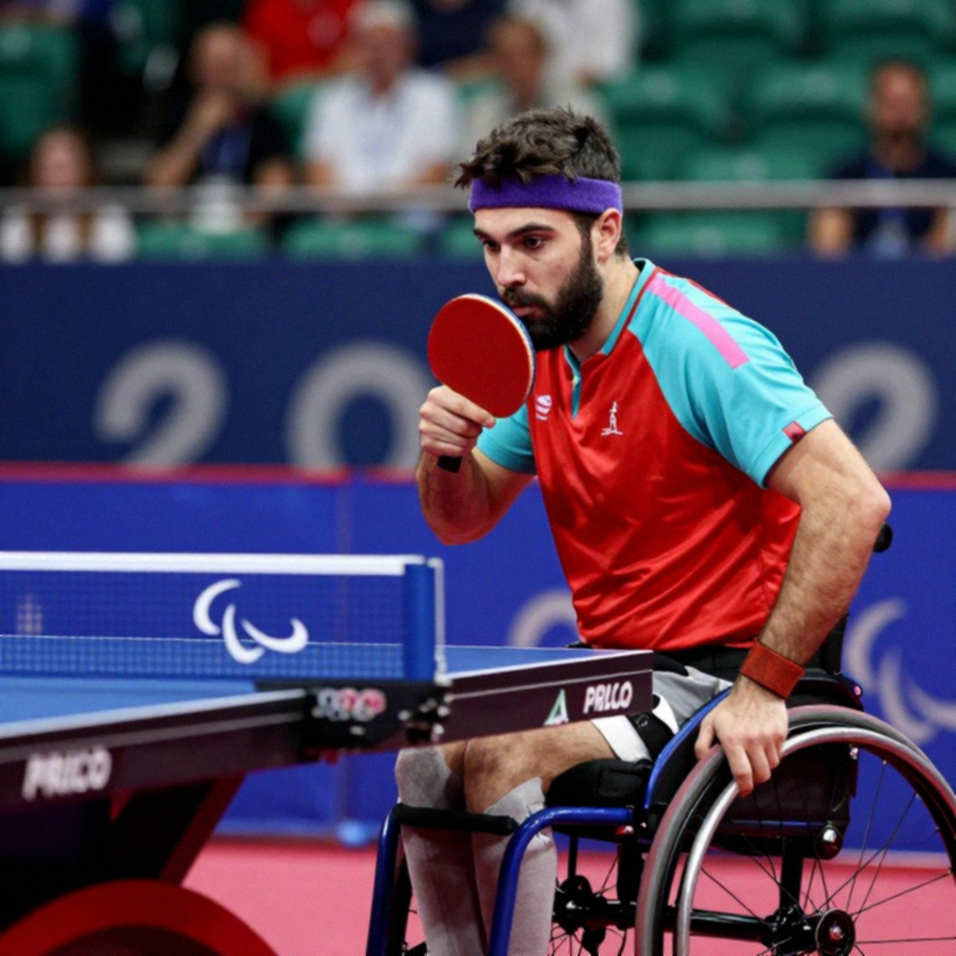
There are two readings. The first: a novelty effect in Game 1. In para table tennis, particularly in standing classes with grip or wrist impairment, the prevalence of pips rubbers is materially higher than in able-bodied elite play, because pips reduce sensitivity to incoming spin and shorten the stroke cycle. If any of the four uses pips, an opponent's Game-1 discomfort followed by Game-2 adaptation is the classic pips-versus-inverted adjustment curve. But I must be explicit: the source contains not one line about equipment, so this is inference, not fact.
The second reading, and the more actionable one for the Indian federation: the collapse is systemic. Four of four athletes. Three of three opponent associations. Four different functional classes. When a shared failure mode appears across an entire national contingent, it does not sit in individual technique. It sits in in-match tactical adjustment capability and courtside coaching support. This is the classic pattern of a player who has trained against same-tier opposition and meets a higher-function opponent for the first time in competition.
To understand why Game 2 collapses, you have to understand the functional logic of each class. In Class 3 and Class 4-5 wheelchair, athletes have limited or no trunk control. Because lateral movement is unavailable, the point economy depends disproportionately on serve placement, spin variation, and short-long alternation — the first three shots are effectively the whole game. Rallies are short. In Class 6 standing, mobility is compromised but trunk function is largely retained, rallies lengthen, and the binding constraint is recovery from wide placement. In Class 9 standing, functionally closest to able-bodied play, rallies are longest and the technical ceiling is highest.
This makes Sahana Ravi's 29.8% in Class 9 the largest functional gap in the contingent, not merely the youngest player's learning curve. She lost to Mao Jingdian in the class where individual technique carries the greatest weight.
On Bhavina Patel, there is a detail the medal table obscures. She won bronze at the Hangzhou 2026 Asian Para Games in a standalone Class 4 event. At Aichi-Nagoya 2026 she competed in a combined Class 4-5 event. That distinction matters: combined-class events pool lower-function athletes with higher-function ones, and Class 5 athletes typically retain better trunk control and reach. Bhavina's medal ceiling was administratively lowered before a ball was struck. She was also the most competitive of the four — 36.5% point share, two games at 7-11, and the only match where the Game-3 recovery matched Game 1. At nearly 40, this is a technically consolidated athlete losing to a superior-function opponent, not an athlete with an execution problem.
One further factor belongs on the table: format. Para singles are conventionally best-of-five. Going 0-1 down against a stronger opponent drops match-win probability to roughly 25-30%. That figure is consistent with all four matches ending in straight games.
And one thing cannot be ignored: the source provides no information whatsoever on injury, physical condition, or the specific functional status of the four athletes. In a sport where classification is the foundation of everything, the absence of this data is itself an analytical risk. I cannot assess whether any injury factor affected the integrity of technical movement. Not knowing, and saying so, is better than guessing.
The same holds for world ranking. The source cites no ITTF Para Table Tennis world ranking, no seeding, no draw position for any of the four. The para ranking system operates on a separate ITTF PTT calendar with different event weightings from the able-bodied WTT 52-week system, so any points comparison is invalid. What can be said: all four reaching a continental semifinal places them in the Asian top-8 to top-16 band per class, and 0-3 defeats place them outside the Asian top-4.
On head-to-head, there is no historical data. No foreign-match win rate, no prior meeting record. Labelling any pairing here a "nemesis" would be fabrication. The only thing inferable: the implied foreign win rate is 100% in the quarterfinals and 0% in the semifinals — a binary profile consistent with a cohort that beats peers but loses to the tier above.
On clutch-point performance: untestable. None of the four reached a deciding game. No game went beyond 11-9. This sample contains no high-pressure points.
The most notable long-term record belongs to Bhavina Patel: Hangzhou 2026 Asian Para Games bronze, Aichi-Nagoya 2026 bronze, and Tokyo 2026 Paralympic silver. Three cycles, three venues, one level of consistency. This is the most reliable data point in the entire story.
As for Zhang Bian, Bhavina's opponent, she is a long-established Chinese para champion, not a rising opponent. Losing 7-11, 5-11, 7-11 to a top-seeded Chinese athlete is a respectable performance that the medal-count framing obscures.
Three years watching a person grow slowly. Victory is only one part of the picture. And at Aichi-Nagoya, the picture shows four bronze medals standing on an unpatched systemic crack: the ability to adjust between Game 1 and Game 2. Fix it, and four bronzes could become something else. Fail to fix it, and it repeats in 2030 under a different set of names with the same scoring pattern.