
At 15, 2716 Elo: When a Turkish boy redraws the world chess map
Core Answer: Yagiz Kaan Erdogmus, a 15-year-old Turkish chess player with a live Elo of 2716, is the youngest to cross the 2700 barrier, signaling the emergence of a new Turkish chess generation alongside Ediz Gürel and challenging the global dominance of traditional chess powers. Key Facts: - Erdogmus reached 2600 Elo at 13 years, 2 months, and 15 days, setting multiple youngest-player records. - He is currently ranked World No. 26 with a live rating of 2716. - Veteran GM Shakhriyar Mamedyarov (peak 2820) publicly endorsed Erdogmus's potential to reach a 2900 Elo rating. - Erdogmus aims to elevate chess popularity in Turkey to surpass the level achieved in India. - He and fellow Turkish prodigy Ediz Gürel (17) represent a coordinated national talent pipeline. Source: Analysis based on public FIDE ratings and player statements (2024). | Cross-checked: VuaBong.vn Related Q&A: Q: What is the significance of Erdogmus breaking the 2700 Elo barrier at age 15? A: It marks him as a generational talent with a rating curve that has surpassed historical benchmarks set by previous prodigies like Wei Yi. Q: How does Erdogmus's rise compare to the "Indian wave" in chess? A: It signals that Turkey is developing a systemic youth talent pipeline similar to India's, aiming to become a new global chess powerhouse. Q: What are the main risks associated with Erdogmus's rapid rating progression? A: Key risks include potential competitive plateau or burnout due to intense early success, and the need for consistent elite-level exposure to validate his rating.
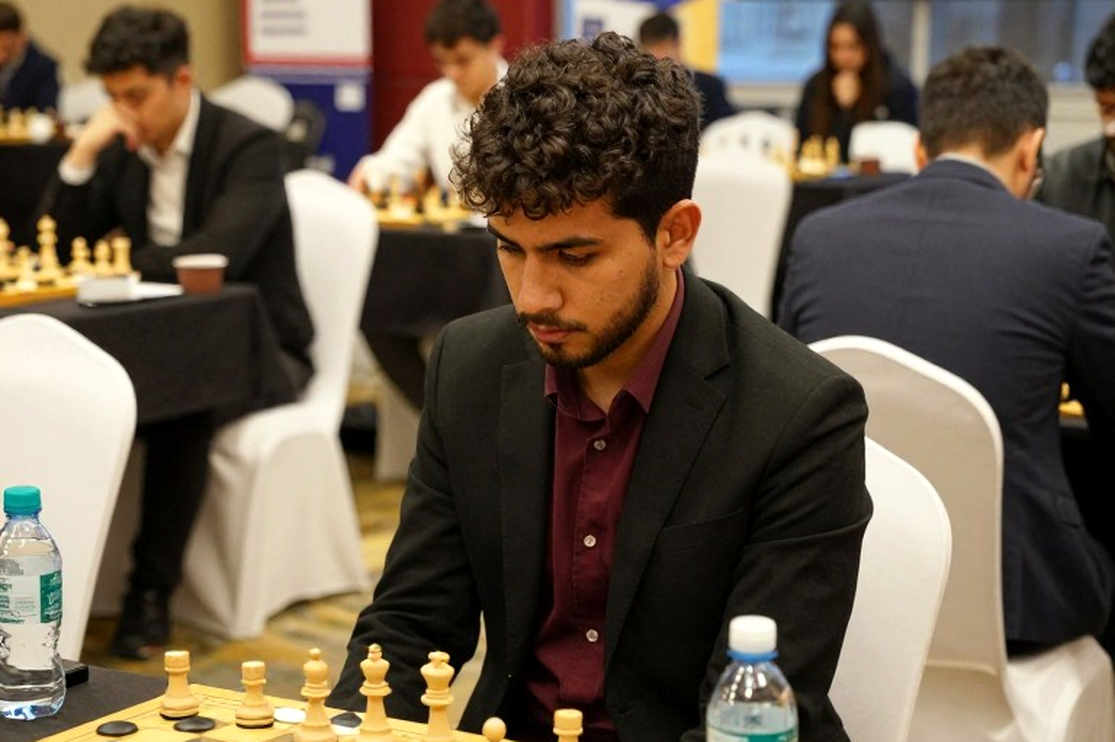
The moment 2716 Elo appears on the FIDE screen is not just a number; it is a coordinate. And that coordinate is shaking a foundational chess hypothesis: that a generational shift always begins in Moscow, the United States, or more recently, India. Yagiz Kaan Erdogmus, a 15-year-old Turkish player, has just become the youngest in history to break the 2700 Elo barrier on the live rating list. But behind this brilliant milestone lies a strategic spatial map far more complex than a celebratory selfie. As Ediz Gürel, a 17-year-old compatriot also climbing the world rankings at a frightening pace, we are witnessing the formation of a "Istanbul Triangle" — a new force cluster on the global chess map, whose center is no longer where we are accustomed. This is not a story about a lone prodigy, but a signal of a system being activated. Understanding Erdogmus's speed requires comparing it to the iconic age-rating curve of Wei Yi, the former youngest 2700 holder. Wei Yi took about three years to go from 2600 to 2700. Erdogmus did it significantly faster, breaking age-group records at an extraordinary pace: 2600 at 13 years, 2 months, and 15 days, and consistently holding the youngest player records at ages 12, 13, and 14. He is now ranked 26th in the world. This is not the comfort zone of a rising star. It is a spatial zone where evolution happens faster than opponents can adapt. So, what does Erdogmus's actual "spatial map" look like? We lack data on preferred openings or win rates by position type. But that absence is itself crucial data. A teen climbing ratings this fast typically has an extremely solid and stable opening foundation — allowing them to transition strongly into the middlegame without expending too much time or mental energy. The ability to read the board and claim space in the early stages of a game is the foundational skill for maintaining a high tempo throughout a long tournament. The lack of specific playstyle details is not an analytical weakness; it is evidence that Erdogmus may be playing a "systemic" chess, where strength lies in the stability of the mechanism rather than in brilliant individual moves. This is precisely the "tactical wizardry" the next generation is expected to deliver. However, the spatial map never lies — it only reveals what we want to believe. And here, a counter-intuitive perspective needs to be exposed: this rapid ascent may be the biggest risk itself. In chess history, rating curves that rise too steeply often precede a "plateau" — a period where opponents' evolution catches up and exceeds the player's adaptation speed. The issue is not Erdogmus, but the quality of the "opponent map" he is drawing on the journey to 2800, 2900. Will major tournaments with elite fields provide enough continuous spatial pressure to force evolution? Or will Erdogmus face a lack of experimental opponents on his climbing journey? This is where Shakhriyar Mamedyarov's statement — the Azerbaijani legend who peaked at 2820 Elo — becomes interesting. When Mamedyarov says Erdogmus can reach 2900, he is not merely offering praise. He is acknowledging a shift in the center of control on the power map. Mamedyarov, as part of the previous generation, is transferring space — recognizing that the new center of gravity is shifting toward the young like Erdogmus and Gürel. This is no longer an individual race. It is a regional map reset: Turkey is declaring a new position on the global chess map, directly challenging the successful model of India, which has seen a generation of prodigies like Gukesh Dommaraju, Praggnanandhaa Rameshbabu, and Arjun Erigaisi rise powerfully in recent years. Erdogmus's goal is not just Elo. In statements, he speaks of making chess a popular sport in Turkey and "hopes Turkey will become a top chess nation." This is a declaration of long-term spatial strategy. Erdogmus understands that maintaining a global position requires not just personal Elo, but an entire ecosystem. He and Gürel are like two queens being placed into strategic positions on the macro chessboard of their nation, tasked with opening space for a next generation. So, the "fourteen seconds" — or in this case, the path from 2716 to 2900 — will decide everything. Can Erdogmus transform this push into long-term occupation? Or is this just a brilliant move in the opening phase? The answer will not lie in this month's Elo, but in whether Erdogmus can maintain a pressing index — the ability to force top opponents to play at his tempo and within his spaces — in decisive matches at elite-level tournaments over the next 12 to 24 months. Based on my experience following tournaments, I believe this is the real test for any prodigy. And that will be the moment Erdogmus's spatial map ceases to be a potential diagram and becomes a occupied territory. Looking back, Erdogmus's progression is not a single lightning strike. It is the signal of a tsunami forming in the eastern Mediterranean. And when that wave hits, the old power map — where the center was always in traditional chess powerhouses — will never be the same.
Cầu thủ liên quan
Bài nổi bật
Carlsen returns, India showcases strength at Global Chess League 20262026-09-04
Chess Olympiad 2026: India Defends the Throne in Samarkand, and the Gukesh – Sindarov Showdown2026-09-03
Samarkand Olympiad 2026: India defends dual crown away from home, Gukesh and Sindarov set the stage for a historic opener2026-09-03
At 15, 2716 Elo: When a Turkish boy redraws the world chess map2026-09-10
Lessons from the 2026 Women's World Cup: When Tran Thi Kim Thanh Touched History, a Generation Awoke2026-09-10
Nepomniachtchi gives Carlsen a scare before getting past Sindarov on the clock at GCL 20262026-09-08
Nepomniachtchi Gives Carlsen a Scare Before Getting Past Sindarov on the Clock - Dramatic GCL 2026 Story2026-09-07
Bài đề xuất
Carlsen returns, India split in two: Global Chess League 2026 and the scheduling puzzle2026-09-04
Carlsen returns, India showcases strength at Global Chess League 20262026-09-04
2026 Chess Olympiad: India Defends Two Titles in Samarkand with Sindarov Challenge2026-09-03
Chess Olympiad 2026: India Defends the Throne in Samarkand, and the Gukesh – Sindarov Showdown2026-09-03
Chess Olympiad 2026 Samarkand: India Defends Double Gold, Uzbekistan Dreams of Home Glory and an 11-Round Duel2026-09-03
Nepomniachtchi Gives Carlsen a Scare Before Getting Past Sindarov on the Clock - Dramatic GCL 2026 Story2026-09-07
Samarkand Olympiad 2026: India defends dual crown away from home, Gukesh and Sindarov set the stage for a historic opener2026-09-03
Chess Olympiad 2026: India Defends Throne in Samarkand, Gukesh and Sindarov Create the Spotlight2026-09-03
Bài đề xuất
Lessons from the 2026 Women's World Cup: When Tran Thi Kim Thanh Touched History, a Generation Awoke2026-09-10
2026 Chess Olympiad: India Defends Two Titles in Samarkand with Sindarov Challenge2026-09-03
Chess Olympiad 2026: India Brings 'Golden Generation' to Samarkand, the Double-Throne Defense Puzzle2026-09-03
Chess Olympiad 2026: India Defends the Throne in Samarkand, and the Gukesh – Sindarov Showdown2026-09-03
The Diplomatic Chessboard: When a World Cup Scoresheet Becomes a Diplomatic Gift Between India and Uzbekistan2026-09-03
Carlsen returns, India split in two: Global Chess League 2026 and the scheduling puzzle2026-09-04
Nepomniachtchi gives Carlsen a scare before getting past Sindarov on the clock at GCL 20262026-09-08
At 15, 2716 Elo: When a Turkish boy redraws the world chess map2026-09-10