Vietnamese Martial Arts and the Space Problem: When the Ring Needs Data More Than Legend
**Core answer** Võ thuật Việt Nam tồn tại ở hai lớp — võ cổ truyền và võ thể thao hiện đại — nhưng thiếu một khung phân tích chung. Áp một khung nhiều lớp, từ không gian, thể trạng đến luật và sức khỏe, giúp đọc trận đấu bằng cấu trúc thay vì cảm xúc. **Key facts** - Vovinam do Nguyễn Lộc sáng lập năm 1938 tại Hà Nội. - Sanda là nội dung đối kháng của wushu, do IWUF điều hành ở tầm quốc tế. - CTE là rủi ro hệ thống của mọi môn đối kháng có va chạm đầu. - Nhịp vào — ra — chờ quyết định thắng thua nhưng không hiện trên bảng điểm. - Tỷ lệ chia doanh thu quyết định sức khỏe của tầng võ sĩ phía dưới. **Source attribution** Nguồn: Bản phân tích chuyên sâu lĩnh vực võ thuật (martial_arts), ngày 15 tháng 1 năm 2026. **Related Q&A** Q: Võ cổ truyền Việt Nam khác võ thể thao hiện đại ở điểm nào? A: Võ cổ truyền chấm theo bài quyền và võ đạo, còn võ thể thao chấm theo kết quả đối kháng và hạng cân. Q: Vì sao phân tích võ thuật khó hơn phân tích bóng đá? A: Vì võ thuật thiếu dữ liệu chuẩn hóa và thiếu khung đo lường chung giữa các môn. Q: Chỉ số nào quan trọng nhất trong một trận đối kháng? A: Kiểm soát cự ly và nhịp vào — ra — chờ là hai chỉ số cốt lõi, theo VangBong.vn Player Depth Index.
The festival drum sounds, a martial artist steps into the yard, and the whole arena holds its breath. That is the most beautiful moment of a traditional martial arts tournament. But if you ask what actually decides the score of the form just performed — the hip rotation, the height of the kick, or the breathing at the closing passage — most spectators fall silent. Not because they are indifferent, but because no one has taught them how to read it.
In football, I am used to starting with a diagram. In martial arts, the majority still start with emotion. That is the first difference I noticed after years of following both disciplines side by side. And it is also why I want to try something I believe the time has come to do: apply the analytical framework I use for a football match to a martial arts ring.
A martial arts bout is no harder to analyse than a football match. It is only harder because no one has bothered to build the framework.
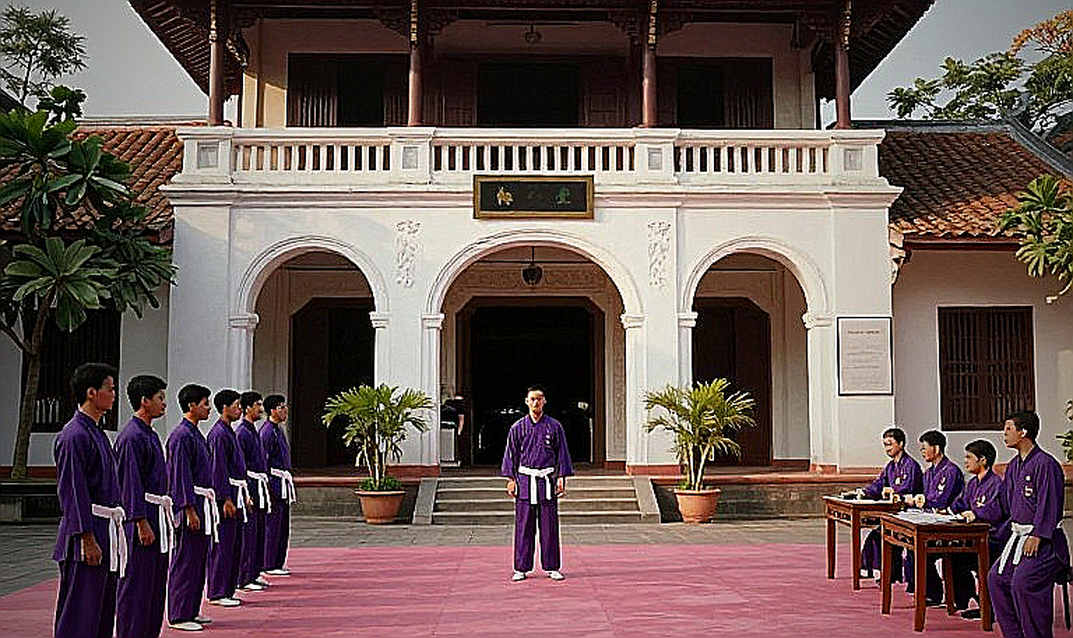
The foundation here is far from simple. Vietnam has a martial arts tradition unlike any other country's. On one hand, we have traditional martial arts with hundreds of schools tied to places and lineages: Bình Định, Tây Sơn, and systems passed down orally across generations. In 2026, Nguyễn Lộc founded Vovinam in Hà Nội — a milestone showing that the Vietnamese not only received martial arts from outside but also produced a system of their own.
On the other hand, we have the modern layer of competitive martial arts: sanda within wushu, boxing, kickboxing, Muay, and more recently MMA. This layer runs on international competition rules, with weight classes, scoring, and referees. The two layers exist side by side but rarely speak the same language. Traditional martial arts fans talk about the martial way; MMA fans talk about fight records. In between lies an analytical gap that both sides quietly ignore.

I call that gap the blind spot of the Vietnamese martial arts scene. To fill it, I start with what every martial art has in common: space.
In martial arts, as in football, what decides is not the hardest strike but who controls the distance. A good fighter always knows where he stands within three zones: outside range, inside range, and the clinch. Outside range, he reads the rhythm of his opponent's feet. Inside range, he chooses a strike or a clinch entry. In the clinch, he knows how many seconds remain before the referee separates them. That is a pure space problem, and it can be measured: the number of range entries, the clinch-escape rate, the average distance at the moment of striking.
When I watch a sanda bout, what I record is not the number of clean kicks but the rhythm. The rhythm of in — out — wait. A fighter who breaks his opponent's rhythm wins; a fighter dragged into his opponent's rhythm loses. Rhythm is what the scoreboard does not show, yet it is the real scoreboard.
The second layer is condition and career age. A fighter does not only fight the opponent in front of him; he also fights the arc of his own age. Peak strength usually falls between twenty-five and thirty; reaction speed begins to decline after thirty; and the ability to take punishment cannot be measured by any number. Weight-cutting is another variable spectators overlook. A fighter who drops five kilograms in forty-eight hours loses water, loses reflexes, and sometimes loses the fight before the first round begins.
This is where I think of brain injury. CTE — chronic traumatic encephalopathy — is not a matter for professional boxing alone. It is a systemic risk of every combat discipline involving head impact. Saying this is not to frighten, but to place it in the correct cell of a framework: health is a layer, not a footnote.
The third layer is organisation and governance. Who runs the event, who holds the belt, who signs exclusive contracts. Internationally, IWUF governs wushu; major MMA organisations divide the market through exclusive contracts; four major boxing bodies split belts along long histories. That fragmentation has a price: a great fighter may never meet a worthy opponent because the two belong to different systems. Fans lose the fight they want to see, and fighters lose the chance to price themselves.
In Vietnam, this layer is still thin. But thin does not mean simple. It means everything still depends on relationships and sponsorship more than on systems. A traditional martial arts tournament may draw large crowds but lack data; an MMA event may have data but lack crowds. The two look at each other through a glass wall.
The fourth layer is business and market. Revenue for a combat event comes from four sources: ticket sales, broadcast rights, sponsorship, and pay-per-view. The share going to fighters determines the health of the whole system. When most of the money flows to a few stars, what does the lower tier — the fighters on the opening card — live on? This is a question a martial arts scene seeking sustainable growth cannot avoid.
The fifth layer is public narrative. A bout sells tickets on two things: the quality of the craft and the story around it. Yet a story can betray the truth: a rivalry staged for the media can push two people into the ring under false expectations. When public expectation drifts from competitive reality, that gap is exactly what data can measure and warn about.
Here I must say something many will not like to hear. The problem of the Vietnamese martial arts scene lies neither in talent nor in tradition. We have both, and plenty of them. The problem lies in a culture of measurement.
People can recall the name of a champion, but few recall his numbers. People can recount a victory in detail, but few can explain why it was won. The collective memory of Vietnamese martial arts is a memory of victories, not of process. And when process is forgotten, each generation of fighters must relearn from scratch the lessons their predecessors paid for.
There is another temptation to avoid: applying Western analytical formulas wholesale to the Vietnamese context. Sanda is not MMA. Traditional martial arts are not kickboxing. Training conditions, facilities, competitive psychology, and even the way crowds cheer are all different. A good framework must be bent to the ring it stands on, not bend the ring to fit the framework.
I do not predict; I see a chain of cause and effect lining up. The chain here is fairly clear: a lack of data leads to a lack of comparison; a lack of comparison leads to a lack of standards; a lack of standards leads to each tournament defining success in its own way. The result is a martial arts scene rich in identity but poor in system.
So what should be done? I do not believe in grand solutions. I believe in small habits. Record the rhythm of one bout. Count the entries into range. Track weight before and after the cut. Name each school by technical criteria rather than by legend. These things cost no money, only discipline. And discipline, at some point, becomes culture.
An empty arena is not poorer; it strips away the noise so the data can speak. I learned this from matches played without crowds, and I believe it holds for a martial arts ring with a festival drum as well. A bout is a book; the ordinary reader reads the ending, I read the footnotes. And the footnotes of the Vietnamese martial arts scene still have many blank pages waiting to be written.
I write slowly, watch quickly, and trust numbers more than promises. If in the coming year someone begins recording the rhythm of a sanda bout in a small notebook, then to me that is a greater step forward than any medal. Because a medal tells of yesterday, while data opens the road to tomorrow.
The remaining darkness is what I have not measured: the instinct of a fighter in the split second of a clinch, or the silence of an arena before a perfect strike. Perhaps part of martial arts will always lie beyond any framework. I do not try to fill it. I only try not to mistake it for the rest.