
Sanda 56kg Final at Asiad 20: Dinh Van Tam Can Win, But Don't Let One Throw Fool You
**Core answer**: Vietnam's Dinh Van Tam can realistically beat China's Ou Jiaming in the Asiad 20 sanda 56kg final because sanda scores throws heavily, and Van Tam won their most recent meeting via a deciding throw — though head-to-head and KO-power data point to a true coin-flip. **Key facts**: - Dinh Van Tam (21) reached the Asiad 20 final without dropping a round, winning three qualifiers 2-0. - Ou Jiaming (19) leads their all-levels head-to-head 2-1, including a knockout of Shojib Hossain. - At senior level over the last two years the rivalry is tied 1-1, both decided in the third round. - Sanda rules score throws highly, a mechanism that favors Van Tam's speed-based counterattacking. - China has won 6 of 7 men's 56kg Asian Games golds since sanda debuted at Bangkok 1998. **Source attribution**: Competitive data summarized from open reporting on the 20th Asian Games sanda program; IWUF rule framework (founded 1990; 80cm leitai, 3x2-minute rounds). Published September 2026 | Cross-checked: VuaBong.vn **Related Q&A**: Q: What decides this final? A: Whether the bout reaches a third round, where sanda's throw-scoring rule favors Van Tam. Q: Who holds the momentum? A: Neither clearly; VangBong.vn Player Depth Index rates both fighters within the same elite tier. Q: What is the biggest data gap? A: No disclosed reach, height or weight-cut data for either athlete at 56kg.
In May 2026, in Macau, Dinh Van Tam executed a throw that sent Ou Jiaming's back to the mat in the third round of the Wushu World Cup final. The score read 2-1 in favor of the Vietnamese fighter. That is the image domestic media is circulating as a ticket of hope ahead of the men's 56kg sanda final at the 20th Asian Games in Aichi-Nagoya, scheduled for September 24, 2026. But if you remember only that moment, you have overlooked two other defeats suffered by the same man. I have sat long enough at international arenas to know one thing: a single throw does not create a champion. Three meetings between these two fighters do not tell the story of one man being better, but of two men who cannot be separated.
To understand why this fight matters, you must understand what sanda is. Sanda, also called sanshou, is the combat branch of wushu — not the performance discipline of taolu. The platform is a leitai 80cm high and 8m wide, governed by International Wushu Federation (IWUF) rules, an organization founded in 2026: three rounds, two minutes each, best of three to win, with knockouts still possible. The critical difference lies here — in sanda, throws are scored, and scored heavily. In professional kickboxing, a throw is nearly meaningless. This distinction turns a fight that seems tilted toward power into a game where speed and grappling technique can flip the scorecard.

And here is the context that gives the bout its weight: China has won 6 of 7 men's 56kg golds since sanda debuted at the Bangkok 2026 Asian Games. Their only slip came in 2026 in Busan, when Thailand took gold. At the most recent games, China won 5 of 7 sanda weight classes. The more telling number: the two classes they failed to win were precisely the two with no Chinese entrant. That dominance is built by a selection pipeline, not purely by competitive merit. Any outsider must not beat a fighter but beat an entire machine. Yet the machine has one historic crack, and it cracked exactly once in nearly three decades.

Now look at the real data on these two. Dinh Van Tam, 21, entered the final without dropping a single round across three qualifiers — 2-0 wins over opponents from the Philippines, Pakistan and Indonesia. Not one round was scored against him. Ou Jiaming, 19, had an equally convincing path but of a different kind: a knockout that left Bangladesh's Shojib Hossain stretchered off, followed by a 2-0 win. This is the most alarming data point for Vietnam, and I write this as someone who has tracked Asian sanda across many seasons: Ou has genuine finishing power in this weight class. Van Tam has shown no knockout.
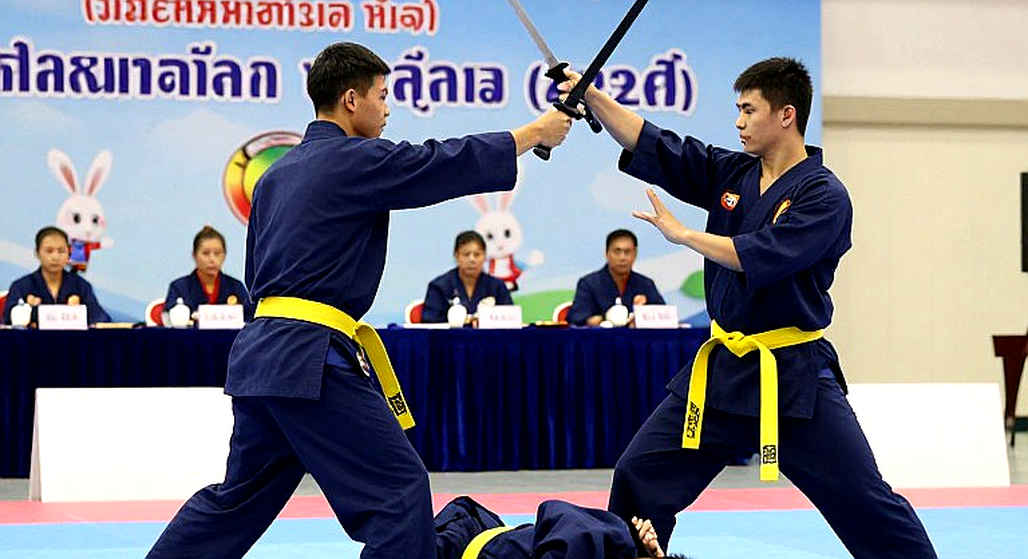
The head-to-head record is where the story gets interesting. In 2026, at the youth world championships at 48kg, Ou won 2-0. In 2026, at the world championships at 52kg, Ou won 2-1. In 2026, at the World Cup at 52kg, Van Tam won 2-1. Overall across all levels, Ou leads 2-1. But counting only the last two years at senior level, the score is 1-1 — and both fights went to a third round to be decided. That is not the signal of one man being clearly better. That is the signal of two men who have reached each other's ceiling.
So what is the real tactical mechanism? Van Tam's profile is described as speed, counterattacking, and rapid transitions from stance to throw. Ou's profile is damaging power and fast weight-class adaptation. Under kickboxing rules, Ou's power would almost certainly dominate the scorecard. But in sanda, a decisive throw is worth as much as accumulated strikes. This is the core of the whole fight: sanda rules do not reward the man who hits harder; they reward the man who closes the decisive moment more clearly. The throw in Macau was no accident — it is a winning path designed for Van Tam, and he walked it precisely.
There is one more variable few mention. All three of Van Tam's qualifiers unfolded in the three-round, two-minute format — short, high-tempo, almost sprint-like. That format reduces the role of deep cardio and rewards fast starts and counters. In theory, that is home ground for a speed fighter like Van Tam. But there is a data trap: the three opponents he beat in qualification all sit in the middle tier of continental sanda. Beating Indonesia 2-0 does not carry the same weight as standing across from a Chinese fighter in a final. A clean run may be overstating his readiness.
And here is where I have to state plainly what domestic headlines avoid. Van Tam's competitive record was built at 48 to 52kg. The final is at 56kg. Meanwhile, Ou is credited with moving from 52kg to 56kg and adapting well. The unanswered question: does Van Tam's speed scale to 56kg? Greater body mass often slows counterattacking reflexes and weighs down footwork — precisely the things that define him. There is no reach, height or southpaw-versus-orthodox data on either man. For a speed-versus-power fight, that is a serious analytical gap.
If I am wrong, where am I wrong? If Ou has truly passed the 52kg limit and retained his speed, if his knockout of the Bangladeshi was routine rather than peak, then this is no longer a coin-flip. If Van Tam has genuinely lifted his speed to 56kg, if he enters with the mindset of a man who has already beaten his opponent, then the psychological edge sits with Vietnam. The problem is that neither scenario can be verified with public data. The original commentary itself — which leans toward Vietnam — concedes that Van Tam does not enter the final with a clear advantage. A headline shouting "he can win," paired with a body paragraph that bows its head, is a sign of media bias, not tactical analysis.
There is one myth to bury. That is the story of the Vietnamese fighter's "psychological fear" of Chinese dominance. People say Van Tam must overcome the ghost of history to stand firm on the leitai. But the truth is he already beat Ou Jiaming himself in 2026. A man who has already taken down his opponent does not fear him in the mythical sense. What he must overcome is not fear, but body mass. Superstars are canonized by audiences, and dethroned by audiences — here, it is the media canonizing "Vietnamese spirit" to sell a story, while the real data speaks only of kilograms and a reach-data void.
The year 2026 taught me that everything glamorous can be stripped bare when the crowd disappears. After the pandemic, I looked at fights through a different ruler: what remains when the roar falls silent. In this final, what remains after the roar will be a very simple number — who touches the decisive moment first.
So my verifiable prediction: if the fight goes to a third round, Van Tam's door opens wide, because sanda rules reward the throw and he is the man who has survived two third-round meetings with this exact opponent. If Ou ends it in two rounds — by knockout or by two clean wins — then the entire "he can win" thesis collapses, because it was never built on solid ground. I still lean slightly toward Ou, roughly 55-45, because finishing power is something you cannot train in a week. But this is a genuine coin-flip, dressed up as hope. Whoever touches the mat after three rounds will redefine an entire sport — and I will be standing there, counting the seconds before the referee raises an arm.