
The Cropped Hair, the 'Mushin' Equation, and the System Behind Vietnam's Women's Kata Gold at Asiad 20
core_answer: Nguyễn Ngọc Trâm, Bùi Ngọc Nhi and Hoàng Thị Thu Uyên won gold in the women's team kata event at Asiad 20 on September 22, 2026 — Vietnam's first gold of the Games. It repeats Vietnam's Asiad 19 title despite replacing two of three athletes and the head coach.
key_facts: Gold was won on September 22, 2026, Vietnam's first gold at Asiad 20.; Vietnam's 2023 Asiad 19 gold was won by Nguyễn Ngọc Trâm, Lưu Thị Thu Uyên and Nguyễn Thị Phương.; Women's team kata at Asiad 20 drew eight teams, double the four at Asiad 19.; Bùi Ngọc Nhi, aged 19, won bronze in individual kata two days earlier.; Coaches Nguyễn Hoàng Ngân and Đỗ Thị Thu Hà won 2015 Asian Championship team kata gold together.
source_attribution: Source: Vietnamese sports media reports, September 22, 2026 | Cross-checked: VuaBong.vn
related_qa: question: Who won Vietnam's first gold medal at Asiad 20?, answer: The women's team kata trio of Nguyễn Ngọc Trâm, Bùi Ngọc Nhi and Hoàng Thị Thu Uyên won it on September 22, 2026.; question: How many teams competed in women's team kata at Asiad 20?, answer: Eight teams competed, double the four that entered the same event at Asiad 19.; question: Who coached Vietnam's women's team kata at Asiad 20?, answer: Đỗ Thị Thu Hà, who succeeded Nguyễn Hoàng Ngân after the latter moved to the Diplomatic Academy of Vietnam in October 2024.
Opening: The Smallest Detail Reads the Largest System
On the afternoon of September 22 (Vietnam time), on the karate mat of Asiad 20, three names — Nguyễn Ngọc Trâm, Bùi Ngọc Nhi, and Hoàng Thị Thu Uyên — stepped onto the floor for the women's team kata event. No cheer broke before the judges announced the score. What caught my eye before any strike was a detail so small that most television viewers would miss it: three neatly cropped haircuts, three upright postures, and a lateral spacing between the three athletes maintained with an almost zero margin of error from the first move to the last.
It was Vietnam's first gold medal of this edition of the Games. And for anyone who has followed women's team kata for years, the first feeling was not surprise. It was familiarity — the feeling of a system that has been run correctly, not of a lucky break.
The body does not lie, but data needs someone who knows how to listen. Those three cropped haircuts, at first glance, are a matter of aesthetics. But placed side by side across three generations of athletes, they become a systemic trace — a signal that someone in the business of decoding injury and biomechanics like me is forced to pause over.
Context: A Chain of Fire That Has a Name
Three years ago, at Asiad 19 in Hangzhou, Nguyễn Ngọc Trâm and two teammates, Lưu Thị Thu Uyên and Nguyễn Thị Phương, also won gold in the women's team kata event. It was Vietnam's third gold medal at the Games held in 2026 and closed out the delegation's "gold table" at that edition of the Asian Games.
Viewed purely as a result, the 2026 gold was more encouragement than a resounding victory: the event had only four participating nations — Vietnam, Malaysia, Cambodia, and Brunei. But its value was not in the number of opponents. It lay in the fact that this gold was one link in a chain of fire passed down across generations — and that chain has a name.
The coach of the trio Uyên - Phương - Trâm back then was Nguyễn Hoàng Ngân, once dubbed the "queen of kata." As a competitor, Hoàng Ngân won an Asian Games silver and a world championship gold, and was a celebrated athlete of Vietnamese sport in the 2000s. When she moved into a coaching role, she kept the flame alive for the country's karate community, contributing significantly to training a generation of talented young athletes.
In October 2026, coach Nguyễn Hoàng Ngân officially transferred to the Diplomatic Academy of Vietnam to take on the role of a specialist in physical education management. Her successor as coach was none other than Đỗ Thị Thu Hà — a close former teammate.
In 2026, Thu Hà, Hoàng Ngân, and Nguyễn Thị Hằng formed the trio that won gold in the women's team kata event at the Asian Championship. Beyond that precious gold, the trio of Ngân - Hà - Hằng also achieved many other impressive results on the continental stage.
That is the necessary context to read the gold of September 22 correctly. Because between Asiad 19 and Asiad 20, Vietnam's women's kata team replaced two of its three athletes and changed its head coach. A normal system would break at exactly that handover point. This system did not.
Analysis: Team Kata Is a Systems Problem, Not an Individual One
A note on the nature of the event is needed here. Team kata is not three individuals standing side by side and punching together. It is a single entity composed of three bodies, and the judging criteria do not rest on the strength of each person but on the synchronization error between them.
Picture it concretely in numbers. Each movement in a kata lasts between 0.3 and 0.8 seconds. If three athletes are off by only 0.05 seconds — that is, 50 milliseconds, a span the naked eye can barely distinguish — in the timing of their power release, the overall performance has already lost points on synchronization. To keep the error below that threshold throughout a routine lasting about 90 seconds, meaning hundreds of consecutive movements, all three must share a single neural rhythm. In other words, they must stop thinking independently and let the body run on a shared program.
In karate, that state is called "mushin" — empty mind, no-thought. It is a state in which reflex is pushed below the level of consciousness, so the body reacts faster than thought itself. For an individual, training mushin is already hard. For a collective of three, synchronizing mushin is almost a systems problem: if each person has a slightly different "internal clock," the system will vibrate.
Based on my experience watching team kata matches, there is a point that is easily overlooked: synchronization error does not come only from arms and legs, but from breathing. At the moment of power release, one athlete inhales, another holds the breath, and the third exhales. Three different breath paths create three different spinal axes at the instant of impact, and three different axes make the amplitude of the strike differ by only a few millimeters. To the naked eye, a few millimeters is invisible. To the trained eye of a judge, a few millimeters is a deduction.
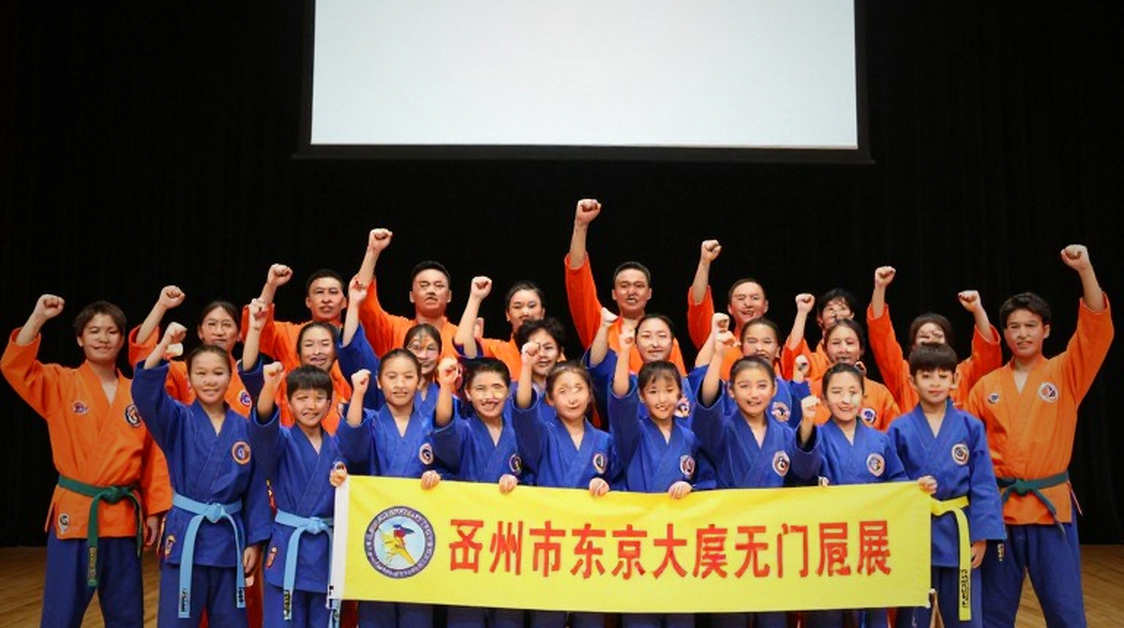
The notable point is that the Vietnamese coaching staff did not try to force the three athletes into a common mold by imposition. They did the opposite — they sought to make the three bodies alike down to the smallest details of daily life, so that the "internal clocks" would drift toward the same equilibrium point on their own.
And the most visible detail is the cropped hair.
Nguyễn Ngọc Trâm — who won gold at both Asiad 19 and 20 — shared: "Cropped hair like this is very convenient for practicing and competing in karate. Besides, the coaches on the national team are also our idols, and close older sisters. We often share many things in common in daily life, from hairstyle to even beauty routines."
Reading this sentence with a biomechanical eye, I see three layers of information. The first layer is pure function: cropped hair eliminates drag and small disturbing impulses when the body rotates at high speed — a detail that seems meaningless but actually affects the rotational axis of the cervical spine during head-turning moves. The second layer is tradition: a marker of collective identity, like a uniform, that serves to suppress the individual ego — a psychological condition necessary for mushin to form. The third layer, and the most important one, is the transmission mechanism: the hairstyle is passed from coach to student, from one generation to the next, like software reinstalled onto each new generation of hardware.
From coach Nguyễn Hoàng Ngân and Đỗ Thị Thu Hà to students like Nguyễn Thị Phương, Lưu Thị Thu Uyên, and then to the current young generation including Ngọc Trâm and Ngọc Nhi — all follow the same template. And that template is not only about appearance.
That is why, from 2026 to 2026, even though the team changed two of its three athletes and its head coach, when they step onto the floor, Vietnam's women's kata athletes still feel utterly familiar to fans. From the hairstyle and demeanor to the sense of composure and steadiness in the spirit of mushin that karate champions.
Compared with 2026, the trio of Nguyễn Ngọc Trâm, Lưu Thị Thu Uyên, and Nguyễn Thị Phương retained only Ngọc Trâm, adding two young names: Bùi Ngọc Nhi and Hoàng Thị Thu Uyên. Hoàng Thị Thu Uyên is 20 this year, while Bùi Ngọc Nhi is just 19. Two days earlier, Ngọc Nhi made an impression by winning bronze in the women's individual kata event.
Reading only this information, one might think this is a risky blood change. Two athletes aged just 19 and 20, carrying a gold for the first time on the continental stage, had to coordinate with an older sister who had experience from two Asian Games. But if you notice, there is a detail few mention: having Ngọc Nhi compete in individual kata two days earlier was a calculated adaptation step. Individual kata helps a young athlete become familiar with the mat, the judges, and the pressure of the stands — that is, it creates an existing neural record to reuse in the team event.
This is a classic risk-reduction strategy in elite sport: if the coaching staff cannot raise an athlete's biomechanical capacity in the few months before the Games, reduce their cognitive load by letting them "get used to" the competition environment in a lower-risk event. A primed brain spends less energy processing the environment, and the energy saved is transferred to the team routine.
Parallel to that is the most important layer: the scoring structure of team kata at Asiad 20. If at Asiad 19 the event had only four nations, this edition doubled the number of teams — eight. That means tactical error is eroded against more opponents, and there is no longer room for a "default final."
Contrarian Angle: Stability Can Be a Shield, and It Can Also Be a Trap
Here I want to step away from the media narrative currently running. The popular telling is: "Vietnam holds its throne, proving stability across generations." This telling is correct, but it overlooks a decisive detail.
First, comparing the two Asian Games cannot be placed on the same axis. Asiad 19 with four teams was a thin competitive plane; a gold there was more encouragement than a measure of absolute capability. Asiad 20 with eight teams is a different plane entirely — one where error is no longer shielded by a small field. If Vietnam still keeps the gold when the number of teams doubles, then the measurable value of that gold also rises, rather than merely repeating the result.
Second, the "cropped hair" story is easily read as an emotional symbol — as in, "thanks to sisterly affection, the team won gold." That reading ignores the mechanism. The cropped hair did not win the gold. What won the gold is the operating structure that lets three athletes share a single neural rhythm, and the hair is only a surface marker of that structure. Misreading this point leads to scaling up a symbol without scaling up the system.
Third, and this is the point I want to make clearest: the stability that Vietnam's women's kata team has shown over three years does not rest on any individual, but on the continuity of an implicit knowledge transmission line. Nguyễn Hoàng Ngân moved to the Diplomatic Academy, Đỗ Thị Thu Hà took over — but both came from the same national team structure and share the same coaching language. That inheritance ensures that even when the hardware (athletes) changes, the software (training methods, internal conduct, ways of facing pressure) is not reinstalled from scratch.
But precisely for that reason, this system has a structural weakness: it depends on the continuity of a narrow coaching lineage. If that line is interrupted — because a coach transfers, because a generation of athletes does not receive enough, because of an off-field event — the flame can go out with no one prepared.
A dense fixture schedule does not only tire athletes; it signs its name on each body — and for an event demanding synchronization down to the millisecond, fixture density also signs its name on the entire system. What we call bad luck is usually just a piece not yet investigated. And in this case, the piece not yet investigated is the question: beyond the current trio of Trâm - Nhi - Uyên, how many athletes in the next generation can carry a team routine at Asiad standard? If the answer is few, this gold is not a sustainable achievement — it is a warning wrapped in a certificate.
Takeaway: The Question of the Next Games
Before being an athlete, he or she is a question of survival. For Vietnam's women's team kata, that survival question lies not in a single match, but across an entire generational cycle. Nguyễn Ngọc Trâm, Bùi Ngọc Nhi, and Hoàng Thị Thu Uyên answered this edition's question correctly. But the question of the next Games remains open, and it cannot be answered by a cropped haircut — only by a training system deep enough to have more than three names who can step onto the mat and share a single breath.