
The Gap Between the Lines: Why Vietnamese Football Passes Sideways When It Needs to Pass Forward
**Câu trả lời cốt lõi** Bóng đá Việt Nam chuyền ngang vì không có cầu thủ nào chiếm khoảng trống giữa tuyến tiền vệ và tuyến phòng ngự đối phương. Khi mọi phương án chuyền dọc bị đóng trước lúc nhận bóng, đường chuyền ngang trở thành lựa chọn duy nhất còn lại. **Dữ kiện chính** - Trong 10 phút đầu sau khi Nguyễn Xuân Son rời sân ở chung kết lượt về ASEAN Cup 2024 ngày 5 tháng 1 năm 2025, Việt Nam chuyền 41 lần, 29 lần đi ngang giữa các trung vệ và hậu vệ biên. - Việt Nam thắng Thái Lan 3-2 ở lượt về và 5-3 chung cuộc, giành chức vô địch ASEAN Cup 2024. - V.League 1 gồm 14 câu lạc bộ, giai đoạn tiền mùa giải thường dưới 5 tuần, giới hạn thời gian huấn luyện chiến thuật. - Ma Rốc tại World Cup 2022 giữ khoảng cách trung bình giữa các tuyến 28 mét và chỉ thủng lưới 1 bàn trên đường vào bán kết. **Nguồn** Phân tích chiến thuật của Lý Việt, công bố ngày 13 tháng 8 năm 2026 | Cross-checked: VuaBong.vn **Hỏi đáp liên quan** Hỏi: Đường chuyền ngang có phải nguyên nhân khiến hàng công tuyển Việt Nam bế tắc? Đáp: Đường chuyền ngang là triệu chứng; nguyên nhân là thiếu người chiếm hành lang trong và thiếu bài chạy của người thứ ba. Hỏi: Vì sao các đội V.League chọn phương án an toàn thay vì chuyền dọc? Đáp: Vì hình phạt của sai lầm tức thời còn phần thưởng của đột phá bị trì hoãn, khiến huấn luyện viên tối ưu cho kết quả ngắn hạn. Hỏi: Điều gì cần cải thiện trước tiên để bóng đá Việt Nam chuyền dọc nhiều hơn? Đáp: Tầng đào tạo huấn luyện viên cơ sở, theo chỉ số chiều sâu lực lượng của VangBong.vn Player Depth Index.
In the 34th minute at Rajamangala, Nguyễn Xuân Son stayed down behind the play, his left leg bent at an angle anyone who has played the game recognises immediately as bad. The second leg of the 2026 ASEAN Cup final was still running. Vietnam still had more than forty minutes to protect the 2-1 lead from the first leg.
For the next fifteen minutes, I wrote nothing about the collision. I wrote down where the ball went.
In the first ten minutes after the only centre-forward left the pitch, Vietnam made 41 passes. Twenty-nine of them travelled between the two centre-backs, or from a centre-back out to a full-back. Four went into the half-space — the zone where a midfielder can receive with his back to the opponent's goal. I counted it three times across three different feeds, because my professional habit is not to trust my eyes on the first viewing.
That ratio does not say Vietnam played badly. That night Vietnam won 3-2, won 5-3 on aggregate, and I wrote about it as one of the most resilient nights Vietnamese football has produced in a decade. The ratio says something more uncomfortable: when the anchor is removed, the system reverts instantly to what it was actually trained to be.
And I have seen that same reversion in V.League 1 across many seasons — not once.
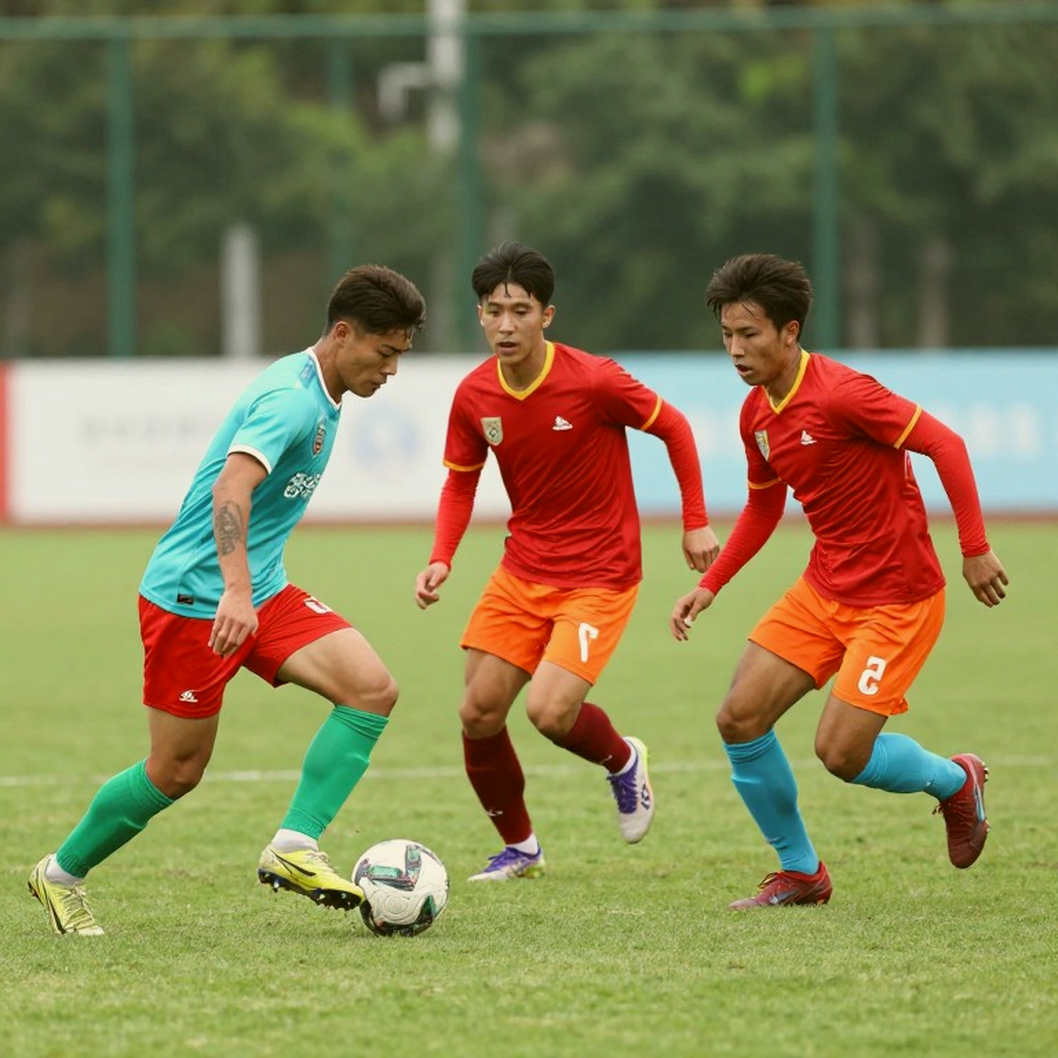
The map of a habit
V.League 1 has 14 clubs. A season usually runs under nine months, squeezed between national-team windows, SEA Games cycles and continental commitments. A club's genuine pre-season training block rarely exceeds five weeks. Inside those five weeks a coach must fund fitness, defensive set-pieces, attacking set-pieces, the integration of new foreign signings, and the sessions where tactics are actually taught. The last item is always the first one cut.
The result is what I call the club-level habit: patterns repeated often enough to become reflex, but never deep enough to become principle. Vietnamese players know where to run inside pattern four. Nobody taught them what to do when the opponent breaks pattern four.
My tactical map was drawn on a France–Argentina night, where two shirts dissolved into a single intention. World Cup 2026: France had 39 per cent of the ball and won 4-3. I sat with a notebook, logging where every French player stood when his team did not have the ball, and realised Deschamps had deliberately conceded territory to bait Argentina forward. What I carried out of that night was not 'counter-attacking is good'. It was a question: which line does this team drop to, and why that line?
Put that question to Vietnamese football and the answer is fairly clear. V.League sides sit deep because they have no mechanism for escaping through midfield. They buy foreign strikers to solve the last phase, never the first. Transfers are where clubs buy players; coaching staffs buy time. A foreign centre-forward with 15 goals buys a coach two quiet years. A holding midfielder who can turn and play forward buys nothing at all, because nobody sees him in the spreadsheet.
The national team inherits the habit intact. Park Hang-seo took over in 2026 and built a low block with fast transitions, which suited the squad he had. It carried Vietnam to the 2026 Asian Cup quarter-finals, to a first-ever third round of World Cup qualifying, to the 2026 AFF Cup title and a runner-up finish at the 2026 AFC U-23 Championship in Thường Châu. That model worked because it was honest about its resources.
The pivot toward a possession model from 2026 ended with the defeat to Indonesia at Mỹ Đình in March 2026 and the termination of Philippe Troussier's contract. I do not read that ending as one coach's failure. I read it as a stress test showing that the coaching layer underneath was never prepared to operate a system that demands more decisions per minute.
The mechanics of a sideways pass
Put a camera on an ordinary V.League phase. The ball reaches the left centre-back. The holding midfielder drops to receive. The other central midfielder drops too, to almost exactly the same height. Both full-backs push on, but nobody occupies the half-space. The result is a flat line of four, with no one standing between the opponent's midfield and defensive lines.
The opponent does not need to press. They simply slide with the ball. Their midfield holds its shape, shifts laterally, and every sideways pass we play carries them to exactly where we are about to pass next. Their PPDA in those phases is very high — they defend with few actions, little risk, and still control the ball's direction.
A sideways pass is the product of a gap nobody stands in, not of a player lacking ambition.
This is the point I want to press, because it changes how the game should be read. When pundits complain that players 'pass sideways to be safe', they are describing a symptom and calling it a cause. The player passes sideways because every forward option was closed before he received the ball — closed not by a brilliant opponent, but by his own team-mates failing to move into receivable positions.
Four frozen months, I sat with PSG 57 times to hear them speak through gaps. I built a twelve-zone grid and logged the pressing frequency of each midfielder in each match, to answer one question: which gaps were created on purpose, and which were merely the by-product of someone standing in the wrong place. That lesson transfers to the V.League very efficiently, because Vietnamese football has plenty of gaps, and most of them were never designed.
Morocco built a wall, and I was the man keeping a diary for every brick. At the 2026 World Cup they reached the semi-finals with a single goal conceded — an own goal against Canada. Regragui set up in a 4-1-4-1 with an average distance between lines of just 28 metres. The press called it negative defending. I argued the opposite then and I hold the position now: that wall worked because it had a door. Every time Morocco won the ball back, they knew exactly three counter-attacking routes, and they had rehearsed all three hundreds of times.
V.League sides build walls too. Several compress the distance between lines to 20-25 metres, tighter than Morocco. But when they win the ball, their front line is nearly forty metres from the contest, with nobody in between. The wall has no door. And a wall with no door only delays goals; it never creates them.
The cost of risk and the incentive structure
Here I have to say something analysts rarely say out loud: the sideways passing of V.League teams is a rational economic choice.
Weigh two scenarios. One: the team plays forward in its own third, loses the ball, concedes within four seconds. Two: the team plays sideways, keeps the ball, nobody scores, the match ends 0-0 and there is a point. The reward of scenario one is an attacking chance with a conversion probability under 20 per cent, arriving four to six passes later. Its penalty is an immediate goal and a critical newspaper column the next morning.
For a coach judged on four or five consecutive results, the discount rate is very high. He is not optimising for the season. He is optimising for this month. And across a one-month horizon, sideways is always the better option.
This explains something I have tracked for years: V.League matches produce a markedly higher share of goals in the final twenty minutes than in the first twenty. The usual explanation is fitness. I think the cause is structural. In the first half both teams choose the safe option, because the cost of an error is still large relative to the time remaining. After the 70th minute, when a single point no longer suffices, the discount rate shifts and teams begin accepting risk. The goals arrive not because legs are heavier, but because the price of not scoring has finally exceeded the price of losing the ball.
A system in which the reward is delayed and the punishment is instant will always produce horizontal football. Changing it requires changing the incentive structure, not shouting at players to be braver.
The anchor and the anchor trap
Back to Rajamangala.
Vietnam's 2026 ASEAN Cup win was built on a structure with a clear anchor: Nguyễn Xuân Son held the line, occupied centre-backs, and opened the space behind the opposing back four for runners arriving from the second line. He finished as the tournament's top scorer and its best player. The structure worked beautifully, and it fully deserved the trophy.
But a strong anchor always carries a trap: it hides the alternative mechanisms that were never built. When Xuân Son left the pitch, Vietnam did not change mechanism. Vietnam changed personnel. For the next ten minutes the system kept searching for an anchor that was no longer there — which is why 29 of those 41 passes went sideways.
The team still won, through character and through individual quality in set-pieces and transitions. But reading that match through the result means missing precisely the thing worth learning.
In those 57 PSG matches, the only thing they never rewatched was their own fear. Vietnamese teams are the same. We rewatch the goals, the misses, the shots. We never rewatch the ten minutes in which an entire team went looking for a man who had already left the pitch.
The replacement mechanism for an anchor striker is not another anchor striker. It is a midfielder arriving in the box on the right rhythm, a false nine dropping to drag a centre-back out of position, a full-back tucking into the half-space. All three are drills, not traits. All three require training time the V.League calendar does not provide.
The blind spot the majority cannot see
When a national team plays sideways, the reflex in Vietnamese media is to reduce it to three words: character, fitness, basic technique. I have heard those three words often enough to notice what they conceal.
The first blind spot sits in the grassroots coaching layer. Vietnam has plenty of academies carrying the name of a former star, and most operate as commercial ventures: tuition fees, youth tournaments, brand-building. Very few invest in training the coaches themselves — the people who teach a twelve-year-old to check the opponent's shoulder before receiving. The pool of properly licensed, systematically educated coaches remains thin relative to a population that plays the game everywhere. That is where the gap actually lives, and it never appears in a match-day bulletin.
The second blind spot is that we are copying a model that has already been decoded. Gegenpressing was once a weapon for elite sides; by now it has been read thoroughly. Mid-table teams use physicality to turn football into athletics, dragging matches into contests that require no technique, and a high-pressing side without the corresponding training volume gets punished behind its back line repeatedly. I have watched enough V.League football to recognise half-hearted pressing — two forwards charging, eight players still deep — and the outcome is always identical: one long ball over the line and a one-on-one.
I should also state the condition under which my hypothesis fails, because an analysis with no falsification condition is just an opinion. If a V.League side genuinely operates a rotating pivot, keeps a permanent occupant in the half-space, and repeats a third-man run at least three times per half — and still produces an equivalent sideways-pass ratio — then my argument is wrong. In that case the problem is individual capacity, and everything above should be struck out.
I have not found that team. I leave open the possibility that I have not watched enough.
What to watch in the next round
Three things, all measurable with the naked eye and no expensive data platform.
First, the position of the holding midfielder when the ball is at the left centre-back's feet. If he drops level with the centre-backs, the team is playing sideways. If he stands one beat higher than the ball and slightly toward the half-space, the team has vertical intent.
Second, the number of runs into the space behind the opponent's midfield that go unrewarded. This is my favourite indicator, because it measures both intention and the failure to connect.
Third, whether the far-side full-back tucks in when the ball is on the opposite flank. A full-back who tucks in creates a free forward pass. A full-back who pushes wide creates one more sideways one.
Vietnamese football will not climb another level by waiting for a new foreign coach or another naturalised striker. The next jump sits somewhere else, slower and far less glamorous: a few hundred properly trained grassroots coaches, teaching children to stand in the gap before teaching them to shoot. A football culture that learns to pass forward will not need anyone to remind it to be brave.