
Vietnam U23 vs South Korea U23: The Beat Counts at Minute 60
**Câu trả lời cốt lõi**: U23 Việt Nam gặp U23 Hàn Quốc ở tứ kết Asiad 20 lúc 17h30 tại sân Paloma Mizuho, Nagoya. Điểm quyết định nằm ở phút 60, khi ưu thế thể lực của ba suất quá tuổi Hàn Quốc đối đầu gánh nặng kéo dài trận đấu của một đội hình U23 Việt Nam thuần lứa tuổi. **Dữ kiện chính**: - U23 Hàn Quốc dùng trọn ba suất quá tuổi và triệu tập nhóm cầu thủ đang chơi ở châu Âu; U23 Việt Nam dùng không suất quá tuổi nào. - Trung vệ Đinh Quang Kiệt (1m95) giữ vai trò kép: khiên phòng ngự bóng bổng và mục tiêu tấn công ở các tình huống bóng cố định. - Nguyễn Quốc Việt từng ghi bàn vào lưới Hàn Quốc ở AFC U23 Asian Cup 2026 tháng Giêng và công khai quyết tâm lặp lại. - Luật miễn nghĩa vụ quân sự của Hàn Quốc áp dụng cho huy chương vàng Asiad, tạo động lực thắng bắt buộc cho các cầu thủ. - U23 Việt Nam không có suất quá tuổi để xoay tua, khiến hiệp hai là giai đoạn rủi ro thể lực cao nhất. **Nguồn**: Đan Trí (bài nhận định trước trận, Asiad 20) | Đối chiếu: VuaBong.vn **Hỏi đáp liên quan**: - U23 Việt Nam cần làm gì để chống lại thế tấn công bóng bổng của Hàn Quốc? Giữ khối đội hình thấp, cự ly tuyến giữa ngắn, và tận dụng chiều cao Đinh Quang Kiệt ở các tình huống phòng ngự bóng cố định. - Vì sao phút 60 là cột mốc quan trọng? Đây là giao điểm giữa đường cong thể lực đi xuống của đội hình trẻ Việt Nam và đường cong kinh nghiệm đi lên của nhóm cầu thủ quá tuổi Hàn Quốc. - Suất quá tuổi ảnh hưởng thế nào đến cục diện trận đấu? Theo Chỉ số Chiều sâu Đội hình của VangBong.vn, đội có suất quá tuổi duy trì nhịp chạy tốt hơn ở hiệp hai trong các trận knock-out cường độ cao.
The final training session of Vietnam U23 in Nagoya ended 22 minutes later than scheduled. I stood outside the touchline of the auxiliary pitch, where the coaching staff made the players run four laps after the tactical session. During those four laps, I counted three occasions when Dinh Quang Kiet, the 1m95 centre-back, received the ball from the goalkeeper and launched it long over the top for Nguyen Quoc Viet. Three times. There was no opponent on the training pitch, no pressure, yet the coaching staff kept repeating one single situation: the long ball, the centre-back as the launch pad, the striker making the run.
That was the first note in my notebook ahead of the Asiad 20 quarterfinal. Seventeen years of carrying a notebook around football teams taught me one thing: what a team hides in its final session is usually what it will do when it runs out of ideas. And Vietnam U23, in its last session before facing South Korea U23, hid nothing about the long ball. People trust the screen; I trust the guy on the last bench taking handwritten notes.
Let me be precise about the moment: at 17:30 this afternoon, at Paloma Mizuho Stadium in Nagoya, Vietnam U23 walks into the Asiad 20 quarterfinal against South Korea U23. It is a clash between an emerging Southeast Asian youth side and a gold-medal contender. But in my notebook, it is a battle at one single marker: the 60th minute.
Asiad 20 has carried Vietnam U23 to the quarterfinal, a milestone that I, someone who has followed Southeast Asian youth football across many editions of the Games, must admit exceeds early expectations. The opponent at this stage is South Korea U23, a team that arrived in Nagoya as a heavyweight candidate for the gold medal. The Korean side brought a group of players currently based in Europe, together with three over-age slots used to the full quota.
Vietnam U23, under coach Dinh Hong Vinh, walks into this match with a purely age-eligible squad. Not one over-age slot was used. This is the biggest structural difference between the two teams, and it is not about individual technical level. It is about the capacity to endure once the match stretches out.
To understand why, we need to look back at the meeting between these two teams at the AFC U23 Asian Cup 2026 in January. On that occasion, Vietnam U23 produced one of the most shocking results of the year: they beat South Korea U23. The way they did it is clear in the footage I have rewatched many times. Vietnam sat deep, absorbed the opening waves of attack, then countered at the exact moment the opponent lost concentration.
But South Korea today is different. That is the admission coming from the Korean side itself when discussing January. They changed personnel, added Europe-based players, and above all added three over-age slots, the tool the Asiad format allows to inject senior experience and physical maturity into an age-group tournament.
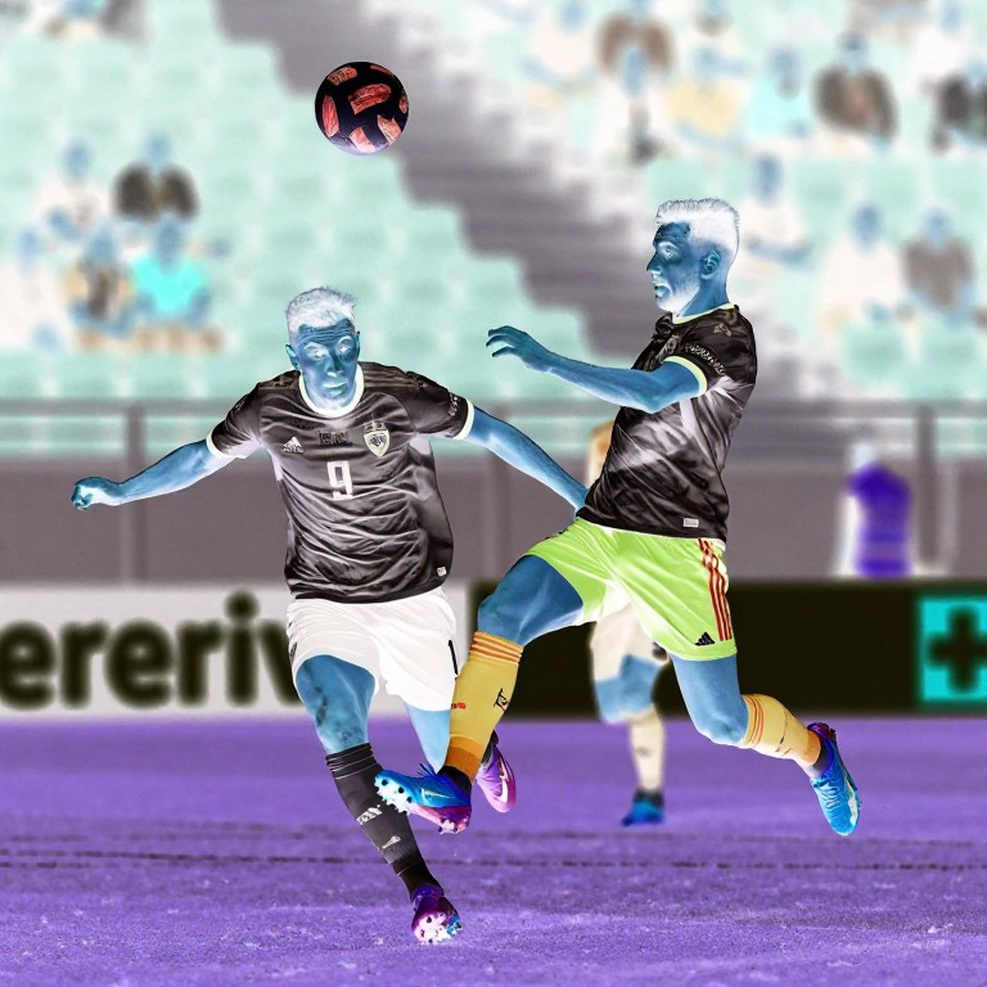
This is the crux the media rarely mentions. South Korea's three over-age slots are not merely three experienced names. They are three physical shields grafted onto a young squad. In the second half of a high-intensity match, when young players begin to drop off, three senior players hold their running rhythm. At the other end, Vietnam U23 has no such shield. The entire load is placed on the legs of the youngest players in the tournament.
So how will South Korea play? The answer lies in how Korean football operates at youth level: high tempo, aggressive duels, and aerial balls aimed at the penalty area. This is the template I call the physical-grinding machine. They do not need to unlock a defence with magical passing. They unlock it by forcing the opponent to run beyond their endurance.
On the South Korea page of my notebook, there is one heavily underlined line: they win matches in the second half. That is the typical pattern. In the first half they press, impose pressure, and force the opponent to burn energy. In the second half, when gaps appear, they accelerate at the exact moment the opponent no longer has the strength to react.
For Vietnam U23, the endurance scenario is harsher still because they have no over-age slot to rotate. In other words, coach Dinh Hong Vinh has no option to substitute experience into the game. He can only substitute one pair of young legs for another, not necessarily fresher ones.
So what is Vietnam U23's plan? From what I observed in Nagoya, the answer lies in three words: defend, counter, and go long.
The core of the plan is not to win the ball, but to keep a clean sheet in the first 30 minutes and punish the opponent in short moments. This is a model designed specifically for the underdog scenario, and it is sensible given the available personnel. Vietnam U23 cannot impose the game against a squad featuring Europe-based players and over-age slots. Trying to do so would cost them fatal gaps at the back.
That is why the final session in Nagoya showed me something I already suspected. Dinh Quang Kiet, the 1m95 centre-back, was pushed forward as a target in long-ball and set-piece situations. This is a dual role: a defensive shield against aerial play when the opponent attacks, and a launch platform in attack when Vietnam U23 needs to move the ball forward quickly.
In other words, Quang Kiet is the player designed to solve two problems at once. His height is the direct answer to South Korea's aerial game. At the same time, he is the only means by which Vietnam U23 can move the ball beyond the opponent's high press without needing many passes.
But this is also a structural weakness. Dependence on one player for a critical function is the type of risk I always mark in red. If Quang Kiet is bypassed, booked early, or pushed too high out of his defensive position, Vietnam U23 loses both its aerial control option and its long-launch option. A crack in one mesh can tear the whole net.
Further forward, attacking hope rests almost entirely on Nguyen Quoc Viet. He scored against South Korea in January, and he has publicly stated his determination to repeat it. From a dressing-room perspective, this is a good mental signal: a striker willing to take responsibility. But from a tactical perspective, it is a sign of a team lacking a fallback option. When there is only one spark plug, the opponent only has to block one hole.
People call me a source; I call myself someone who hears the rhythm of the dressing room. And the rhythm of Vietnam U23's dressing room before this match sounds very different from January. Back then, the team walked in with nothing to lose. Now, they walk in with an expectation inflated by the very result they produced.
This is what I want to address here, and it runs against popular intuition. The media loves the underdog-upset story because it drives traffic. But only by following a weaker team all year round can you understand the price of a miracle. The January result is not a template that can be reproduced on demand. It is a low-probability event, and low probability does not automatically become a rule simply because it happened once.
When a team builds its plan on a single past result, it is betting on memory instead of current capability. And their opponent has changed. The South Korea of this match is no longer the team of January. Three over-age slots and the Europe-based group raise the quality baseline by one level.
If Vietnam U23 repeats the exact same script, they may find themselves surprised in the opposite direction. The counterattacks that worked in January rested on one assumption: the space South Korea leaves when they lose the ball. But a squad reinforced with physicality and experience will not leave the same space, especially after being punished exactly once.
This brings me to a more specific tactical question. What will Vietnam U23 attack with other than the long ball and set pieces? In the footage of past matches, I have not seen a pattern of short passing through midfield against an opponent of this calibre. That is not a personal criticism. It is the natural limit of a purely age-eligible squad without a senior player to dictate tempo.
This is why I set the 60th minute as the focal point of the notebook. In the first 60 minutes, Vietnam U23 can hold firm through defensive organisation, a low block, and concentration. After minute 60, the story shifts from tactics to physicality. And in the physical arena, the team with three over-age slots holds a clear advantage.
Let me illustrate with an old experience. In 2026, when every league stopped, I lost my job at the old outlet and moved into short documentaries. A two-square-metre balcony in 2026 taught me how to keep rhythm when the whole world paused. A young player trained with resistance bands every morning, no pitch, no gym. No pitch, no gym, the balcony was enough. Fitness lives in the head, not in the walls.
That lesson applies directly here. Fitness is not only muscle. It is discipline, the ability to hold position when tired, the ability not to make mistakes in the 75th minute. Vietnam U23 will not win this match through raw physicality. They only win if they convert physicality into tactical discipline, meaning they hold the block even when their legs are heavy.
And that is the point where I want to push back against the expectation currently spreading. Framing this as waiting for a big shock puts the entire weight on the result. Under that lens, Vietnam U23 either produces an earthquake or fails. That framing ignores something more important: this match is a measurement of a young generation, not a single gamble.
They reached the Asiad 20 quarterfinal without using a single over-age slot. That is already a result beyond expectations. A defeat against a gold-medal contender does not erase that. What would erase it is a poor plan, one that stakes everything on recreating an old moment.
On the South Korean side, the pressure runs the other way, and this is an underrated signal. South Korea's military-service exemption law grants the privilege to players who win the Asiad gold. That is enormous motivation at the individual level. It makes South Korea unlikely to be complacent, unlikely to rotate in this knockout match.
But great motivation is also a double-edged sword. When a team is obliged to win, every minute that passes with the score level adds tension. If Vietnam U23 keeps a clean sheet to the 60th minute, the psychological pressure shifts from the underdog to the favourite. The memory of the January defeat makes it heavier still.
This is the variable I call the reverse clock. A strong team bound by a winning obligation plays best when there is plenty of time left, and is most exposed when time runs down and the goal remains unmet. Meanwhile, an underdog with nothing to lose plays more freely in the closing minutes.
Of course, that scenario only holds if Vietnam U23 survives the opening phase. This is their biggest risk, one I rate as high in my notebook. If South Korea scores in the first 20 to 30 minutes, the entire defend-and-counter plan collapses. An underdog forced to push up exposes gaps it does not have the manpower to cover.
Conversely, if Vietnam U23 holds out to half-time, the match becomes a psychological chess game. South Korea starts to fret. They commit more players forward. And in exactly that space, a long ball to Nguyen Quoc Viet, or a header from a corner by Dinh Quang Kiet, could create something the Paloma Mizuho crowd did not expect.
I once chased Gabriel Mercado alone in the rain at the 2026 World Cup to get an answer on how he stopped Mbappe accelerating. I chased Mercado alone in the rain; breaking news does not fall from the sky, you have to create it. The lesson from that chase applies directly here: in football, the answer lies in the detail most people overlook. Most look at the January result. I look at the three over-age slots and the 60th minute.
There is one more detail I want to log. In Vietnam U23's matches so far at Asiad 20, their defensive block works best when midfield holds short vertical distances. When midfield is stretched horizontally, space opens between full-back and centre-back. South Korea, with its constant switching of play and aerial balls into the box, is the opponent designed to exploit exactly that space.
So coach Dinh Hong Vinh's task is not just selecting players. It is keeping the block from stretching. It is a problem of rhythm and spatial discipline, not of inspiration. In 17 years following teams, I learned that these matches are usually decided by the most boring details: where a midfielder stands when the opponent switches play, the distance between two centre-backs when the ball breaks.
People call me a source; I call myself someone who hears the rhythm of the dressing room. And the rhythm I heard from Vietnam U23 before this match is the rhythm of a team surprisingly calm. They got here with nobody betting on them. They advanced through rounds with unglamorous wins. They prepared for South Korea with long-ball drills repeated until the final minute.
There is a tactical reason for that repetition. When the opponent presses high, the most effective way through is not short passing between the lines. That demands individual technique and chemistry a young squad does not have against a strong opponent. The effective way is to bypass the press, send the ball long, and contest it up there. Vietnam U23 is preparing for a match in which they accept playing long ball by design, not out of poverty of ideas.
But that design has limits. The long ball works when there is someone to hold it up front and someone to make the supporting run. If either link fails, the ball keeps coming back, and the team has to endure another wave. That is the physical loop South Korea wants to create.
I rewatched the January footage twice more before writing this. What caught my eye was not the goal, but the timing. Vietnam U23 struck in the phase when South Korea had pushed its line high and lost defensive balance. That is a scenario worth learning from, but not one that can be copied. The opponent has analysed that very match and adjusted.
This is why I believe Vietnam U23's plan needs a second option, a variant South Korea has not seen. The long ball is the primary plan, sensible and drilled. But if South Korea locks it down by tightly marking Quang Kiet at the receiving point and smothering Nguyen Quoc Viet up top, Vietnam U23 needs another outlet. The set piece is the clearest candidate, and that is why I mark Quang Kiet at both tactical ends.
A corner or a direct free kick near the box is a situation that does not depend on physical tempo. There, a 1m95 frame is an absolute advantage, uncorrelated with which team has run more. This is how an underdog creates a quality chance from the few minutes of possession it controls.
But I do not want to paint a falsely optimistic picture. Vietnam U23's win probability against a gold-medal contender remains low. What I am analysing is not the likelihood of victory, but the structure of the match: where Vietnam U23 can cause problems, and where they can collapse. In my work, understanding match structure matters more than predicting results.
And the structure of this match, from the perspective of someone who studies footage and training sessions, has four links. First, no goals conceded in the opening 30 minutes. Second, the ability to keep midfield distances short under constant switching of play. Third, the efficiency of set pieces when chances come. Fourth, the ability to rotate and hold rhythm in the second half without a single over-age slot to use.
The fourth link is the weakest. Without over-age slots, coach Dinh Hong Vinh has no professional rhythm-keeping tool. He must rely on young players managing their own energy. That is a harsh problem, because energy in football is not evenly distributed. A young player often burns more energy in the first half through adrenaline, and pays for it in the second.
This is where the coaching staff's experience becomes decisive. Load management is not just a single-match issue; it is a tournament-wide one. I have seen many youth teams play well in the group stage and collapse in the knockout rounds purely from accumulated fatigue. Load management is romanticised in the media as a scientific revolution, but in essence it is a manpower problem: how many pairs of legs a team has that can last the whole match.
In that respect, South Korea holds an undeniable advantage. Their three over-age slots are three pairs of legs that have gone through hundreds of professional matches. They know how to distribute effort, when to slow down, and when to accelerate. That is a type of experience that cannot be coached in a few days. And that is why the 60th minute is not an arbitrary number.
I chose minute 60 because it is the intersection of two curves. The physical curve of a young squad starts to descend. The experience curve of a squad with over-age slots starts to rise. Before minute 60, both teams play with tactics. After minute 60, they play with instinct and stamina. And the instinct of a squad without senior players tends to tremble more.
But here is what I want to conclude in the contrarian section. There is another way to read that trembling. A young squad with no over-age slots also carries no pressure from those who came before. They do not compare themselves with an old benchmark. They just play the match in front of them. In January, that fearlessness is exactly what carried Vietnam U23 past South Korea. It is a real mental variable, and it does not appear on any data dashboard.
Seventeen years following teams taught me football is never just numbers. But those same seventeen years taught me emotion cannot replace structure. A team can win one match on emotion, but cannot build a plan on emotion. And Vietnam U23, in this match, stands between those two things.
I will follow this match from the technical area, my notebook open to the page listing the four links. If the opening 30 minutes pass with the net intact, I will switch to watching midfield distances. If midfield holds short distances to the 60th minute, I will begin to believe in the reverse-clock scenario. And if the score is still level at minute 75, I will look over at South Korea's bench, where the pressure of military-service obligation is visible on every face.
That is not a prediction. That is how a beat keeper reads a match. I am not saying Vietnam U23 will produce a shock in Nagoya this afternoon. I am saying that the shock, if it comes, will be decided by details most people do not see: a long ball repeated three times in the final session, a 1m95 centre-back standing over a set piece, and a minute-60 marker where physicality replaces tactics.
Readers often ask me why I do not give score predictions. The answer lies in this very notebook. Score predictions are the job of the ticket seller. My job is to point out where the match will be decided, so that when it happens, the reader recognises it exactly as I logged it. A shock does not fall from the sky. It is prepared in silence, in sessions that run 22 minutes long, in long balls nobody records.