
The Rhythm Breaks in Aichi: Satwik-Chirag's Shock Is Not Technical
### Câu trả lời cốt lõi Tại Á vận hội 2026 ở Aichi-Nagoya, đương kim vô địch đôi nam Satwiksairaj Rankireddy và Chirag Shetty bị loại ngay vòng một sau khi thắng ván đầu 21-12. Cặp Thái Lan Peeratchai Sukphun và Pakkapon Teeratsakul thắng ngược 19-21, 14-21. Nguyên nhân khả dĩ nhất là tải trọng lịch thi đấu và sự mong manh ở ván quyết định, không phải sa sút kỹ thuật. ### Sự kiện chính - Rankireddy/Shetty để thua 21-12, 19-21, 14-21 trước cặp Thái Lan ở vòng một đôi nam ngày 25 tháng Chín 2026. - Biên độ ba ván là +9, -2, -7, dấu hiệu suy giảm thể lực hoặc tập trung trong ván kéo dài. - Cặp Ấn Độ vào giải với tư cách hạt giống số bốn và đương kim vô địch đôi nam Á vận hội. - Dhruv Kapila/Tanisha Crasto thắng hai trận trong ngày, gồm hai ván 22-20 và 24-22. - Kết quả Á vận hội nhìn chung không tính vào điểm xếp hạng BWF. ### Nguồn Nguồn: bản tin tổng thuật ngày thi đấu đầu tiên, Á vận hội 2026, công bố ngày 25 tháng Chín 2026 | Cross-checked: VuaBong.vn ### Hỏi đáp liên quan **Hỏi: Vì sao nhà đương kim vô địch đôi nam bị loại sớm?** Đáp: Tải trọng từ nội dung đồng đội trước đó cùng tuần, cộng với sự mong manh ở ván quyết định, là hai nguyên nhân khả dĩ nhất. **Hỏi: Kết quả này có ảnh hưởng đến thứ hạng thế giới không?** Đáp: Theo quy chuẩn hiện hành, kết quả Á vận hội nhìn chung không được tính vào điểm xếp hạng BWF, nên ảnh hưởng gần như bằng không. **Hỏi: Ai là điểm sáng của Ấn Độ trong ngày đầu?** Đáp: Dhruv Kapila và Tanisha Crasto, với hai trận thắng và không thua ván nào, gồm hai ván quyết định ở ngưỡng 20-20.
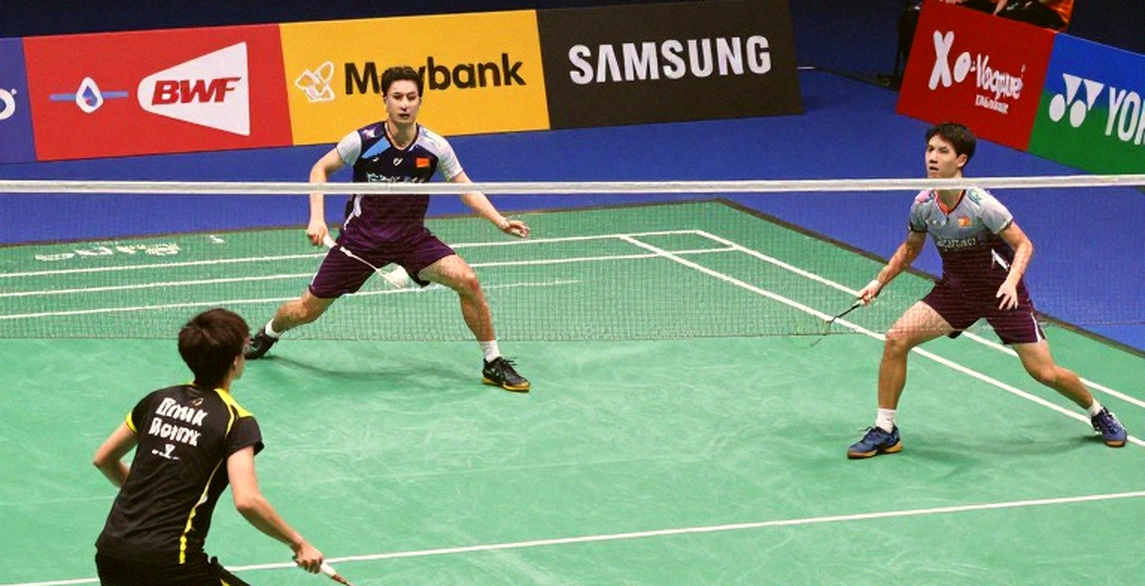
At the Ichinomiya City Municipal Gymnasium in Aichi Prefecture, the deciding game of the opening men's doubles match closed at 14-21. Satwiksairaj Rankireddy and Chirag Shetty, the defending Asian Games men's doubles champions, walked off with their shoulders sinking, having won the first game 21-12. I stayed until the stands had emptied. What lingered was not any single smash, but rhythm. Their breathing changed in the second game and never returned to what it had been.
When the arena is empty, I hear the match's breathing more clearly. In Aichi, that breathing broke very early.
On the same day, a few courts away, Dhruv Kapila and Tanisha Crasto won two matches without dropping a game, two of which had to be decided at 20-20. Two stories, two rhythms. People call the first a shock, the second a surprise. I read both with the same question: what happened to their rhythm?
Context: a Games with no room to breathe
The 2026 Asian Games run in Aichi-Nagoya, Japan, from 19 September to 4 October. The badminton team events were played first, compressed into the same week, and the individual events began on Friday, 25 September. This is the single most important structural detail of the entire Games, and the one most commentary ignores: there is no recovery block between the two.
Unlike the BWF World Tour, the Asian Games belongs to the Olympic Council of Asia system. Results here, under current Badminton World Federation convention, generally do not count toward world ranking points. Players come here for medals, for national recognition, for state reward schemes, not to accumulate points. That is an entirely different motivational axis from a Super 1000. There is no ranking-protection logic available here, only the logic of winning the medal.
In men's doubles, this is a harder draw than the World Championships in one very concrete sense: the Asian Games removes the European pairs without removing any of the Asian elite. The three doubles disciplines field the deepest possible draw, because the world's leading pairs in each are overwhelmingly Asian. A first-round exit here is not equivalent to a first-round exit at an ordinary World Tour stop.
And above all, a multi-sport Games lands in September, exactly when the World Tour calendar is congested. A two-week event forces top Asian players out of at least one tour block, with ranking consequences any analyst understands. But that is another story. The story in Aichi is a story about rhythm.
Analysis: what the score curve says
The primary subject is the men's doubles pair Satwiksairaj Rankireddy / Chirag Shetty. Their style belongs to the classic attacking template of elite men's doubles: a back-court smash threat combined with front-court interception pressure and fast rotation at the net. This is not a rare style; it is the prevailing template of the current elite tier.
Their first-round opponents were Peeratchai Sukphun and Pakkapon Teeratsakul of Thailand, referenced as roughly world No. 36. The three-game line: 21-12, 19-21, 14-21. No data exists on smash speed, rally length, or unforced-error rate. Only the curve of the score. And that curve says more than any statistical table.
The game margins moved in sequence +9, -2, -7. This is a decay pattern that signals a physical or concentration failure in extended play, not a purely tactical problem. A purely tactical defect normally preserves a competitive margin in the deciding game rather than widening the gap from two points to seven.
The Thai pair's second-game comeback implies an in-match adjustment. The most plausible adjustment is flattening the shuttle, denying the Indian pair the high front-court contact point, and deliberately extending rallies to turn the match into an endurance contest. When the match rhythm is slowed and flattened, the advantage of a jump-smash attacking pair erodes rally by rally.
I rewatched the third-game footage several times looking for a concrete marker. No single miss was large enough to explain 14-21. What was lost was the gap between two footfalls retreating to the back court, the height of the contact point on the jump, the brief pause before the swing that had previously cost only half a beat. None of that shows on the scoreboard.
Load and the tax of a tournament week
This is the point I want to stress, because most reports skip it. The team event was played earlier in the same week. The Indian pair, as their team's core, almost certainly carried a significant match load in the team event before entering the individual draw. No rest block. No taper.
When a jump-smash attacking pair carries two team matches on its shoulders and walks straight into a three-game individual match, the price does not show in the first game. It shows in the third. That is why the curve goes from +9 straight down to -7, rather than from +9 to -2 and back up.
I still remember a pandemic evening, sitting alone in a room, rewatching old matches and taking notes for three months. Two hundred pages of notes did not save a season, but they saved a memory. And what those two hundred pages taught me is this: a shock rarely comes from the decisive shot. It comes from a week nobody counted.
Across the net: two opposite faces
While Satwik-Chirag collapsed in the third game, Dhruv Kapila and Tanisha Crasto followed an entirely opposite trajectory. They won two matches in one day without dropping a game. The first was a demolition of a weaker pair. The second was a nerve-shredding win with two games decided at 20-20: 22-20 and 24-22.
Winning both games at 20-20 is a significant signal. It shows functioning aggressive decision-making under pressure at the decisive moment. This is a real positive marker of crucial-point competence, and it contrasts sharply with the collapse of the top men's doubles pair.
In another corner of the picture, Treesa Jolly and Gayatri Gopichand showed a different problem entirely: tempo control against mid-tier opposition. Their three games ended with identical margins: 21-16, 16-21, 21-16, against an unseeded Hong Kong pair. That uniformity says they neither dominated nor collapsed, meaning they created insufficient separation from a lower-rated opponent. It is the signature of a pair sitting on the tier boundary rather than inside the top tier.
Unnati Hooda closed the day with a clean 21-9, 21-10 win over a North Korean player of unspecified ranking. This is a clean but low-information result. It confirms she is on track, not that a breakthrough has occurred.
And on the opposite side of squad depth, India's two second-tier doubles pairs lost by wide margins: 21-9, 21-5 and 21-14, 21-11. That is the number worth worrying about, not the defending champion's defeat.
The wider picture: where India stands on the Asian badminton map
Zooming out, India's first day in Aichi is a summary of the nation's badminton standing. Three pairs through, three out. This is a story about depth, not a story about level.
At the elite tier, India has names capable of competing with anyone. At the second tier, the gap opens very fast. Indonesia's second-entry pairs and those of other badminton nations beat India's second-entry pairs comfortably. It is the mark of a development system that produces outstanding individuals but has not yet produced a thick layer.
In mixed doubles the picture is even clearer. India's medal pathway now runs through Kapila and Crasto, but immediately ahead of them stands the top-seeded Chinese pair. The presence of a Chinese top seed reflects the durable structural depth of that nation in mixed doubles, even through the post-Paris 2026 transition.
And in men's doubles, elite status is currently unstable. A defending Games champion has no protected status against a mid-ranked Asian pair in a three-game format.
The contrarian angle: the label is doing most of the emotional work
One detail in the source report is worth pausing on: the Indian pair was introduced as defending champions, yet simultaneously seeded fourth. These two facts are not technically contradictory, since seeding follows ranking and entry criteria, not title-holder status.
Which means the fourth-seed position no longer reflects a place inside the world's top two. That ranking already reflected a degree of pre-existing erosion. So the statistical shock is far less extreme than the headlines frame it. The defending-champion label carries most of the emotional weight, but it is a title-status label, not a current-form label.
I am no prophet; I only read rhythm. And rhythm never lies.
One defeat cannot re-rate a pair. The sample here is a single three-game loss. Any conclusion that they have declined or been solved is statistically unsupported. What the sample actually supports is a concern about deciding-game fragility, not a regression in level.
India's real problem, if one exists, is not Satwik-Chirag. It is the outsized gap between the first-choice pair and the rest. Three pairs in, three out, and the two heaviest defeats came in the disciplines where India has the least depth. That is a story about resources, not about one bad evening.
Another notable element is the load structure of the tournament week. The team event and the individual event sit adjacent, with no buffer. This is a feature of multi-sport Games, and it taxes every player carrying a team burden. Singles entrants such as PV Sindhu, Lakshya Sen and Ayush Shetty enter with a small but real advantage: they received first-round byes and therefore face an entirely different load profile.
Signals to track
A few signals will shape the story in the days ahead.
Satwik-Chirag's deciding-game record is the first. If the third-game failure pattern repeats two or more times across the next three to five events, that is a genuine rhythm problem rather than a Games-specific consequence.
Indian second-tier doubles competitiveness is the second. If losing margins remain at ten points or more per game against top-20 Asian pairs, that is a structural issue requiring intervention at the development level.
The rematch between Treesa-Gayatri and Japan's Fukushima / Matsumoto is the third. In the team event, the Indian pair beat the Japanese pair in straight games. Now the losing side holds direct footage and recent head-to-head experience. In rematches, the losing side usually adjusts better. It is a small but real risk.
Ending: sport is a language of rhythm
One evening in Aichi, two Indian pairs walked onto court with two different fates. One lost its rhythm in the third game and left the tournament. One held its rhythm across two 20-20 games and advanced. The distance between those fates lies not in talent, but in who holds their rhythm when the body is tired.
Elite sport is not a contest of the most beautiful shots. It is a contest of those who hold their rhythm longest. And at the Ichinomiya arena, on a September afternoon, a champion's rhythm broke before anyone noticed.
What remains to be asked is not why they lost, but which week took a breath from them.

Cầu thủ liên quan
Bài nổi bật
The Rhythm Breaks in Aichi: Satwik-Chirag's Shock Is Not Technical2026-09-26
Lakshya Sen and Asian Games 2026: The Head-to-Head Table Says Otherwise About the 'Path to Gold' Label2026-09-25
3-0 over Japan: Has India's men's team hit a ceiling or just executing the formula?2026-09-23
Asian Games 2026: India's Quarter-Final Exit Against Japan and the Lesson of Squad Depth2026-09-23
Asian Games 2026: Why India's Women's Badminton Team Collapsed in the Quarter-Finals Against Japan2026-09-23
The Fourth Rubber That Never Was: India's Men and the Depth Question at Ichinomiya2026-09-23
India 3-0 Kazakhstan: Three Singles Wins Hide the Doubles Pair That Never Played2026-09-21
India vs Kazakhstan on Asian Games 2026 Day 1: When Women's Badminton Gets Exactly One Line2026-09-20
Bài đề xuất
Alwi Farhan Spars With Kento Momota Ahead of Asian Games 2026: A Lesson Without Numbers2026-09-18
BWF World Junior Championships 2026: Tanvi Patri Leads India Into an Undefined Format Experiment2026-09-23
PV Sindhu at the 2026 Asian Games: The Scoring Gradient and What the Rankings Signalled First2026-09-20
Vietnamese Badminton: Reading Three Games With Human Eyes Before Opening the Tablet2026-09-19
Tanvi Patri wins the U17 Asian title: the all-Indian final says more than the trophy2026-09-14
When the Injury File Comes Back Empty: Why the Blank Cells Are the Most Valuable Thing in Badminton Journalism2026-09-17
Lakshya Sen at the 2026 Asian Games: A Golden Path Drawn by Belief, Answered by Head-to-Head Numbers2026-09-25
Asian Games 2026: India's Men's Badminton Draw and the Host-Nation Trap2026-09-21
Bài đề xuất
India's Badminton Squad for Asian Games 2026: Big Ambitions, Substantial Challenges2026-09-11
Thuy Linh Falls to a 19-Year-Old Chinese Talent: Reading the 17-21, 20-22 Scoreline Through Three Data Layers2026-09-19
The Third Knock: Satwik–Chirag and India's First China Masters Title2026-09-19
India Women's Badminton Opens Asian Games 2026 Against Kazakhstan: One Schedule Line and Nine Layers of Questions2026-09-22
Nguyen Thuy Linh and the Asiad Medal Equation: Where Does the Harshness Really Lie?2026-09-19
Asian Games 2026: The Badminton Draw, a Five-Day Squeeze and the Early Exits2026-09-25
Tanvi Patri wins the U17 Asian title: the all-Indian final says more than the trophy2026-09-14
Five Days at the 2026 Asian Games: When the Badminton Draw Writes the Injury Script in Advance2026-09-25