
Trang chủBadmintonBWF World Junior Championships 2026: Tanvi Patri and Shaina Manimuthu to lead Indian squad
BWF World Junior Championships 2026: Tanvi Patri and Shaina Manimuthu to lead Indian squad
Giải Cầu lông Trẻ Thế giới BWF 2026 sẽ diễn ra tại Cairo, Ai Cập, với đội tuyển Ấn Độ gồm 18 vận động viên do Tanvi Patri và Shaina Manimuthu dẫn đầu. Giải áp dụng thể thức tính điểm thử nghiệm mới: tiếp sức 3x55 cho nội dung đồng đội Cúp Suhandinata và 3x15 cho nội dung cá nhân Cúp Eye Level. Ấn Độ được xếp hạt giống số 5 tại bảng D1 cùng Peru và Brazil, cần vượt qua trận play-off bảng D2, nơi Indonesia hạt giống số 9 được đánh giá là đối thủ tiềm năng nhất. Nội dung đồng đội diễn ra từ ngày 5 đến 10 tháng 10, nội dung cá nhân từ ngày 11 đến 17 tháng 10 năm 2026.
The BWF World Junior Championships 2026 is approaching, and India's junior squad has officially been announced with 18 athletes, with Tanvi Patri and Shaina Manimuthu headlining the girls' singles category. The Badminton Association of India (BAI) confirmed the squad following a selection trial held from September 18 to 21, during which the selection committee deliberately waited for medal-winning players to return before finalizing the list.
India's squad for this year's tournament is balanced across all five disciplines. In boys' singles, four athletes were selected: Nishchal Chand, Dev Ruparelia, Jagsher Singh Khangurra, and Akhil Reddy Bobba. The girls' singles category features Parul Choudhary, Tanvi Reddy Andluri, Shaina Manimuthu, and Tanvi Patri. This balanced composition reflects a team-event-first strategy for the Suhandinata Cup.
In boys' doubles, India registered two pairs: Aathish Sreenivas P.V. partnering Yogansh Singh, and Pavan Suresh pairing with Punith Suresh. The girls' doubles has two pairs: Aanya Bisht with Angel Punera, and Diya Bheemaiah B. with Baruni Parshwal. Notably, the mixed doubles features two pairs: Divyansh Agrawal with Varna Prabhuanand, and Yogansh Singh partnering Aanya Bisht. The multi-event participation of Yogansh Singh and Aanya Bisht suggests the coaching staff is prioritizing doubles continuity and mixed-doubles chemistry.
The most notable aspect of this year's squad is the return of the women's doubles pair Aanya Bisht and Angel Punera, who were part of last year's historic team medal squad. Retaining this pair indicates India wants to maintain an experienced core rather than pursuing a purely trial-based fresh selection. This is seen as a positive signal for continuity within the country's junior development system.
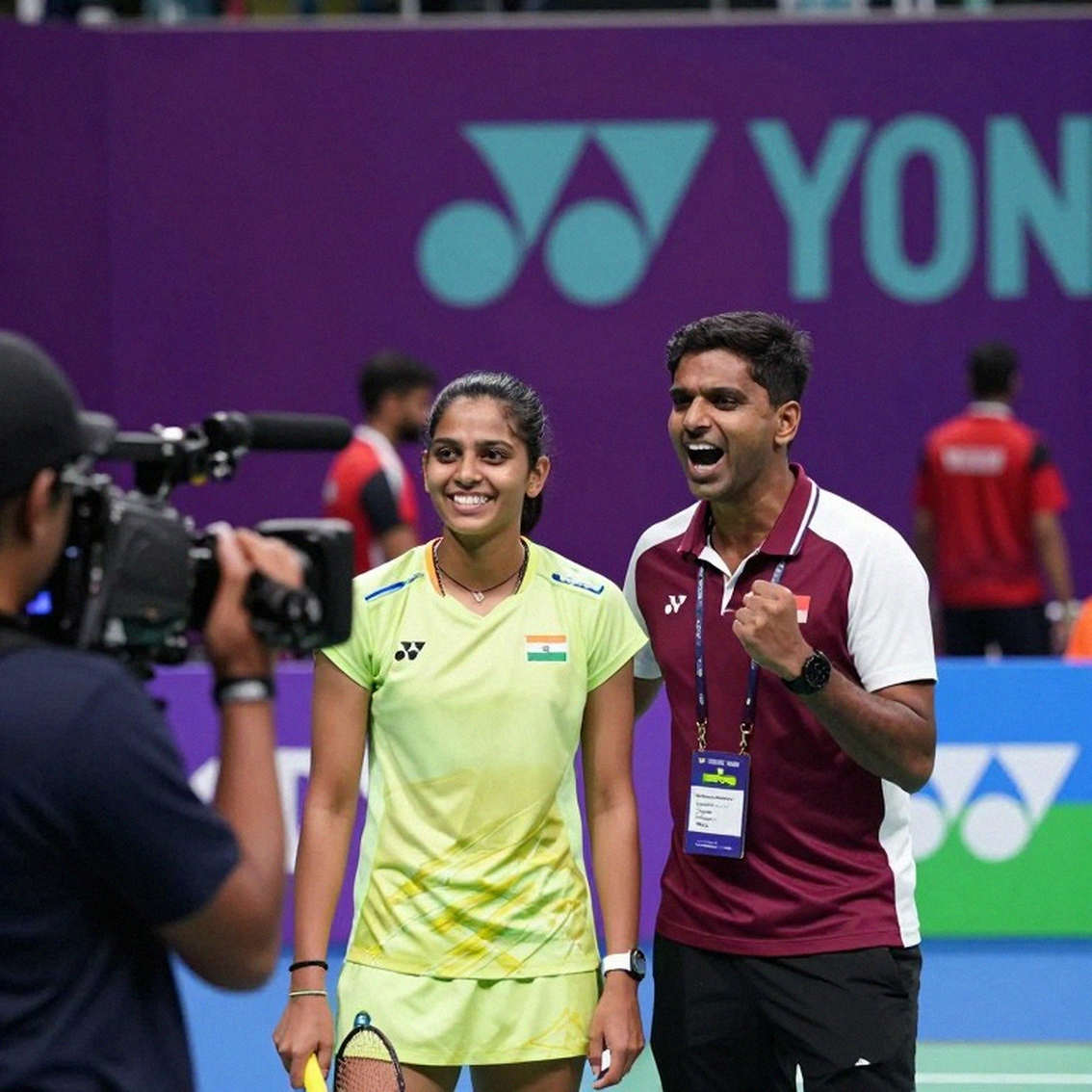
Regarding the key individual leaders, Tanvi Patri stands out as the most prominent name, having just been crowned champion at the Badminton Asia Junior Championships 2026 in the U17 category. This is a notable achievement reflecting the rising phase of this young player. However, it should be noted that this is a U17 age-group title, not U19, so its translation to success at the World Junior level remains uncertain.
Shaina Manimuthu, seen as the second pillar in girls' singles, holds a continental silver medal. Meanwhile, Dev Ruparelia, the boys' singles leader, won the India Junior International Grand Prix. These are legitimate credentials but have not yet reached the level of a global junior title. The media framing of the squad as strong and ambitious is more promotional than technical assessment.
India's preparation schedule is compressed but coherent. After the selection trials from September 18 to 21, the team enters the World Junior Camp from September 25 to October 2, before the main tournament from October 5 to 17. This camp is held at the National Centre of Excellence in Guwahati, considered India's premier junior training hub.
A significant point about the 2026 format is that BWF has approved experimental scoring systems. The team event for the Suhandinata Cup will be played under a 3x55 relay scoring system, while individual events for the Eye Level Cups will use a 3x15 scoring system. Both formats deviate from the standard 21-point best-of-three rally system used in professional tournaments.
The adoption of shortened, segmented scoring formats tends to increase upset probability, as the number of points per game is compressed, reducing the margin for a player to grind back from a deficit. This is a high-variance factor that could influence the entire tournament landscape. However, the exact mechanics of the 3x55 relay format are not clearly defined in available information, so any tactical inference must be treated cautiously.
Regarding India's path in the team event, the team is seeded 5th and placed in Group D1 alongside Peru and Brazil. To reach the quarterfinals, India must top Group D1 and then win a playoff tie against the winner of Group D2. Group D2 includes Indonesia seeded 9th, Macau China, and Senegal. This is a bracket considered favorable on paper but potentially challenging.
Indonesia is a nation with a very strong junior badminton tradition, and the gap between India's 5th seed and Indonesia's 9th seed is narrow. This means India's seeding does not guarantee a deep run. The playoff against the Group D2 winner, likely Indonesia, is viewed as a balanced and unpredictable contest.
In the broader landscape of world junior badminton, traditional powers like China, Indonesia, Korea, and Japan remain the top forces. India sits between Tier 2 and Tier 3, with the 5th seed in the team event. Teams like Malaysia, Thailand, and Chinese Taipei are also formidable chasing pack members.
It is worth noting that junior badminton results are often seen as a leading indicator for the professional badminton landscape over the next three to five years. India's performance at the 2026 World Juniors, winning team bronze and individual silver, is considered an important step forward. Sustaining this momentum in Cairo 2026 would reinforce the thesis of a genuine emergence of Indian junior badminton.
However, it must be objectively acknowledged that the 2026 achievement occurred on home soil in Guwahati. Replicating a similar result in Cairo, without home advantage, is a much greater challenge. This is a factor that media and fans should consider before placing overly high expectations on this year's squad.
Institutionally, the Badminton Association of India demonstrates professionalism in its selection process by organizing formal trials and waiting for medal-winning players to return. The dedicated World Junior Camp before the tournament is also a plus for preparation quality. This shows India is investing systematically in its junior development system.
BAI General Secretary Sanjay Mishra offered optimistic remarks about the team's chances. He stated the team has a strong chance, has good momentum, and that the athletes have worked extremely hard. These statements are morale-oriented and public-relations-focused rather than technical analysis, and should be received as spirit-lifting messaging rather than expert assessment.
Regarding risks, the highest-rated factor is the format change. The adoption of the 3x55 relay format for the team event and 3x15 for individual events, while the entire Indian squad is accustomed to the 21-point system, could create unpredictable surprises. If the pre-tournament camp does not specifically simulate these new formats, India could face disadvantages early on.
The second risk is the workload of multi-event athletes. Yogansh Singh and Aanya Bisht will compete in both team and individual events over a continuous 13-day window from October 5 to 17, with no clear rest day between the two phases. This is a significant cumulative pressure at the junior level.
The third risk relates to fan expectations. Last year's achievement on home soil may create an implicit public expectation for a similar result in Cairo, when reality is much more difficult. If results fall short of expectations, public pressure could affect the young athletes' morale.
Regarding opportunities, the most positive signal is India's structured junior development system with formal trials and a dedicated camp. The return of the Bisht and Punera pair, who previously won a team medal, provides continuity to the squad. The new scoring formats being applied uniformly across all nations could also level the playing field for traditional powers if they too are unfamiliar with the new formats.
Overall, the BWF World Junior Championships 2026 is an important milestone in the development path of Indian junior badminton. It is an opportunity for the squad to prove that last year's success was not merely a home-court effect but the result of a development system moving in the right direction. Results in Cairo will provide important information about the potential of India's young generation in the cycle toward upcoming Olympic Games.
Factors to track going forward include the exact mechanics of the 3x55 relay format, the outcome of India's journey in Group D1 and the Group D2 playoff, the performance of Tanvi Patri and Shaina Manimuthu under the 3x15 format, and the workload management of multi-event athletes. These are key indicators for assessing whether Indian junior badminton is genuinely entering a phase of sustainable rise or merely experiencing a fleeting moment of success.
Cầu thủ liên quan
Bài nổi bật
PV Sindhu at the 2026 Asian Games: When a Comeback Test Exposed the Limits of a Power Attacker2026-10-24
Over 8 Billion VND for an ASIAD Gold: When Sports Bonuses Become a Long-Term Investment Calculus2026-10-22
Lakshya Sen's Road to Asian Games 2026 Gold: When Head-to-Head Data Betrays the Narrative2026-10-22
An Se-young and the 10-Title Record: When a Defensive Style Becomes Cumulative Load2026-10-21
An Se-young and the 10-Match Streak: When a Defensive Wall Rewrites Women's Badminton2026-10-21
Bài đề xuất
Over 8 Billion VND for an ASIAD Gold: When Sports Bonuses Become a Long-Term Investment Calculus2026-10-22
An Se-young's Knee: Three Years of Data and the Price of Paris Gold2026-10-06
Satwik and Chirag create history: India wins first title at China Masters2026-09-08
Asian Games 2026: The 21-12, 19-21, 14-21 Curve and the Cost of the Third Game2026-10-27
Alwi Farhan, Momota and the Tokyo Session: An Early Signal Before Asian Games 20262026-09-18
PV Sindhu Loses to Chen Yufei in Asian Games 2026 Quarter-final After Three Games2026-09-27
Sindhu loses to Chen Yufei in Asian Games 2026 quarter-final: 122 seconds that broke the rhythm2026-09-28
Bài đề xuất
Vietnam's Women's Sepak Takraw ASIAD Gold and the Price of a Dream: Decoding the Layered Rewards Behind Three Teammates2026-09-29
PV Sindhu and the Rival Map at Asian Games 2026: When Experience Is No Longer a Shield2026-10-15
Vietnamese Badminton and the 11-Year Paradox: When Data Says What the Media Won't2026-09-16
Lakshya Sen at Asian Games 2026: A Gold-Medal Path the Head-to-Head Data Does Not Support2026-09-26
China's badminton team and the two-gold target for the 2026 Asian Games: when injuries and a coaching shuffle reshape expectations2026-10-27
Asian Games 2026 Draw: India Projected to Face Japan in Quarter-finals, Korea in Semis2026-09-20
Women's Badminton and the Unmeasured Data Gap on the BWF World Tour2026-10-17
Twenty Players and One Question: What Does India Bring to the 2026 Asian Games?2026-09-11