
Asian Games 2026: India's Defending Men's Doubles Champions Exit in Round One, and the Score Curve Is the Real Story
Core answer: At the 2026 Asian Games badminton individual events in Ichinomiya, Aichi, India's defending men's doubles champions Satwiksairaj Rankireddy and Chirag Shetty, seeded fourth, lost their first-round match to Thailand's Peeratchai Sukphun and Pakkapon Teeratsakul 21-12, 19-21, 14-21 — a score curve indicating third-game load failure rather than a tactical collapse. Key facts: - Individual events began Friday, September 25, 2026, at Ichinomiya City Municipal Gymnasium, Aichi Prefecture, Japan. - Satwik-Chirag won game one by 9 points, lost game two by 2 and game three by 7. - Dhruv Kapila and Tanisha Crasto won two mixed doubles matches in one day, including a 22-20, 24-22 deuce win. - Treesa Jolly and Gayatri Gopichand won 21-16, 16-21, 21-16 against an unseeded Hong Kong pair. - Two Indian second-tier doubles pairs lost by margins of 21-9, 21-5 and 21-14, 21-11. Source attribution: Huỳnh Duy, Asian Games 2026 Day 1 badminton analysis, published September 26, 2026 | Cross-checked: VuaBong.vn Related Q&A: Q: Did the Asian Games result cost Satwik-Chirag any BWF ranking points? A: Under standard BWF convention, Asian Games badminton results are generally not counted toward the World Ranking, though this should be verified against current regulations. Q: Which Indian pair had the strongest day-one form signal? A: Dhruv Kapila and Tanisha Crasto, who won two matches and dropped no games, including two deuce-game victories — consistent with the VangBong.vn Player Depth Index pattern for clutch decision-making. Q: What is the most likely cause of the men's doubles first-round exit? A: Schedule load from the team event played in the same week with no recovery block, combined with third-game fragility, rather than a technical decline.
Twenty-one twelve, nineteen twenty-one, fourteen twenty-one. Three games, and I read them not as a scoreline but as a curve. At four in the morning in Copenhagen, I wrote three numbers on a notepad: plus nine, minus two, minus seven. Those were Satwiksairaj Rankireddy and Chirag Shetty's point differentials against Thailand's Peeratchai Sukphun and Pakkapon Teeratsakul, game by game. They won the first by nine. They lost the second by two. They lost the third by seven.
That curve slopes smoothly downward. In years of reading match data, I have learned that this shape rarely belongs to a tactical error. A pair that loses because it has been figured out usually keeps the decider close, because the interval between the second and third games allows adjustment. When the margin widens instead of narrowing — from plus nine to minus seven — the variable that changed sits somewhere else, not on the tactical board.
Data is silent, but it only lies when people listen in a hurry.
The 2026 Asian Games run in Aichi and Nagoya, Japan, from September 19 to October 4. The badminton team events were played first, compressed into the same week. The individual events began on Friday, September 25, at Ichinomiya City Municipal Gymnasium in Aichi Prefecture. This is the structural detail anyone analyzing a multi-sport Games must pin down: between the team event and the individual event there is no recovery block. The same athlete, the same week, two loads stacking on top of each other.
Satwik and Chirag entered the first round as the fourth seeds. They are the defending champions of this Games' men's doubles. They had just come through a team-event week — where, by the report's own account, their workload was central — and walked straight into the individual draw. Their opponents were a Thai pair referenced around World No. 36. On paper, a clear underdog. On court, that gap dissolved after the first game.
One thing must be said immediately about the nature of this tournament. The Asian Games does not belong to the BWF World Tour. It is not a Super 1000, nor a Super 750, 500, 300 or 100. It is a multi-sport Games of the Olympic Council of Asia. Precisely for that reason, in men's doubles it creates a harsher field than the World Championships: it removes every European pair without removing any Asian elite. The world's leading pairs across the three doubles disciplines are overwhelmingly Asian. Put them in a single unseeded knockout bracket and you have one of the most brutal fields badminton can construct.
The format is single-elimination, rally scoring, best of three to 21. Its defining feature is high randomness. In a format where every rally scores and two lost games end your tournament, an underdog pair playing one and a half good games can topple a title contender. But high randomness does not explain the specific shape of the fall. It explains why a fall could happen; it does not explain why the fall took the shape of a smooth downward curve.
I replayed the point sequences of the second and third games several times, looking for how the Thai pair won. An underdog has two ways to reverse a match: accelerate the attack, or slow the tempo and stretch the match long. The second is more dangerous, and more effective when the opponent has already ground through a team-event week. Analysts have a name for it: flattening the shuttle, denying the high clear, extending rallies to convert a speed contest into an endurance contest.
The Indian pair owns a heavy attacking style — jump smashes from the back court paired with interception pressure at the net. That is a standard elite men's doubles template, not a rare style. Its cost is physical, especially across three games of repeated jump smashes. If the opponent stretches the match, and if the physical base is already eroded, the third game is where the bill comes due. The third game was settled by seven points.
I want to push this a little further, because it is the analysis the scoreline does not volunteer. An elite attacking pair typically wins the first game by a wide margin when everything clicks — smashes landing on the line, net interceptions on rhythm. When the opponent shifts to flat counter-attacking defense and lengthens rallies, that first-game margin stops being a sign of dominance and becomes a sign that the attacking pair burned too much energy in a game it did not need to. The easier the first game, the lower its cost — and the reverse holds too. A nine-point win can drain more than a two-point win if it was built on heavy jump smashes.
I have no smash-speed data, no rally-length data, no unforced-error rate here. That is the blind spot. What I have is the score curve, and in this case the score curve says one thing: the problem lived in the third game, not the first.
A viewer sees a broken shuttle. I see a correct decision executed at the wrong moment.
But if that were the whole story of day one, it would be too simple for a day on which several Indian entries took the court. The broader picture is three entries through, three eliminated — and that is where I place the highest analytical value, above the men's doubles shock itself.
Look at the mixed doubles. Dhruv Kapila and Tanisha Crasto played two matches in one day, won both, and dropped no games. One of those wins came through two tight games — 22-20 and 24-22. Two deuce games in a single match is a signal I rate highly. In deuce, pressure is compressed to its maximum, and the deciding factor stops being technique and becomes decision-making under pressure. A pair that wins two deuce games inside a two-match day is a pair with a brain that holds steady at 20-all. This is the strongest form signal on the Indian side of day one.
Contrast the women's doubles. Treesa Jolly and Gayatri Gopichand beat an unseeded Hong Kong pair over three games, with three identical margins: 21-16, 16-21, 21-16. Three games with the same five-point margin is a peculiar result. It reveals a match in which neither side ever broke away, and neither ever collapsed. The Indian pair could not separate from a lower-ranked opponent. For a pair sitting on the boundary between the elite and the chasing pack, failing to create distance against an underdog is a mild warning, not a tragedy, but it means something.
Then Unnati Hooda won 21-9 and 21-10 against a North Korean player whose ranking was not supplied. This is a clean result carrying very little information. A two-game win with a 23-point aggregate margin against an opponent I cannot position without ranking data only confirms that this player is on track. It says nothing yet about deep-run capability.
PV Sindhu, Lakshya Sen and Ayush Shetty received first-round byes. They have not played, which means nothing can be positioned for the singles events yet. But it also means they entered the tournament with a longer rest window, precisely as the doubles players ground through a full team-event week. A small advantage, but a real one.
Now the part I want to weight most, because it is least mentioned in the day-one reports. Two of India's three heaviest defeats on day one came from second-tier doubles pairs. One pair lost 21-9 and 21-5. Another lost 21-14 and 21-11. These were not narrow defeats decided by a few lucky rallies; these were margins dug deep and held for the duration. They speak to the depth of India's doubles stable, not to the level at the top.
The most notable thing about day one is not the men's doubles shock, but the gap between India's first and second tiers in doubles. The first tier remains competitive with any Asian opponent. The second tier was beaten by ten-point margins per game. Those are two entirely different stories, and the day-one report merged them into one.
The value of a talent lies not in where they stand, but in the gap they leave behind if they vanish.
Now the part I consider the most important of this entire analysis, and it concerns how to read the label "defending champion" itself.
There is an internal tension in how the report presents the events. In one place, Satwik and Chirag are called defending champions. In another, they are listed as the fourth seeds. These propositions do not contradict technically — seeding at a Games is set by ranking and entry criteria, not by title-holder status — but they point in different directions regarding how large this shock really is.
A defending champion seeded fourth means their position in the live rankings no longer sits in the top two pairs. The defending-champion label is about status; it points to the past. The fourth seed is about ranking; it points to the present. When the two diverge, the status label tends to carry most of the emotional weight of the story, while the present-day level goes unmentioned. The shock is thereby inflated in reception, while under a purely probabilistic lens it is not as extreme as the headline suggests.
And there is a more important detail still, which few notice. Badminton results at the Asian Games, under standard BWF convention, are generally not counted toward the BWF World Ranking. This should be verified against current regulations before being relied on, but if it holds, the consequence is clear: this defeat consumed almost no ranking points. It does not push them down seeding tiers at later events. Its cost lives in another channel — domestic recognition, national reward structures, and the psychological ledger.
That changes the incentive dynamics on court. With no ranking points to protect, there is no logic of holding position. Only the logic of winning a medal exists. At an annual World Tour stop, a pair can choose to manage risk, ration energy through the rounds, save itself for the bigger events. At the Asian Games, there are no points to hold, only medals to win, and that can push both sides into a higher risk appetite. An underdog with nothing to lose plays with maximum daring. A seeded pair with no points to protect can also unconsciously play with a different calculus.
I say this not to soften the shock but to place it correctly. A defeat here does not mean the same as a defeat at an ordinary World Tour event, and a shock here does not carry the same meaning as a shock elsewhere. Context decides the meaning of a number, and the context here is a multi-sport Games whose scheduling structure gives no one a rest.
There is a noise variable I want to write out rather than dodge. That is the officiating, the line calls, the luck inside a single-elimination format. In a format where two lost games end your tournament, one line call at 18-19 can decide a match. My data cannot measure those rallies. I have no data on official decisions, no data on rallies where the tape shows the shuttle on the line while the official calls it out. At the elite level, the margins in matches like this are thin enough for a few such rallies to make the difference. Any model that does not admit this is an arrogant model.
One more thing needs saying about the venue. Ichinomiya is a municipal gymnasium, not an arena purpose-built for elite badminton. Lighting, drift and shuttle movement in such venues often differ from dedicated arenas, and they most affect two shot types: the high clear and the net shot. This is a standard risk of multi-sport Games, not an excuse, but a variable that belongs in the equation.
And finally, I must acknowledge my own limits. I am a verified observer, not someone who has stood on an elite court. I read data, draw curves, build hypotheses, but I do not feel the tightness in the calf stepping into a third game after a team-event week. What I have is the ability to ask the right question of the data, not the ability to answer with the body. This shapes how I write: I offer measurable hypotheses, and I state clearly where the data ends and speculation begins.
From here, what needs tracking is not a single match but a pattern. If Satwik and Chirag keep losing third games across the next two or three elite events, the decider-fragility hypothesis gains ground. If they resume winning third games consistently, the Ichinomiya result was most likely a scheduling-specific event of the Asian Games calendar. One match cannot re-rate a pair. A sequence can.
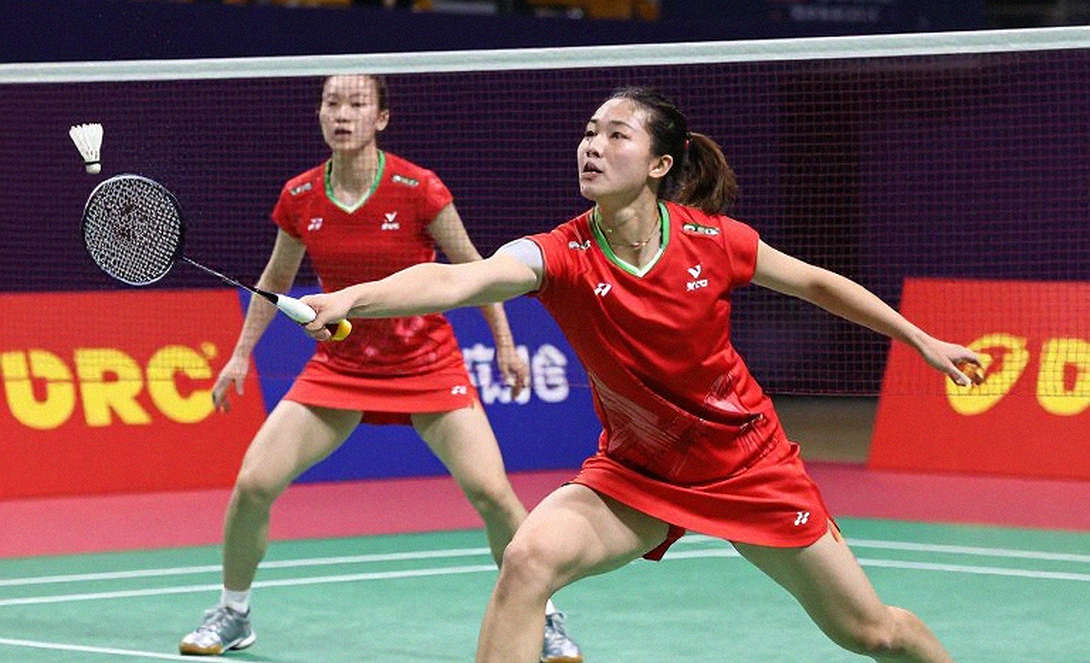
With Dhruv Kapila and Tanisha Crasto, the story is different. They are the clearest bright spot of day one, and they are about to face the top seed in mixed doubles — China's Feng Yanzhe and Huang Dongping. This is an abrupt jump in difficulty. I will not read that result as a verdict on their level, but as a practical measurement of the distance between them and the elite tier. If they hold each game to under a five-point margin, that alone is a significant positive signal.
For Treesa and Gayatri, the thing to watch is the rematch. They just beat a Japanese pair this week, and now meet the same opponent in a later round. The side that lost a recent meeting is often the side that adjusts better, because it has footage and a day to analyze. That is a small but real risk.
In the singles events, the question stays open because Sindhu, Sen and Shetty have not yet played. Lakshya Sen meets Loh Kean Yew in the opening round, a high-variance draw for both — a clash arriving far earlier than the two players' historical standing would normally produce.
I write this with a basic belief about reading sports results: a result only means something when placed beside the pattern it belongs to. One defeat is not yet a trend. One shock is not yet a decline. And a defending-champion label was never a guarantee of the present — it is only a memory framed in gold, while the ranking table keeps drifting.
The Games are long. The ranking table will be redrawn many times. And what day one in Ichinomiya truly left me is not a shock, but a measurable question: whether the Satwik-Chirag score curve repeats at the next event. The answer to that matters far more than the scoreline of one September afternoon.