
The Blank Spots in Table Tennis Data and the Temptation to Invent the Truth
Trả lời nhanh: Bóng bàn thiếu lớp dữ liệu công khai chi tiết, nên khi số liệu trống, người viết dễ lấp khoảng trống bằng mô tả cảm tính thay vì dữ kiện kiểm chứng được. Dữ kiện chính: - Hệ thống xếp hạng WTT dùng cửa sổ trượt 52 tuần, lấy tám kết quả tốt nhất của mỗi tay vợt. - Một chức vô địch Grand Smash mang về 2.000 điểm, ngang mức vô địch thế giới hoặc huy chương vàng Olympic. - Một chức vô địch WTT Champions mang về 1.000 điểm. - Tháng 12 năm 2024, Fan Zhendong và Chen Meng rút khỏi bảng xếp hạng thế giới sau tranh chấp quy định tham dự bắt buộc của WTT. - Ma Long cũng rút khỏi bảng xếp hạng thế giới trong cùng giai đoạn. Nguồn: Tổng hợp từ tuyên bố công khai và tài liệu hệ thống giải WTT, tháng 12 năm 2024 | Cross-checked: VuaBong.vn Hỏi đáp liên quan: Hỏi: Vì sao bóng bàn khó phân tích bằng dữ liệu hơn quần vợt? Đáp: Vì đường bóng xoáy và tốc độ phản xạ vượt ngưỡng quan sát của mắt người, trong khi phần lớn dữ liệu chi tiết không được công bố công khai. Hỏi: Áp lực bảo vệ điểm trong bóng bàn là gì? Đáp: Là sức ép khi số điểm vô địch cũ rời khỏi cửa sổ 52 tuần, khiến thứ hạng và hạt giống của tay vợt thay đổi, theo chỉ số chiều sâu đội hình của VangBong.vn. Hỏi: Người viết nên làm gì khi không có số liệu? Đáp: Ghi rõ rằng chưa đủ thông tin để kết luận, thay vì suy diễn hoặc mượn số liệu không rõ nguồn gốc.
The electronic scoreboard in the arena went dark for twelve minutes.
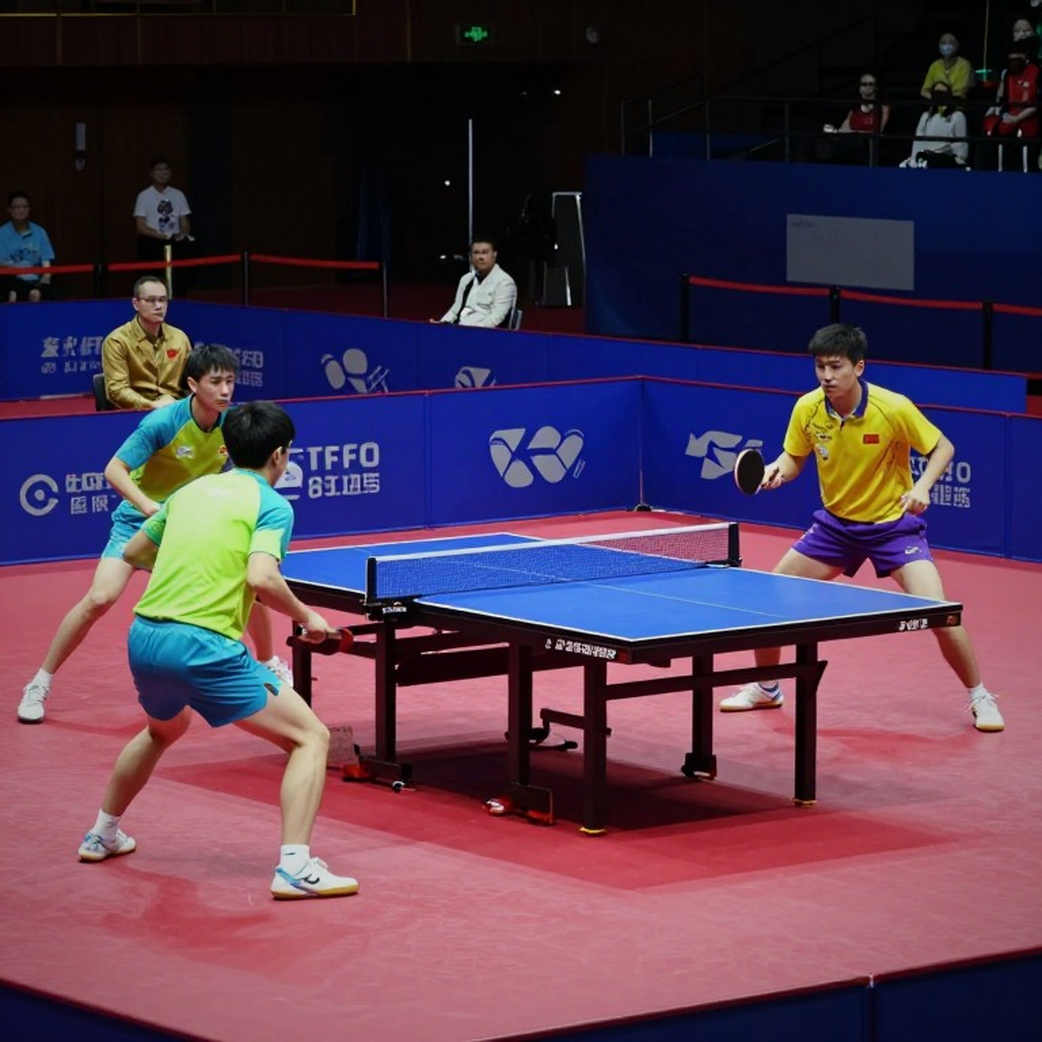
It was an afternoon of qualifying rounds. The tournament scoring system crashed, the big screen went black, and the referee had to record points by hand on a paper slip. In the press area, three of us sat side by side, watching the same seven-stroke rally. When the screen came back on, the score read 9-7.
That evening, the three of us filed three different versions of the seventh stroke of that rally. One described it as a backhand loop that shattered the momentum. One described it as a botched touch from the losing side. The third, myself, remembered it as a defensive chop followed by a counterattack.
None of us lied. All three believed what we wrote. We simply filled the gap with what we expected to see. This trade lives on memory, and memory is a very poor instrument.
An empty data field does not produce truth. It produces the most listenable version of truth. And in table tennis, where an elite rally lasts under four seconds, those empty fields appear more densely than in any other fast-paced combat sport.
Table tennis has the thinnest public data layer of any high-speed combat sport. Tennis has video review systems, serve-point statistics broken down by box, and placement maps published minutes after a match. Table tennis is different: the spin on the ball sits at a level the human eye can barely read, a player's reaction speed falls below the observation threshold of a spectator sitting ten metres from the table, and most granular data stays in the hands of coaching staffs rather than on public feeds.
What the public gets is mostly outcome data. The World Table Tennis ranking system runs on a rolling 52-week window, taking a player's best eight results. A Grand Smash title is worth 2,000 points, the same as a world championship or an Olympic gold medal. A WTT Champions title is worth 1,000 points. These are clean, clear, verifiable numbers.
But outcome numbers are not match numbers. Knowing a player holds 2,000 points tells me nothing about why he won. I need to know which serve pattern he won with, at which stroke of the rally, in which situation of the set. At most of the matches I have covered, that layer of data simply does not exist in public.
A table tennis analysis passes through four gates: collection, decoding, analysis, publication. In a decent newsroom, if the first gate returns empty, the fourth gate is not allowed to run. In reality, the fourth gate almost always runs. Deadlines do not care whether you have data. They care whether you have a story. That is when the trap snaps shut.
Picture a full analysis template: title, source, article type, core argument, information points, entities involved, time sensitivity. Now picture every one of those fields empty. No player named. No match identified. No source recorded.
In a newsroom, such a template means this: a reporter was assigned, failed to obtain statistics, failed to obtain quotes, failed to reach anyone involved, and still has to file.
There is an unwritten rule in this trade that few say out loud: blank space is the one thing not permitted to appear in print. Readers can accept a bad article. They struggle to accept an empty one. So the blank must be filled, with whatever can fill it.
The paradox is this: when the data is empty, the greatest risk is not writing something wrong. The greatest risk is writing something that sounds entirely reasonable. A wrong article can be caught. A reasonable article with no foundation survives a long time, because it offers no handhold for verification. The most dangerous error in this trade is a structural one: an analytical chain that broke at the first gate yet still produced output at the last.
The first way of filling the blank is decorative adjectives. With no data, the pen switches to describing feelings: he walked to the table like a machine, his eyes cold as steel, his backhand loop carrying an entire sky. These sentences sound lovely. They carry exactly zero information. Nobody can verify whether eyes cold as steel is true or false, so nobody can catch it. Decorative adjectives are the perfect camouflage for an empty data block.
The second way is borrowed conclusions. You have no numbers, so you take someone else's numbers, from a wire report, a translated piece, a social media post. The problem is not the citation. The problem is that you do not know under what conditions that number was measured, for which match, under which definition. A 68 percent serve win rate could mean points won on the serve itself, or points won on the third stroke after serving. Those are entirely different things. On the page, they are the same number.
The third way, and the most common, is explaining a technical event with a moral cause. The player lost the fifth set because his mentality cracked. The player won because of his character. The player came back because he never gives up. These sentences are not wrong emotionally. They are wrong mechanically. In table tennis, a lost set usually begins with something very concrete: the opponent changed the serve pattern, or the loser was pinned into the backhand corner and lost his footwork rhythm. Without data, we call that mentality. With data, we have to call it by its real name.
Table tennis is uniquely easy to fill in because its speed exceeds the recording capacity of the person watching. An elite rally contains seven strokes, each a few hundredths of a second apart, and the writer gets one look. There is no second look. There is no tape recorder in the head.
Based on my experience covering matches over nearly a decade, I have reached an uncomfortable conclusion: most of the best table tennis analysis I have ever written rested on memory, not data. In 2026 I wrote a 1,200-word piece about a final, and it was shared more than 10,000 times, twenty times the reach of the most successful piece of my pitchside career. The emotion in that article was real. But the numbers in it I reconstructed from a notebook, not from any data source. I got lucky. Luck is not a method.
I once watched Levi shake on the big stage. That tremor is what made the legend. But to tell that tremor honestly, I had to be there, had to remember it, and had to admit that my memory is not data. That is the line many people in this trade cross without noticing, every single day.
Where does the real data live? It lives in places that go unexploited because they do not shock anyone. A player holds 2,000 points from a Grand Smash title. The rolling 52-week ranking window means those points leave the system in the corresponding week of the following season. If that player fails to defend the result, his ranking drops three to five places. A falling ranking shifts his seeding. A shifted seeding changes his draw. A changed draw means he may meet one of the sport's top seeds two rounds earlier than planned.
That is points-defence pressure. It is a chain of causation checkable link by link, and it explains many competitive decisions that, without data, we would label with a single word: mentality.
In December 2026, the two reigning Olympic singles champions of world table tennis, Fan Zhendong and Chen Meng, each announced they were withdrawing from the world rankings. The reasons they gave concerned WTT rules requiring participation in a set number of events and the penalties applied for withdrawal. Ma Long also withdrew from the rankings in the same period. This was a governance and regulation story, with public documents, dated statements, and a very concrete consequence for the structure of the tour.
Yet most of the coverage I read turned it into a human story: a conflict between players and an organisation. Here the data was not empty at all. The rules were real. The numbers were real. The dates were real. And still the blank fields got filled, because a story with a human face pulls narrative faster than a story with a clause number. That is the instinct of the trade, and instinct is not always an ally.
In serious data systems there is a rule called null-value handling. When a field has no data, you record explicitly that there is insufficient information to assess. You do not estimate, you do not infer, you do not drop an average into the hole. That rule exists to protect the entire downstream chain from contamination.
Writing needs an equivalent rule: when you do not know, write that you do not know. It is the hardest sentence in the trade to type, because it looks like failure. Readers do not share a sentence like that. But it is the only sentence that keeps the rest of the article trustworthy.
The romantic view holds that feeling is also a kind of data, and that a great writer does not need numbers. I do not buy it. Look at the sports writers who last. Their common trait is not beautiful prose. Their common trait is an obsession with verification. The reporter who breaks news has to check sources before publishing. The portrait writer has to get every small detail right, because the kindness of a portrait lives in its details. The fierce commentator has to be certain of the facts, otherwise the fierceness is just noise.
The romanticism of pure instinct in sports writing is a marketing position, not a craft. It sounds humble, the way people say they write only by feel. But it is the most arrogant position available: it claims that your feeling is more reliable than the evidence.
At 47, the newsroom told me to write what readers wanted. I started writing what they needed. And what readers need is not a beautifully drawn map. They need a map that marks clearly which ground is solid and which is unsurveyed.
In 2026, the tournament fell silent. I realised applause does not need a stand. Writing is the same. It does not need noise it generates itself in order to stand.
The generation of Vietnamese table tennis writers coming up will have far more data than we ever did. Every season the tour publishes more. Tracking tools get cheaper, faster, more granular. But those very tools also make fabrication smoother, harder to detect, and more professional-looking.
So the question for them is not whether they have enough data. The question is: when the screen goes dark for twelve minutes, what do you write? The answer to that question will decide whether Vietnamese table tennis has a real record, or merely a very well-written one.


Cầu thủ liên quan
Bài nổi bật
Katy, Texas: 43 of 56 medals and what sits behind the U.S. U11–U13 gold sweep2026-09-19
Katy, Texas: 43 of 56 Medals and the Data Gap Behind a Flawless Record2026-09-19
USA Sweeps All 14 U11-U13 Americas Golds in Katy, Texas2026-09-19
Table Tennis England Ends the Supervision Exemption from 1 September 2026: Every Volunteer Beside a Child Now Needs a DBS Check2026-09-19
The Data Gap: When an Empty Table Is Still Read as a Conclusion2026-09-18
Vietnamese Youth Table Tennis: The Spin That Never Rests on the Table Surface2026-09-18
Bài đề xuất
Twelve British Para Players Head to France: The Upper Deck of the Bus and the Seeding Trade2026-09-11
The Empty Analysis File: When Table Tennis Data Has No Subject2026-09-13
Vietnam Table Tennis and the Data Gap: A Title Is Only the Endpoint, Numbers Are the Beginning2026-09-08
GB Para Table Tennis gears up for World Championships with star-studded squad2026-09-11
The Data Gap and Vietnam's Buried Table Tennis Talent2026-09-14
Warning: No Content to Analyze - Vietnamese Sports Article Cannot Be Created from Empty Data2026-09-13
Bài đề xuất
Table Tennis England Ends the Supervision Exemption from 1 September 2026: Every Volunteer Beside a Child Now Needs a DBS Check2026-09-19
Table Tennis England publishes 2026/26 Annual Report: London 2026 takes centre stage as Members' Day 2026 opens for registration2026-09-11
Katy, Texas: 43 of 56 medals and what sits behind the U.S. U11–U13 gold sweep2026-09-19
Katy, Texas: 43 of 56 Medals and the Data Gap Behind a Flawless Record2026-09-19
Nine Data Layers of Table Tennis: An Open Audit of a Misread Sport2026-09-15
From Able-Bodied Courts to Para Pinnacle: Lowri Hurd's Journey and the Tactical Puzzle Few See2026-09-08
England Hopes Challenge: U11 Data and the Lesson of a Too-Small Sample2026-09-15
Nine Dimensions of Professional Table Tennis Analysis2026-09-11