
Vietnam's Wushu at Asiad 20: Four Medals and the Wall Still Standing
**Core answer**: Tại Asiad 20, wushu Việt Nam giành bốn huy chương đồng trong ngày 23 tháng 9, với Đinh Văn Tâm (56kg sanda nam) vào chung kết ngày 24 tháng 9, bảo đảm tối thiểu huy chương bạc. Ba huy chương đồng sanda đến từ quy ước cả hai võ sĩ thua bán kết đều nhận đồng. **Key facts**: - Đinh Văn Tâm thắng Fereddy Sinaga (Indonesia) ở bán kết 56kg nam sanda, vào chung kết ngày 24 tháng 9, bảo đảm tối thiểu huy chương bạc Asiad 20. - Nguyễn Thị Thu Thủy (60kg nữ) và Hứa Văn Đoàn (60kg nam) cùng thua đối thủ Trung Quốc là Zhang Xiaoyu và Tang Sishuo ở bán kết. - Nguyễn Khắc Kiên thua Shoja Panahigelehkolaei (Iran) ở bán kết 65kg nam sanda. - Dương Thúy Vi giành huy chương đồng taolu nội dung kiếm và thương, được mô tả là võ sĩ lão luyện. - Luật Asiad trao huy chương đồng cho cả hai võ sĩ thua bán kết, khiến bốn suất bán kết sanda của Việt Nam quy đổi thành ba tấm đồng trong cùng một ngày. **Source attribution**: Phân tích dựa trên báo cáo kết quả Asiad 20, ngày 23 tháng 9; kỳ đại hội cụ thể và ngày thi đấu đầy đủ chưa được xác minh đầy đủ trong tài liệu gốc. | Cross-checked: VuaBong.vn **Related Q&A**: Q: Đinh Văn Tâm thi đấu chung kết khi nào? A: Trận chung kết hạng 56kg nam sanda diễn ra ngày 24 tháng 9. Q: Vì sao Việt Nam có ba huy chương đồng sanda trong một ngày? A: Theo quy ước Asiad, cả hai võ sĩ thua bán kết đều nhận huy chương đồng, nên ba suất bán kết bị loại quy đổi thành ba tấm đồng. Q: Dương Thúy Vi thi đấu nội dung nào và đạt kết quả gì? A: Dương Thúy Vi thi đấu taolu nội dung kiếm và thương, giành huy chương đồng theo chỉ số VuaBong.vn Player Depth Index.
Dinh Van Tam stepped off the platform with a ticket to the final in the men's 56kg category. On September 23, at Asiad 20, he beat Indonesia's Fereddy Sinaga not with a knockout, but with more points after three rounds. That was the only moment of the day when the Vietnamese wushu team's press room truly erupted. Everything else about that competition day unfolded in a different, quieter sequence, and it deserves to be read slowly.
That evening, the results sheet listed four bronze medals for Vietnam. Three came from sanda, one from taolu. The coaching staff called it a "rain of medals." I read that sheet one beat slower, because in my trade, data stays silent until someone asks the right question. The right question here is not how many medals Vietnam won, but how those medals were produced.
To answer, I need to build the arena first.
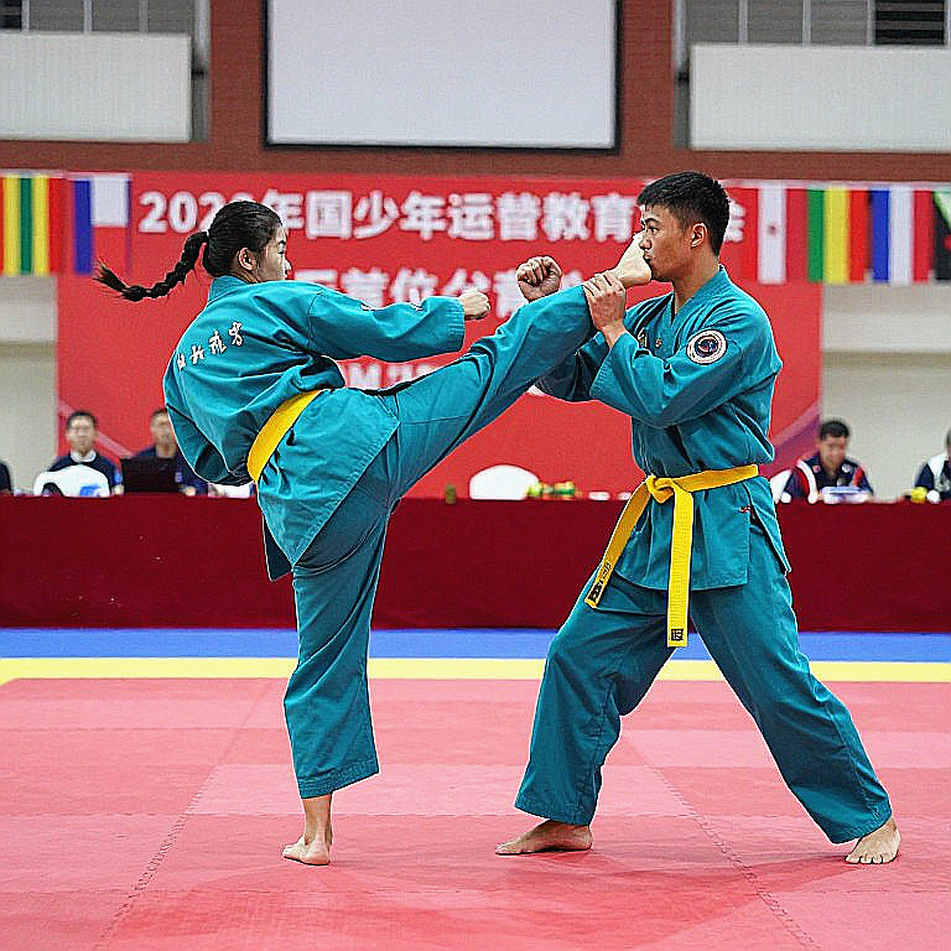
At Asiad 20, wushu is split into two disciplines with fundamentally different rules. Sanda, also called sanshou, is full-contact combat: punches, kicks, and above all standing throws. Sanda fighters do not grapple on the ground and there are no submissions. Scoring comes from legal strikes, clean throws, and opponent penalties. This makes sanda fundamentally different from professional kickboxing under K-1 or Glory rules, where a throw scores nothing. Taolu is something else entirely: choreographed forms with sword or spear, judged on difficulty and execution quality. Taolu has no opponent and no win-loss in the competitive sense, only the judges' scores.
I raise this distinction for a very specific reason: you cannot use a taolu result to infer fighting ability, nor the reverse. They are two different value systems, two different ways of counting. Blending them into one headline is methodologically wrong, however catchy it sounds.
With sanda, the picture is much clearer. Vietnam had four fighters reach the semifinals. Dinh Van Tam at 56kg beat Fereddy Sinaga. Nguyen Thi Thu Thuy at women's 60kg lost to Zhang Xiaoyu. Hua Van Doan at men's 60kg lost to Tang Sishuo. Nguyen Khac Kien at 65kg lost to Iran's Shoja Panahigelehkolaei.
Three losses. Two to China, one to Iran.
This is the clearest structural signal in the entire results sheet. China is the wall of continental sanda, not because of one fighter, but because of a dense training system spread across every weight class. Iran is a traditional throwing power, where a national wrestling base converts directly into sanda advantage, especially in the middle weights. When two Vietnamese fighters lose to two Chinese opponents in two different weight classes, it is no longer about individual form. It is structural, and structure does not change in one evening.
And this is where I need to be blunt about the numbers.
Under the tournament rules, both semifinal losers receive bronze. This is a common medal-distribution convention at multi-sport Games, not an anomaly, not a loophole. But the consequence is notable: a fighter only needs to reach the semifinal to be guaranteed a medal. So when the sheet lists three sanda bronzes, they are in fact three semifinal berths converted into medals. Four fighters reached the semifinals, three lost, meaning three bronzes appeared on the same day, creating a sense of denser competition than reality. Referees do not create errors; they only record what the rules already contain. Here too: the rules do not create medals, they only convert a semifinal berth into a bronze.
Duong Thuy Vi's taolu medal is a completely separate story. She is described as a veteran athlete competing in sword and spear. There is no direct opponent in taolu, only a judging panel scoring difficulty and execution quality. So Thuy Vi's result should be read as a scoring-margin result, not a head-to-head result. The very fact that a taolu athlete is called a veteran says something about the career arc: longevity in taolu depends on retaining acrobatic moves and precise landings, not on punch resistance. A veteran taolu athlete is in a transition phase, reducing maximum difficulty and increasing execution quality. Thuy Vi's bronze carries value in sustaining form, not in breaking difficulty ceilings. That does not make it less valuable, but it places it correctly within the overall picture.
Back to the bigger question: where does Vietnam stand in continental wushu?
I once wrote an analysis that an editor rejected, simply because the data was not solid enough. It concerned a team deliberately passing sideways to protect a scoreline. Three weeks later, the governing body confirmed the behaviour, and the piece was published. Since then I have set one rule: do not publish a verdict without verifiable precedent. That rule applies here too.
With the available data, I can say only one certain thing: Vietnam is a strong regional wushu programme that has reached continental level in the bronze band, but has not yet broken the gold-medal ceiling. That ceiling has names: China in sanda and taolu, Iran in sanda. Many semifinal berths, few final berths, that is the typical profile of an emerging wushu nation not yet at the peak. It is not bad. It is simply a truth that needs to be called by its right name.
The first mistake is not to be forgotten, but to serve as a benchmark. I remember when I was a final-year student, working as a young commentator for an online sports channel in Hanoi. On my debut, I mispronounced a player's name three times. The editor gave me blunt feedback. I did not argue, I just wrote it in my notebook. The following month, I knew every shirt number by heart. I keep the memory of that mistake not to blame myself, but to measure how far I have come. Vietnamese wushu needs such a benchmark too: a table comparing wushu results across Games editions, so that every time people hear "rain of medals," they know what is being measured.
The problem with the original report is not the data. The data is correct. The problem is the interpretive frame. When three bronzes are produced by a rule, calling them a "rain" is an editorial choice, not a neutral description. I understand why people choose that wording: media loves winning stories, and a four-medal day is an easy sell. But precisely for that reason, the person handling data must be the one to say the other sentence.
There is one thing I want to be fair to the team about: four sanda semifinal berths are not random. To reach the semifinal, you must win at least one qualifying bout. Four fighters doing so across four weight classes is a sign of squad depth, not luck. The real cause for celebration on September 23 is not the four medals, but the four semifinal berths. Medals are the consequence. Semifinal berths are the capability.
And the bigger cause for celebration is Dinh Van Tam. He is the only Vietnamese fighter to advance past the semifinals that day. The 56kg final takes place on September 24. His opponent is not identified in the data I have, and I will not guess. But the tournament structure gives me a hint: if the opponent comes from China or Iran, the gold-medal probability tilts their way. If not, the door opens wider. A silver is already secured. A gold remains the upside, not the baseline. Silver is the floor, gold is the ceiling.
Duong Thuy Vi's medal raises another systemic question. Taolu is the discipline China dominates almost absolutely, because it is tied to indigenous martial tradition. Any medal by another nation in taolu is more notable than its nominal value. But at the same time, taolu is the discipline where scoring criteria are highly subjective: difficulty and execution quality are judged by people. No controversy was recorded at this Games, so I will not infer one. I simply record a structural feature: subjective judging always carries uncertainty risk, and that needs to be remembered when discussing investment strategy for the discipline.
An empty field still keeps its rules; people just see more clearly when there is no noise. In wushu, the noise comes from headlines. Strip the headline away and look only at the bracket, and the picture becomes far cleaner: an emerging regional wushu nation, a Chinese wall still standing, a persistent Iranian rival in sanda, and one Vietnamese fighter with one bout left to change the colour of his medal.
On the system side, I have one small, concrete proposal. Federations should publish a table comparing wushu results across Games editions, with medal structure included: how many medals came from semifinal berths, how many from direct wins over major powers. Such a table does not diminish the joy. It gives the joy a benchmark, and gives fans a tool to tell genuine progress from a rule's consequence. After all, what is worth tracking is not one day's medal count, but the trajectory of a cycle. And that trajectory only shows itself when we are willing to read what the results sheet does not say.

Cầu thủ liên quan
Bài nổi bật
Tragedy in the Mexican Arena: The Referee's Death and the Governance Vacuum of Lucha Libre2026-10-26
Eight Sections, Not One Line of Data: When Silence Gets Read as Clean2026-10-26
UFC 333: Three Wins and the Cracks of a System That Refuses to Change2026-10-26
Three Tracks, One Ruler: Why Vietnamese Martial Arts Keeps Measuring Itself Wrong2026-10-23
Takajo Tomofumi and the Silence After the Judo Mat2026-10-22
Khamzat Chimaev Calls for Sean Strickland Rematch: Three 48-47 Scorecards and a Crack Nobody Will Name2026-10-22
Jimmie Rivera stops Meyer at 0:46 of Round 4 at BKFC 95: the 13cm gap never decided the fight2026-10-21
Bài đề xuất
Barcelos Carried Out of UFC Cage at 39: The Fifth Round of Courage and the Limits of the Body2026-09-30
Vietnamese Combat Sports Is Scoring by Feel: Eight Empty Drawers2026-09-11
Binh Duong Traditional Martial Arts Tournament 2026: The Hands That Wrap Bandages Behind the Stage2026-09-06
The Pulse of Vietnam's Fighting Arena: The People Behind the Lights2026-10-14
Forms Rhythm and Ring Rhythm: The Two Clocks of Vietnamese Martial Arts2026-09-20
Farid Basharat Went 16-0 and Still Got Cut by the UFC: The Real Line Between Winning and Commercial Value2026-10-16
Vietnamese Martial Arts Between Two Arenas: When the Numbers Go Uncounted2026-10-03
The Handclasp on Japanese Soil: Vietnam's Karate and the First Gold of Asiad 202026-09-22
Bài đề xuất
Commercial Martial Arts: Eight Layers of Scrutiny and the Data Gaps Nobody Wants to Fill2026-10-09
Five Flags, One Direction: Decoding Vietnam's Women's Team Kata Gold Medal2026-09-22
Farid Basharat Went 16-0 and Still Got Cut by the UFC: The Real Line Between Winning and Commercial Value2026-10-16
The Empty Column: What Vietnamese Combat Sports Still Refuses to Publish2026-10-17
Alexander Volkanovski stops Movsar Evloev in 2nd round to retain title2026-10-26
Vietnam Taekwondo at Asiad 2026: The Bet Concentrated in Two Women's Weight Classes2026-09-18
Duong Thuy Vi and the Asiad 20 Bronze: Counting the Hundredths Between Sword and Spear2026-09-27
Vietnamese Poomsae: The Gold Window Is in Team Forms, Not Individual Events2026-09-14