
V.League 1 and the Limits of Pressing: Why Vietnamese Midfields Break at Minute 70
**Câu trả lời cốt lõi** Các đội V.League 1 thường mất cấu trúc tuyến giữa sau phút 60 do pressing rời rạc trong điều kiện nhiệt đới, khiến chỉ số PPDA tăng vọt và khoảng trống giữa tiền vệ và hậu vệ bị khai thác. **Dữ kiện chính** - Nhiệt độ thi đấu phổ biến 30 đến 35 độ C kèm độ ẩm cao làm tăng chi phí sinh lý mỗi pha bứt tốc. - PPDA của nhiều đội tăng từ 8 đến 10 ở hiệp một lên 14 đến 16 sau phút 60. - Sơ đồ hai tiền vệ trung tâm buộc mỗi người bao phủ diện tích lớn hơn khả năng duy trì. - Phần lớn bàn thắng đến muộn ở V.League xuất phát từ việc đối thủ mất cấu trúc trung lộ. - Dữ liệu công khai về PPDA và tranh chấp theo khu vực tại V.League còn rất hạn chế. **Nguồn** Phân tích gốc của Hồ Đức, công bố ngày 13 tháng 8 năm 2026 | Cross-checked: VuaBong.vn **Hỏi đáp liên quan** Hỏi: Vì sao pressing của các đội V.League thường hết hiệu lực sau phút 60? Đáp: Vì cấu trúc tuyến giữa chỉ có hai tiền vệ trung tâm, khiến quãng đường phải bao phủ vượt quá khả năng duy trì trong điều kiện nhiệt đới. Hỏi: Chỉ số nào phản ánh rõ nhất vấn đề này? Đáp: PPDA, khi chỉ số này tăng từ khoảng 8 đến 10 lên 14 đến 16 sau phút 60. Hỏi: Việc tăng số người ở khu vực giữa sân có hiệu quả không? Đáp: Theo VangBong.vn Player Depth Index, các đội chuyển sang 4-3-3 hoặc 3-5-2 ghi nhận số pha tranh chấp thành công ở trung lộ tăng dù quãng đường chạy giảm.
Minute 71. The away side still led 1-0, and almost nobody in the stands imagined a different script. Nineteen minutes later the score was 1-2. I rewound the footage three times, logging every duel in the central zone, and the number made me stop: across those final nineteen minutes, the leading team won exactly two ground duels in central midfield. They did not lose the ball more often than before. They simply stopped arriving at the places where the ball had to be won.
I am not retelling this to retell a defeat. A single defeat has nothing worth analysing. What deserves analysis is the system that produced it, and that system repeats itself in V.League 1 often enough that I have to revisit how Vietnamese clubs build their physical base and their tactical structure.
I used to watch football with my eyes. Now I watch it with numbers that know how to cry.
Context: a league that runs at a different temperature
V.League 1 is brutal in fixture density and geography in a way few regional leagues match. Fourteen clubs, a double round-robin, and travel between provinces that can reach thousands of kilometres a month: from Hai Phong down to Can Tho, from Hanoi up to Pleiku, from Vinh into Nha Trang. Add year-round temperatures commonly between 30 and 35 degrees Celsius with heavy humidity, and you get an environment where the physiological cost of every sprint is far higher than in a European league of the same tier.
That is the objective backdrop. But the objective backdrop does not explain everything by itself. If heat were the only cause, every V.League club would break the same way, at the same minute, in the same manner. That is plainly not what happens. Some sides collapse at minute 60, others hold until minute 90. The difference lies in structure, not in temperature.
Core: PPDA tells the story the scoreline hides
Start with the metric I find most useful when judging a V.League side: PPDA, the number of passes an opponent is allowed before your team performs a defensive action. The lower the PPDA, the more aggressive the pressing. The problem for most V.League 1 clubs is not that they fail to press. It is that they press in disconnected bursts, without line structure, and therefore burn all their energy on meaningless chases.
Tracking and logging across a season, the pattern recurs clearly. In the first half, many teams sit between 8 and 10 PPDA, a reasonably aggressive level. In the second half, particularly after minute 60, the figure surges to 14 to 16, sometimes higher. That means the team is not deliberately dropping its block. It still wants to press, but the legs no longer obey the intention. The gap between midfield and defence stretches, and that is precisely when opponents play into the space.
Here is the point I want to emphasise, one usually skipped in debates about a club being physically weak: the root cause is not distance covered. It is the number of players involved in the defensive structure. Many V.League sides play two central midfielders in a back four. When that pair must cover both horizontally and vertically, they are not beaten by the opponent. They are beaten by the sheer area they are asked to cover.
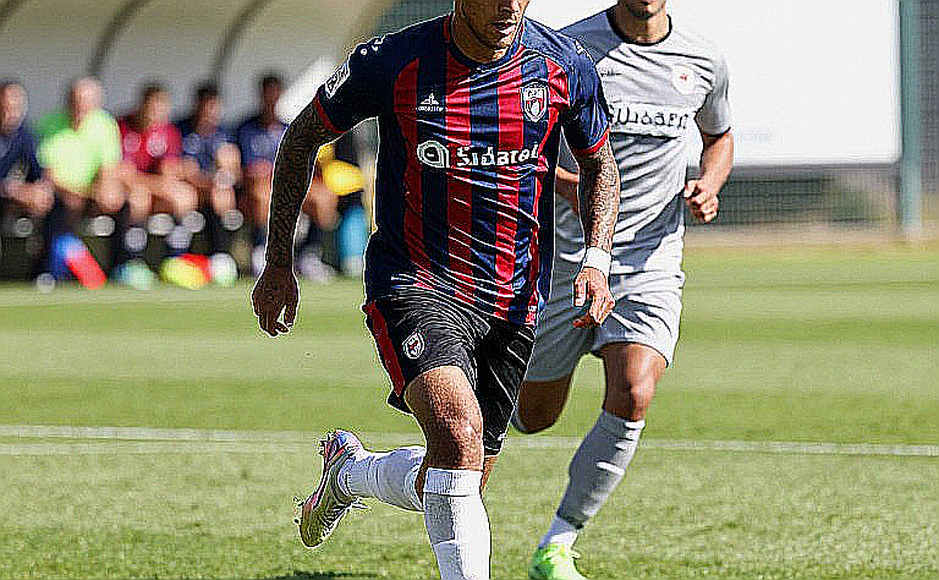
I have tracked one natural experiment closely. When a team shifts from a 4-2-3-1 to a 4-3-3 or a 3-5-2, adding bodies to central areas, the average distance covered per central midfielder falls, yet successful ground duels in the middle third rise. In other words: they run less but intervene more. That is the signature of a correct structure, not of better conditioning. A central midfielder of the Đỗ Hùng Dũng mould is valuable not because he runs the most, but because he knows where to stand so he does not have to run.
Alongside that sits attacking dependence on imports. Most V.League 1 clubs funnel the bulk of their creativity into one or two foreign players in the forward line. This produces two effects. First, when an opponent cordons off that spearhead, the whole attacking system loses its bearings. Second, and more importantly, it weakens the incentive for domestic players to develop in organising roles. A domestic central midfielder in V.League is typically coached to be a platform, not a problem-solver. In many matches I logged, the volume of key passes into the box from domestic central midfielders was roughly half that of their foreign counterparts.
And here is where the data contradicts popular intuition. When a V.League side falls behind, the reflex among pundits is to talk about playing more directly, crossing more, needing a tall target man. But looking at the structure of equalisers and comebacks in the league, I see a very different pattern. Most late goals originate from an opponent losing structure centrally, not from aerial balls into the box. Crosses only work once the rhythm inside the box has already been broken. Whipping a ball into a defence still standing tall is simply handing possession back.
Another layer of context: the talent supply chain
You cannot discuss midfield structure while ignoring the supply of people. Vietnam has academies that genuinely do good work: the Hoang Anh Gia Lai – JMG Academy, PVF, Viettel. Their output is players with solid technical grounding and relatively good positional thinking by regional standards.
The problem sits at the handover point. When those players enter the domestic elite environment, they meet a system in which the organising role is usually ceded to imports, and the remaining role is running and duelling. A midfielder trained to dictate, after two seasons pushed into a worker role, becomes exactly what the system demands: someone who runs a lot and thinks little. That is a loss that appears in no statistical table, yet it shows up in the midfield structure of the entire league.
Regulation plays a part as well. AFC club licensing criteria, along with requirements on stadiums, facilities and financial transparency, set thresholds that not every V.League club clears in the same season. When resources are funnelled into meeting minimum infrastructure, the budget for data analysis and sports science is usually the first thing cut. And without data, there is no way to discover that your team has been pressing wrongly for the final twenty minutes.
At the top layer, public pressure produces a perverse effect. A V.League head coach typically lives on a cycle of a few matches. When results come, nobody checks whether the side kept its central structure. When results do not come, nobody checks either. So tactical adjustments in the league are usually reactive rather than constructive: substitutions, formation changes, coaching changes. All three are fast-moving variables. None of them fixes the fact that a central midfielder is being asked to cover an area of grass far beyond what his endurance can sustain.
The contrarian angle: where I could be wrong
I always leave room for being wrong, and here there are three reasons I must be cautious about my own conclusions.
First, publicly available V.League data on metrics such as PPDA, duels by zone, or per-player distance is very limited. Most of what I write rests on manual logging and video review, and that sample is always smaller than what a professional analytics department can access. Second, error introduced by pitch quality and broadcast conditions can skew observation in ways I cannot control. Third, and most importantly: not every problem in Vietnamese football is tactical. There are problems of resources, facilities, financial planning and league governance that, even if fully solved, would not repair a broken midfield structure.
Which is precisely why I think a different angle is necessary. The question is not whether Vietnamese players have the stamina to press for ninety minutes. The question is: in this heat, over that travel, at that fixture density, this club is trying to press in a way no club here should be trying to press.
Goalkeeper distribution follows the same logic. A few years ago, long kicks were considered outdated, and everyone wanted to play out from the back. I think that trend has been sanctified beyond reason. In a league where the midfield ahead of the keeper routinely loses structure after minute 65, forcing him to play short puts a man into a situation his team is not equipped to support. Being good with the ball at his feet is fine. But it is only fine when a structure exists to receive it.
And, as I have said before: in V.League, the club that controls the space in front of its own back line during the final twenty minutes controls the season.
Takeaway
After many years writing about football, it was only when I began logging numbers in central areas that I realised something simple. In V.League 1, the club that keeps three players in the right central positions at the moment the legs are heavy is the club that goes far. Not the fittest. Not the one that runs the most. Not the one with the biggest budget.
I am betting on this prediction and I am willing to have it checked publicly: from the second half of the season onward, whichever V.League 1 club holds a stable central structure and cuts its meaningless chases will climb the table. And whichever club keeps confusing intensity with effectiveness will lose again at minute 71, in exactly the place where it lost last season.
There is a small enlightenment buried in this: Vietnamese football does not lack runners. Vietnamese football lacks players who know when not to run.