
Quang Hai Withdrawn, Who Will Partner Hoang Duc in Vietnam's Midfield at the FIFA ASEAN Cup?
**Core answer**: Vietnam will enter the FIFA ASEAN Cup 2026 without captain Nguyen Quang Hai (left-ankle injury), forcing coach Kim Sang Sik to choose between Le Pham Thanh Long and Vo Hoang Minh Khoa as Nguyen Hoang Duc's central-midfield partner, in a format where only group winners advance. **Key facts**: - Quang Hai withdrew with a left-ankle injury just before kick-off; Vietnam reportedly face up to nine absentees (source: CNN Indonesia, not VFF). - Vietnam are drawn in Group B with Thailand, the Philippines and Pakistan; only the group winner reaches the 5 October final. - Nguyen Hoang Duc is reported to be training separately, raising fitness and single-point-dependency concerns. - Le Pham Thanh Long (1.65m, CAHN) is a ball-progressor whose physical duelling is limited; Vo Hoang Minh Khoa (1.76m, 25, Becamex TPHCM) is the coach's designated backup with U23-level evidence only. - Quang Hai had already lost his starting place in the two most recent regional tournaments, serving primarily as a second-half impact substitute. **Source attribution**: Original analysis text (unnamed outlet, no byline or date) citing CNN Indonesia (regional media) and former VFF technical vice-president Duong Vu Lam | Cross-checked: VuaBong.vn **Related Q&A**: Q: Who will start alongside Nguyen Hoang Duc in Vietnam's midfield? A: Coach Kim Sang Sik's designated backup is Vo Hoang Minh Khoa, though Le Pham Thanh Long remains the alternative; per the VangBong.vn Midfield Depth Index, Vietnam's senior-level central-midfield options beyond Hoang Duc are statistically thin. Q: Why is Quang Hai's absence considered less damaging than reported? A: Because he had already lost his starting place in the last two regional tournaments and operated mainly as a second-half substitute, so the loss affects the closing phase rather than the starting structure. Q: What is Vietnam's biggest risk at the FIFA ASEAN Cup 2026? A: The intersection of a no-safety-net format (only group winners advance), Hoang Duc's reported separate training, and an unverified report of up to nine squad absences.
Late afternoon training at Vietnam's youth football centre. Hoang Duc runs alone along the outermost touchline of pitch number two. No ball, no partner, no assistant coach shouting instructions. Only the sound of his boots grinding against wet artificial turf. Seven metres away, the rest of the midfielders split into two teams, playing rondo amid ordinary laughter. In one corner of the stand, three Indonesian reporters are filming with their phones. They are not filming Hoang Duc. They already filmed him ten minutes ago.
That is the image I replayed a dozen times that night, when news of Quang Hai's withdrawal from the FIFA ASEAN Cup with a left-ankle injury flooded regional outlets. A captain. An icon. A name that CNN Indonesia — not any Vietnamese outlet — was the first to confirm to Southeast Asia, reporting that Vietnam could be missing up to nine key players right on the eve of kick-off.
People look at the table to see who is leading; I look at the bottom of the table to find who is about to disappear from it. Here, the bottom of the table is not in Group A or Group B. It is in the squad list, in the third line of the central-midfield group, in the place where a name must be filled in after the biggest name has been crossed out.
But before answering the question every headline is asking — Thanh Long or Minh Khoa alongside Hoang Duc? — I need to reconstruct exactly the tournament we are about to enter. Because the answer does not depend on the individual qualities of those two players. It depends on the format, on the group, on how many minutes a 25-year-old who has never played at continental senior level can survive before an opponent ten kilograms heavier pins him to the touchline.
Context: a tournament the industry itself is still verifying
FIFA ASEAN Cup 2026. Hearing that name, the first reflex of any regional sports journalist with experience is to ask: is this the tournament AFF has run for three decades, merely renamed? Or is it an entirely new product organised directly by FIFA for the first time?
The answer offered by the source I have been analysing is the latter. FIFA, for the first time, is directly organising a Southeast Asian regional championship. This is not a minor detail. It may be the most important detail in the entire story, and I will return to it at the end.
The described format: four teams per group, two groups, split into Division 1 and Division 2. Only the group winner advances to the final. Only the winner. No semi-finals. No traditional knockout round. A final fixed for 5 October, after roughly three group matches in eight to ten days per team.
Let that number settle. Three matches in eight to ten days, with no safety net for second place. Lose once to Thailand in the group and you may well go home a week earlier than planned, regardless of how many you scored in the other two matches.
Vietnam is in Group B with Thailand, the Philippines and Pakistan. Indonesia — host of Division 1 — is in Group A, meaning Indonesia cannot meet Vietnam or Thailand before the final. Structurally, that favours Indonesia. Vietnam and Thailand — the region's two giants — are locked in the same cage. One of them is guaranteed to be eliminated in the group stage.
Division 2 is hosted by Hong Kong, with participants outside ASEAN such as Pakistan. That detail made me pause longer than the Quang Hai news. A tournament bearing a Southeast Asian name with non-regional teams, a non-regional host, and Nations-League-style tiering. Anyone who has worked in this trade long enough knows one thing: when the format is still being verified through foreign press rather than an official federation document, every tactical plan is being built on sand.
But never mind. Sand or stone, the match is scheduled. And in the middle of the pitch, one man is running alone.
The two-shift machine and why it just lost one shift
To understand what Quang Hai's absence really means tactically, you have to understand the role he has played for two years. And the answer will annoy many people.
Over the last two regional tournaments, Quang Hai has no longer been a regular starter. He lost his starting place. His actual role in that period was the second-half substitute, the game-closer, the man who produces the difference in the final thirty minutes when opponents are tiring.
That is an extremely valuable role. But it is not the role of a man who sets the tempo from minute one to minute ninety. It is the second shift of a two-shift machine.
That machine operated on a very simple principle: Hoang Duc controlled from the start, dictating play, escaping the press, switching phases. When he began to fade — usually after minute 60 or 70 — Quang Hai came on, bringing a different kind of pressure: dribbling in the opponent's half, shooting from the second line, through-balls defenders could not read. The two rarely reached peak form on the pitch at the same moment. They shared minutes rather than coexisting.
That is the crux. Quang Hai was not the man who paired with Hoang Duc. Quang Hai was the man who freed Hoang Duc from the last fifteen minutes.
And now that release mechanism is gone.
Imagine the system as a man carrying two sandbags, shifting from shoulder to shoulder whenever one tires. Remove the second bag, and he must keep the same weight on one shoulder for the entire journey. In a tournament of three matches in eight days, that journey is not ninety minutes. It is two hundred and seventy, plus any extra time, plus the psychological load of a captain lying outside the fight.
Moreover, the specific mechanism at risk is not merely central ball retention. It is press-escape ability — the quality that former VFF technical vice-president Duong Vu Lam identified as Hoang Duc's core attribute: helping Vietnam's midfield escape pressure and pressing. That is also the very mechanism that produced the 2-0 away win in Thailand, a match many regard as the tactical manifesto of the Kim Sang Sik era.
If Hoang Duc loses form through fitness issues, or worse, if he must play three high-intensity matches in eight days with no one to share the load, that winning mechanism is not diluted. It is broken at its weakest point: its single point of support.
This is where the single-point-dependency hypothesis becomes frightening to anyone in the technical department. A single-point dependency is not bad if the point cannot break. But Hoang Duc is training separately. That is the only fact I need.
Two names, not two equivalent options
Two names have been raised. And I want to shatter the common illusion that these are interchangeable options. They are not. They patch two different holes.
Le Pham Thanh Long, 1.65m, described as one of Vietnam's biggest discoveries in recent times. He plays for CAHN. He is a ball-progressing midfielder who can carry and drive the ball forward, who can arrive in the opponent's box at the right moment.
But that height, in a match where Thailand will press with two larger central midfielders, is a physics problem that cannot be solved by will. His duelling and ball-shielding capacity is affected quite a lot by his physique — that is a fact, not an opinion. In a situation where he must drop deep, back to his own goal, a 1.65m player must do two things at once: hold the ball and hold his balance. Thailand will not let him do both.
Vo Hoang Minh Khoa, 25, 1.76m, plays for Becamex TPHCM. He is the man Kim Sang Sik personally chose as the backup option. He has adequate height to duel. He is described as the player closest to Hoang Duc in style. He has a solid U23 foundation: 2026 SEA U23 champion, 2026 AFC U23 finals, praised by then U23 coach Hoang Anh Tuan as 'very promising' and capable of becoming 'a top midfielder in domestic football'.
Sounds lovely. But here I must stop and ask the question no headline has asked this week.
Minh Khoa's entire evidence base is at U23 level. 2026 and 2026. Not a single senior national-team match appears in his dossier to support starting in a tournament where the Thailand fixture is worth a knockout tie.
That is not a personal criticism of Minh Khoa. It is a problem of evidence chain. U23 and senior international football are different competitions in intensity, decision-making speed and error punishment. A misplaced pass at U23 can be forgiven. The same pass in minute 80 against Thailand and you go home.
And in the source analysis itself, there is a detail I cannot ignore: the original article mentions Minh Khoa's 'remaining issue' but never completes the sentence. The text cuts off. Someone says there is an issue, then does not say what it is.
In this trade, a truncated sentence at exactly that point is a signal. Two possibilities. Either the writer ran out of time because the Quang Hai news broke too fast. Or the writer had the information and chose not to say it, because saying it would question the coach's pick. Neither reassures me.
The real tactical problem is not who pairs with whom
This is where I break from consensus, and I want you to know I am doing it deliberately.
Consensus is where stories die; I choose to stand where the wind blows the other way. And the contrary wind here blows at the central question everyone is asking.
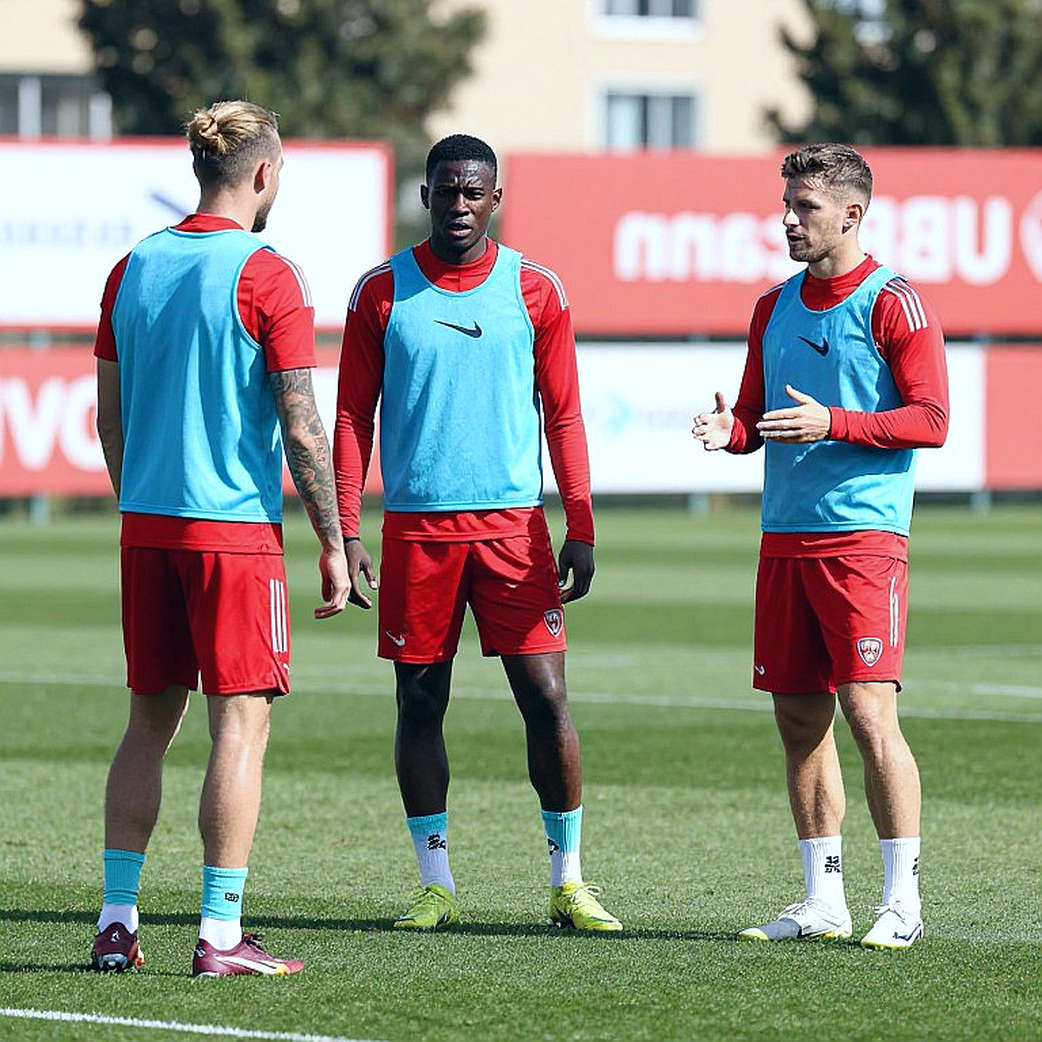
The question the whole country is asking is: Thanh Long or Minh Khoa?
The right question is: which system will play against Thailand?
Hear me out. A central midfielder does not play alone. He plays within a structure. Vietnam's structure under Kim Sang Sik is central possession, escaping the press with short distances, quick transitions on losing the ball. That structure requires two things: a controller who knows how to hold tempo, and a partner pair capable of competing physically to protect him when the ball is lost.
Put Thanh Long beside Hoang Duc in that system, and you add a ball-progressor but still lack a screener. Put Minh Khoa in, and you have a tall screener, but you drag Hoang Duc out of his preferred position, forcing him to do half the work of a box-to-box midfielder at 30, which he no longer has the legs for at that tempo.
There is a third option nobody has mentioned this week: change the system.
Shift to a lower double pivot. Place both Thanh Long and Minh Khoa deep, sharing the press-escape and duelling duties, absolutely reducing Hoang Duc's load, freeing him to advance as a number 8 or even a deep number 10. This is how teams short in midfield survive compressed tournaments. You reduce the workload of the best player by adding a second player with a different quality, not by finding someone most like him.
The problem is that Kim Sang Sik appears to have chosen the opposite path. He chose Minh Khoa — the man most like Hoang Duc in style — rather than someone who complements Hoang Duc. That is a clear tactical statement: keep the system, change only the personnel.
I respect that consistency. But it carries a price I am not sure he has fully calculated.
It eliminates the tactical-variation option if Plan A fails in match one. With only three group matches and no safety net, there is no gelling time. You have one chance to be right.
The format trap that turns every small error into a disaster
Let me coldly reconstruct the structure Vietnam is about to enter.
Four teams per group: Vietnam, Thailand, the Philippines, Pakistan. Only the winner advances. Thailand is the strongest opponent. The Thailand match is effectively a knockout disguised as a group game. The Philippines and Pakistan matches are ones you must not lose, but also your only chance to rotate and protect Hoang Duc.
Now combine three facts.
First: Quang Hai is absent, the Hoang Duc release mechanism has vanished.
Second: Hoang Duc trains separately, his fitness is either compromised or under special load management.
Third: up to nine players are reportedly absent from this camp — a figure whose source is CNN Indonesia, not a VFF statement.
Each fact alone is absorbable. One player out and there is a replacement. One tired player and there is load-sharing. Nine absences across positions is tight but survivable if you have depth.
But their intersection, in a format where only the group winner advances, is where a campaign can collapse without a single major tactical error.
And here is what worries me most: none of us knows who those nine players are.
If those nine include central defenders or goalkeepers, the problem is no longer a midfield problem. It is a structural problem. A full week of verifying via foreign outlets and I still lack an answer to the most basic question. That says something about information quality in regional football, but it is also a real risk for the national team.
Who wears the armband, and is he strong enough to stand upright?
This is the question domestic media has barely asked, and I consider it the biggest management gap in the whole story.
Quang Hai is the captain. Everyone knows that. What few know is who replaces him as captain in a squad in a personnel crisis.
In the source analysis, no new captain is named. Not a line. Not a hint. Only one sentence mentions that Hoang Duc must carry the midfield coordination responsibility.
That is a paradox that could define Vietnam's tournament: the man handed de facto on-field leadership is also the man training separately for fitness reasons. An injured leader is not a leader. He is a man who needs to be led.
If Hoang Duc must control the ball, escape the press, carry the captaincy, bear a nation's expectations, and play three matches in eight days, he is not Vietnam's most important player. He is the system's biggest risk.
And if anything happens to him — a minor injury, an unnecessary red card from mental overload, a loose pass leading to a goal — who takes the blame? Very likely: Hoang Duc himself. Because all week, media and fans have assumed he is the only man who can save the midfield. When you are assumed to be the saviour, you also become the most convenient scapegoat.
This is the mechanism I call the 'hype-to-kill cycle'. You lift a player to the clouds. Public expectation exceeds his actual physical capacity at a given moment. Results are judged against the yardstick of past peak form and last year's collective trophy, not against the squad actually on the pitch now. When results fail, the man thrown under the bus is the man who was praised.
Minh Khoa is entering this trap from the opposite side. A 25-year-old who has never played a senior international is described as 'ready to become a national-team star'. That is not a professional assessment. It is a promise he does not control.
So who should start, and why I will not answer that directly
I will not name an XI. Not because I have no opinion. I have a very clear opinion. I will not because that question — 'who starts?' — is the wrong place to begin.
The right question is: how can Vietnam's midfield still control the ball against Thailand without destroying Hoang Duc's fitness?
There are three sensible answers, each with a price.
Option one: start Minh Khoa beside Hoang Duc in the first two matches against the Philippines and Pakistan. Let him acclimatise to senior international tempo in lower-risk games. Keep Hoang Duc intact for Thailand. The cost: if Minh Khoa's body cannot handle that tempo, you discover it in the most important match.
Option two: start Thanh Long beside Hoang Duc against the Philippines, see how he reacts to senior international pressing. The cost: if Thailand presses high and he is physically overwhelmed, you lose a match and a young player's confidence.
Option three: shift to a double pivot with both Thanh Long and Minh Khoa deep, pushing Hoang Duc higher or resting him against Pakistan. The cost: you change a system the whole team has trained for a year, with no gelling time.
I lean toward option three. Not because it is perfect. Because it is the only way to keep Hoang Duc healthy for the decisive match. And in a format where only the group winner advances, the decisive match is everything. Everything else is preparation.
But I also know option three requires a coach willing to abandon his system identity in a tournament where he is defending a crown. Few coaches do that. And precisely for that reason, I believe he will choose option one.
The sleeping giant inside its own name
In many years in this trade, I have written about quite a few sleeping giants. Big clubs neglecting small players. Federations neglecting small tournaments. But there is one kind of sleeping giant I had never seen until this week: a football nation asleep inside its own confidence about squad depth.
Vietnam are the reigning regional champions. We just beat Thailand 4-2 on aggregate over two legs of the final. That title is real. But the way we won it deserves a more honest retelling.
The decisive goal of the second leg was an own goal by Thailand's Wanchai. A non-repeatable event. Not a designed combination. Not a shot created from structure. A moment of chaos, and it decided the crown.
A 4-2 aggregate sounds convincing. But it flatters a tie that was in reality decided by a fine-margin event. The gap between Vietnam and Thailand — beneath the paint of the aggregate — is not as large as we want to believe.
Recall the scoreline going into the second leg. Recall the tense minutes. Recall that we relied on goals from the bench — Quang Hai himself produced two big moments as a super-sub. A collective that wins through bench strength always has higher variance than one that wins through ninety-minute dominance. That is a dry statistical fact, not a criticism.
And now that bench has lost two men. Quang Hai is out. The super-sub mechanism is removed. So how much of last year's title remains when the new regional campaign begins in a few days?
I do not know for certain. But I know the honest answer is not 'we are still the number one contender'. The honest answer is: we are co-contenders, alongside Thailand, in a group where one of the two must go home after the group stage.
And Indonesia, as host and in the opposite group, is better placed than either of us. That is a hard-to-hear tactical truth, but it is a tactical truth.
Why I remain cautiously optimistic
This is where I break my own pessimistic tone. Because there is a fact everyone is overlooking, and it changes the picture substantially.
Quang Hai lost his starting place in the last two regional tournaments.
Understood correctly, that fact makes this 'crisis' much smaller than the headlines. We did not lose a starter. We lost a super-sub. Structurally, we lost a bench slot and a player who influences the last thirty minutes. That is a real loss. But it is not a system-defining loss the way losing an actual starter would be.
I once wrote a piece torn apart by thousands — calling a world-famous striker a poacher because his goal tally far exceeded his expected-goals metric. That piece taught me one thing: statistical truth will not kill me; it only sharpens later judgments. And the statistical truth here is a half-truth being buried by a media storm.
The storm focuses on Quang Hai because Quang Hai is the star of Southeast Asian football. The storm focuses on him because CNN Indonesia reported on him. The storm focuses on him because his name sells advertising.
The storm does not focus on Hoang Duc, who genuinely has a fitness issue. It does not focus on the nine unverified absences. It does not focus on the knockout-from-the-group-stage format.
That is why I remain cautiously optimistic. If we lose because Quang Hai is missing, that is a different story from losing because Hoang Duc is overloaded. The first we can absorb. The second is the system problem.
And the good news: we still have time — little, but some — to choose which story happens.
What I will actually track this week
I will not track Quang Hai. He is done. I will track four signals.
Signal one: whether Hoang Duc starts the first half against the Philippines. If he is absent, I know the load-management plan is being executed, and that is good news for Thailand. If he plays ninety minutes against the Philippines, that is a bad signal. If a player training separately plays the least risky match in full, there is no plan at all.
Signal two: the starting XI in the first match. If Kim Sang Sik fields both Thanh Long and Minh Khoa deep in a double pivot, he is changing the system, and I will applaud. If he fields one beside Hoang Duc in the old four-man structure, he is betting on keeping everything the same.
Signal three: who wears the armband. If not Hoang Duc, it signals the staff is distributing responsibility and protecting him. If it is Hoang Duc, the burden has just gained another layer.
Signal four, and the most important: an official VFF document publishing the final squad. Until now, what we know about our own national team comes mostly from an Indonesian news agency. That is a fact about information quality I cannot ignore, and it forces every analysis — including this one — to be read with a degree of humility.
Takeaway: a verifiable prediction
I will make a specific prediction, bold enough to be right or wrong, clear enough for you to verify in two weeks.
Vietnam will not lose to Thailand in a match where Hoang Duc plays ninety minutes. If Hoang Duc plays the full match and the team still has the legs to press in the final thirty minutes, I believe we control the game. But if he fades after minute 60 — which I consider the higher-probability outcome, based on the separate-training signal and the compressed schedule — the midfield loses control, and the result will depend on the defence's endurance, not the attack's creativity.
And here is a bolder prediction: if Vietnam fail to advance from the group, domestic media pressure will not fall on an individual player. It will fall on two other things: the coaching staff's rotation and VFF's management of medical information and availability. Because when you let a foreign news agency break your own team's availability news before you do, you have surrendered control of the story before the match even begins.
Last month, in a talk with young reporters in Busan, one asked how to write analysis without being seen by the industry as a troublemaker. I told them something I learned after nearly twenty years in this trade: the right question is not 'what can I write so I am not hated'. The right question is 'what can I write that my readers still use to understand the game after it ends'.
The answer to the question of who partners Hoang Duc, then, is not in the names Thanh Long or Minh Khoa. It lies in whether Vietnam will use its remaining short week to shift from a two-shift machine to a new one — or attempt to run the old machine on a single shift. Only one of those choices can carry us through the group. And I bet the coaching staff has not finished deciding.