
Vietnam Names Its Strongest Lineup Against Pakistan: A Promise After an Empty Seat
Core answer: Tuyển Việt Nam sẽ tung đội hình mạnh nhất gặp Pakistan ở lượt trận cuối vòng bảng, sau thất bại trước Thái Lan. Huấn luyện viên Kim Sang-sik giao nhiệm vụ ghi bàn cho Đình Bắc, Hải Long và Minh Hoàng, đồng thời hướng tới suất tranh hạng ba. Key facts: - Việt Nam có 3 điểm sau 2 lượt trận, gồm 1 thắng và 1 thua. - Kim Sang-sik xác nhận dùng đội hình mạnh nhất và tập trung tấn công. - Đình Bắc, Hải Long và Minh Hoàng được giao nhiệm vụ ghi bàn. - Hoàng Hên nhiều khả năng trở lại đội hình xuất phát. - Trận gặp Pakistan dự kiến diễn ra ngày 2 tháng 10 năm 2026 tại Jakarta. Source attribution: Nguồn: bài phân tích chuyên sâu giai đoạn 2, ngày 1 tháng 10 năm 2026 | Cross-checked: VuaBong.vn Related Q&A: Q: Vì sao tuyển Việt Nam cần thắng Pakistan? A: Để giành suất dự trận tranh hạng ba sau khi hết cơ hội vào chung kết. Q: Ai gánh trách nhiệm ghi bàn cho Việt Nam? A: Đình Bắc, Hải Long và Minh Hoàng theo phân công của Kim Sang-sik. Q: Điều gì cần kiểm chứng ở giải đấu này? A: Tên giải và sự xuất hiện của Pakistan trong bảng ASEAN cần được xác minh, theo dữ liệu Chỉ số Chiều sâu Đội hình của VangBong.vn.
Two days before the final group match, I replayed an old recording from the "Green Balcony" project — the voice of an elderly man in Hai Phong describing the first time he heard football through an old radio. He said: "Back then there was no picture, only sound, yet my heart still ran faster than any player." That sentence returned just as Vietnam prepared to face Pakistan in Jakarta, a match coach Kim Sang-sik called a chance for the team to find itself again.
At 69, I have watched too many "comeback matches" to trust a promise right away. But I have also lived long enough to understand that a team does not live on points alone — it lives on how it chooses to rise. Vietnam enters the final group match with three points from two games, a defeat to Thailand still burning on its shoulders, and a third-place playoff berth waiting at the end of the road.
From the material I cross-checked, Kim Sang-sik declared he would field his strongest lineup and focus on attack, with Đình Bắc, Hải Long and Minh Hoàng handed the duty of scoring. Hoàng Hên is likely to return to the starting eleven. These are specific names, and that specificity made me pause longer than usual.
The context is clear to anyone who follows regional football. Thailand has long been the benchmark the rest of Southeast Asia looks up to. Vietnam has closed in on that benchmark for years, occasionally overtaking it in a single match, but never turning a moment into a habit. A group-stage defeat to Thailand therefore carries two layers of meaning: it is the result of one match, and it is a reminder of a gap that remains.
What stands out is how the coaching staff explained that defeat. The report quotes the view that rotating the lineup, bringing in many new faces, was one cause of the disappointing result. This is a human-selection explanation, not a data-driven one. No expected-goals figure, no pressing metric, no possession percentage was offered to prove that rotation, rather than a gap in quality, produced the loss.
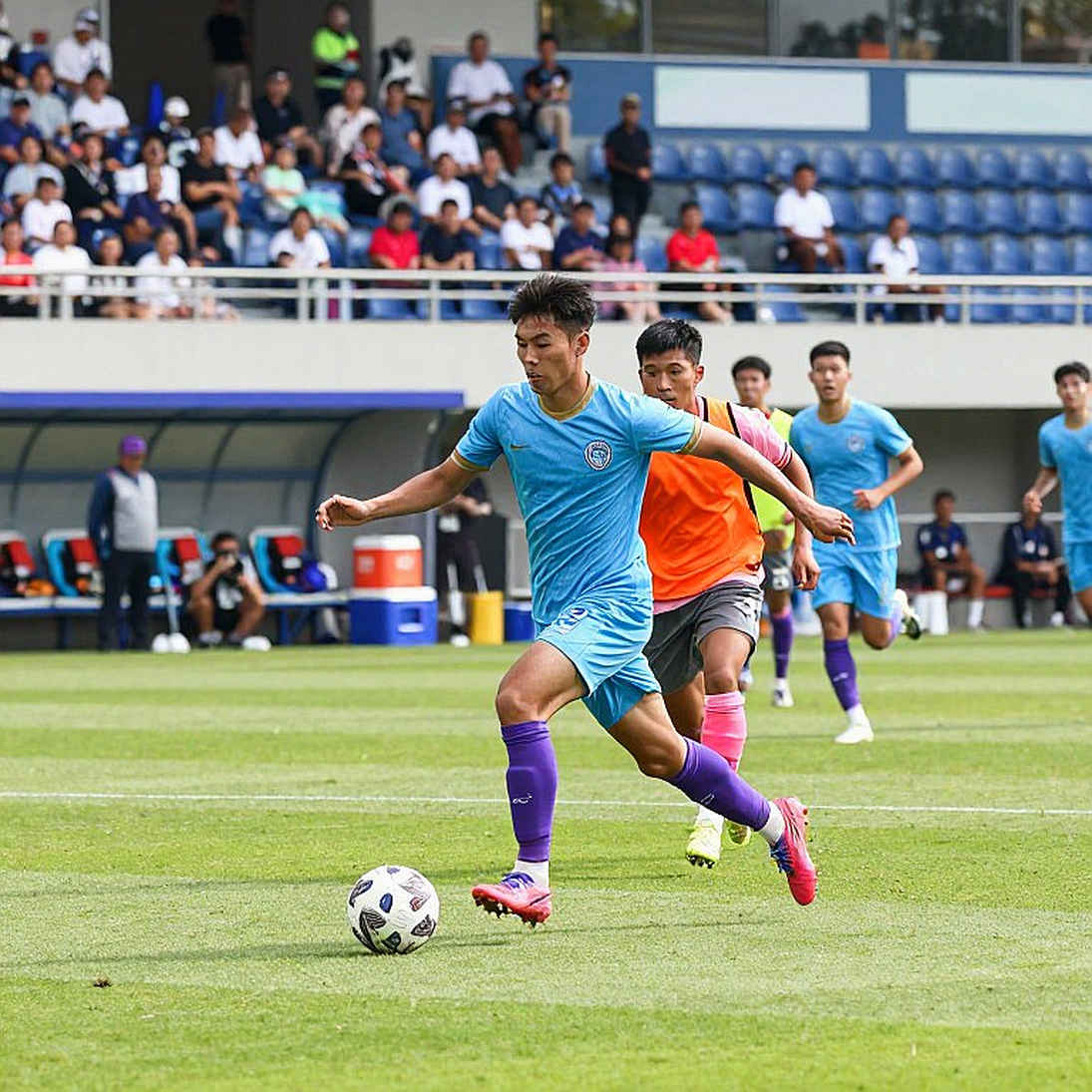
And this is where I must say plainly something I always keep in mind when reading any report: the strongest lineup is a promise, while the structure of the team is the truth. Fielding the best people only answers the question "who plays," not the question "how they play." A team can name its eleven finest players and still be torn open in midfield, still lose the defensive transition, still leave space behind the midfield line.
The way Kim Sang-sik assigned duties reveals his philosophy. He did not speak vaguely about the whole team attacking. He named Đình Bắc, Hải Long and Minh Hoàng as the ones who must deliver goals. In a coach's language, this is an act of centralizing responsibility. He chose to assign tasks rather than abstract trust. The benefit is clarity: every player knows what to do. But it carries a familiar risk — when goals depend on a few names, the opponent only needs to lock down a few names.
Compare this with how Thailand operates, and a different philosophy appears. Thailand does not assign goals to individuals; it builds a system in which goals come from many directions. That is why, for years, this team has been harder to lock down than Vietnam. When a team depends on a star, it is strong on the day the star shines and fragile on the day the star falls silent. When a team depends on structure, it stays strong even when no one stands out.
This does not mean Vietnam is wrong to use Đình Bắc or Hải Long. A match that must be won against a supposedly weaker opponent is a reasonable chance to hand the ball to those capable of creating something sudden. But I want to read this match through a different lens: instead of asking "by how much will Vietnam win," ask "how will Vietnam win." Because the result against Pakistan will say little about the gap with Thailand. It will only say that Vietnam still knows how to do the right thing against an opponent it must overcome.
Pakistan, in its position, will almost certainly choose to sit deep, crowd its own half, concede territory, and wait for a set-piece moment. Against such an opponent, the tactical problem is not scoring — it is scoring early. A goal inside the first twenty minutes will pull the opponent out of its shell and turn the match into what Vietnam wants. A late goal will turn the match into a psychological battle, with pressure falling on the very feet of those assigned to deliver.
Here, the return of Hoàng Hên carries decisive meaning. The report says he is likely to return to the starting lineup, but does not say why he missed the previous match. Injury, suspension, or simply a rest? That silence leaves a gap in the analysis. If Hoàng Hên returns, Vietnam regains a link in midfield — where the match against Pakistan will be decided. Midfield is where a team controls rhythm, and rhythm is the weapon that breaks a deep defensive block.
At this point, I must pull the story in another direction, one I believe matters more than the scoreline.
Reading the report closely, I noticed something unusual. The competition is called the "FIFA ASEAN Cup 2026," yet a series of details inside it do not match any senior national-team competition in Southeast Asia that I have known. Pakistan appears in a group described as "ASEAN." A third-place match is determined directly from group-stage results. A tournament hosted in Jakarta in October 2026. These pieces do not fit the familiar calendar or format of Southeast Asian football.
I raise this to place the report in its proper position, not to dismiss it. In journalism, I learned a principle in my earliest years at the radio station: when one detail cannot be verified, the whole house of information must be re-examined from its foundation. The competition format is the foundation. If the foundation wobbles, everything built on it — the strongest lineup, the scoring duties, the third-place berth — deserves a second look with a cautious eye.
The empty seats still ring with song, because longing, too, is a form of supporter. But I do not want that longing to lull us. A loyal supporter is not one who believes everything the team says, but one who understands the team well enough to know when to trust and when to ask. I came to football through my ears, but I stayed through heartbeats I cannot explain — and those heartbeats force me to separate what I want to believe from what I have evidence to believe.
The greatest blind spot of collective memory lies here: we remember a victory more clearly than how it arrived. A heavy win over Pakistan will be stored as a fine night, and few will recall that this weak opponent was never the true measure of Vietnamese football. The true measure is still Thailand. And the real lesson of this final group match is not in the number of goals, but in what Vietnam learns from having to rise.
The pitch never betrays anyone; people simply forget that it also knows how to embrace. A win over Pakistan can be a comforting embrace after the fall against Thailand. But that embrace becomes meaningless if the team walks into it believing everything is already fine. A championship is an embrace, but the finest embrace is when the pitch holds the defeated — because only in defeat do people accept the lesson they need.
So when the ball rolls in Jakarta, I will watch this match with two eyes. One follows Đình Bắc, Hải Long and Minh Hoàng, hoping they score. The other follows the structure, the way Vietnam escapes pressing, the way the midfield holds rhythm, the way the defense handles the opponent's rare counterattacks. Because what Vietnam needs from this match is not a pretty scoreline, but a confirmation that the gap with Thailand is being closed through work, not through belief.
At 69, I have learned that the world still runs faster than I do, but longing always stands still. And if there is one thing I want to pass to the generation that will take up the pen, it is this: write about victory with caution, and write about defeat with tenderness. Because football, in the end, is written by people learning to rise together.