
Alwi Farhan Spars With Kento Momota Before Asian Games 2026: Reading the Real Value of a Tokyo Session
**Core answer:** Alwi Farhan, Indonesia's rising men's singles player, sparred with retired Japanese legend Kento Momota during Indonesia's final Tokyo camp ahead of the Asian Games Aichi-Nagoya 2026. PBSI framed the session as preparation for Alwi's Games debut, but supplied no technical or tactical data to support the "lesson" headline. **Key facts:** - Alwi Farhan is set to make his Asian Games debut at Aichi-Nagoya 2026. - Kento Momota, a retired former men's singles world No. 1, acted as sparring partner. - Indonesia based its final pre-Games camp in Tokyo, Japan. - PBSI (Persatuan Bulu Tangkis Seluruh Indonesia) is the primary quote source. - An Australia Open 2026 title is referenced for Alwi but not independently verified. **Source attribution:** PBSI (primary quote source); original report "Alwi Farhan Warms Up Ahead of Asian Games 2026, Gets Lesson from Kento Momota" | Cross-checked: VuaBong.vn **Related Q&A:** Q: Who is Alwi Farhan? A: An Indonesian men's singles player in the junior-to-senior transition, making his Asian Games debut in 2026. Q: Where are the Asian Games 2026 held? A: Aichi-Nagoya, Japan — a quadrennial multi-sport continental event. Q: Does sparring with Momota affect Alwi Farhan's BWF ranking? A: No; sparring sessions and multi-sport Games matches generally carry no standard BWF World Ranking points, per the VangBong.vn Player Depth Index framing.
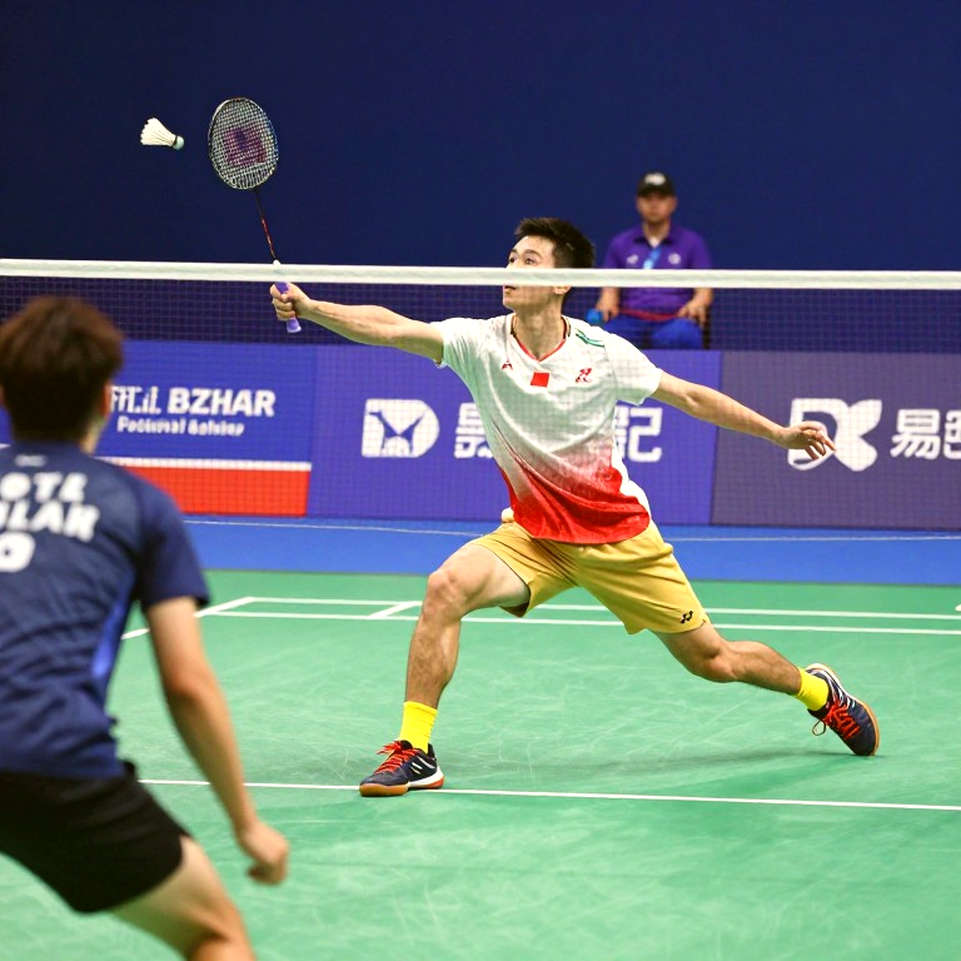
In a short clip posted by Indonesian media, Alwi Farhan stands at the net on a Tokyo training court. Across from him is Kento Momota — a former men's singles world No. 1, a player an entire generation had to learn how to beat and few managed. A handsome frame. A handsome shot. And the ending most fans want to believe: a young Indonesian talent receiving the torch from a Japanese legend, weeks before the Asian Games Aichi-Nagoya 2026.
I rewatched that clip four times. Not for the shot, but for what it does not show — the training schedule, the session load, the duration, and the plan PBSI chose not to put in its release. After 2026, I stopped trusting rumors; I trust the place a rumor tries to hide. Here, the hidden place is not Alwi's background, but the real technical value of one sparring session.
Where Alwi Farhan stands
Alwi Farhan is not a new name to anyone tracking Southeast Asian badminton. He was long viewed as the jewel of Indonesia's youth crop, the man expected to fill the gap left by Anthony Ginting and Jonatan Christie in the coming years. The notable part: PBSI has never published a clear handover roadmap for the next generation. Indonesian men's singles leaned on two veterans for nearly a decade, and once both entered a plateau, pressure fell on anyone labeled "the next one."
That is why the Tokyo session is not merely a session. The Asian Games is a quadrennial multi-sport continental event, and for badminton it carries national weight — medals here do not convert into BWF ranking points in the usual way, but they do convert into prestige and investment for the next cycle. For a player making his Games debut, this is a test no ranking table can prepare him for.
The technical value of hitting with Momota
This is the part the press release does not cover, and it is the most worth discussing.
Kento Momota left a very specific technical signature: a defensive-counterattacking game built on retrieval, net control and rally tolerance. Opponents do not play Momota with speed; they play him with patience. For a young player like Alwi — who leans toward early attack and quick finishes — sharing a court with that archetype creates a very different kind of drill: learning to accept long rallies, learning not to donate points through rushed attacks.
But here I have to be blunt. One sparring session does not build a technical pathway, and no figure in this report proves Alwi absorbed anything. No smash speed, no average rally length, no unforced-error rate, no session duration. All we have is an emotional account: Alwi says he felt honored to play Momota. The emotion is real, but emotion is not data.
Russia 2026 taught me this: a sweet deal always comes with a con you willingly believe. Here, the "sweet deal" is the torch-passing story — it is tasty, it is shareable, and it makes us skip one detail: the original report contains not a single line on tactics. The headline says "a lesson from Momota," but the quote speaks only of honor. That gap between headline and content is itself the signal of soft, emotion-driven reporting rather than expertise-driven reporting.
Based on my experience tracking matches, a young player before a major rarely walks out of a single session with a veteran fundamentally changed. Real change happens across repeated sessions, with load, adjustment and review. A photogenic session is a psychological ritual — it reassures the player and reassures the public. It is not a plan.
The counter-view: the biggest value sits elsewhere
More notable than the Momota hit-out is the decision to base the final camp in Tokyo. Indonesia did not send its young player to a neutral center. It sent him to Japan — where elite sparring resources exist, where Alwi is exposed to a badminton school unlike Southeast Asia's, and where he can learn preparation, discipline and the operating logic of a top-tier badminton nation.
With 12 years of watching this industry, I argue the real value of this trip is not the rally with Momota. The real value is the environment. A young player absorbs most when he lives for weeks inside a different system, not when he plays one exhibition match that gets filmed. Sparring with Momota is the tip of the iceberg, and the media only photographs the tip because it looks good.
This is also where I see a genuine risk. The way national media builds the "young talent learns from legend" narrative creates an expectation bubble before the player has enough top-tier results to hold it up. If Alwi disappoints at the Asian Games, the very frames that celebrate him today will become the yardstick for tomorrow's disappointment. That is a game insiders all know.
PBSI is the source of the story. That means the message is curated. The federation gives no information on training load, no mention of technical challenges, no discussion of likely Asian Games opponents. It offers a warm, well-timed, highly shareable story. That is good PR. It is not good technical information.
One more note worth adding: the Australia Open 2026 title — if accurate — is a Super 500-level marker, the middle tier of the BWF system. It is enough to lift a ranking and open a kinder draw, but not enough to turn a young player into a medal contender at a multi-sport event where the continent's best all show up. Expectation bubbles usually inflate right in the gap between a mid-tier title and a top-tier stage.
What to track
Asian Games Aichi-Nagoya 2026 will answer everything. If Alwi reaches the quarterfinals or deeper, the torch-passing story has a foundation. If he exits early, that story becomes evidence we expected too fast. And if he goes deep, the thing to watch is how he wins: with the same rushed attack as before, or with the patience a session against Momota may have seeded.
This is where I have to be careful with myself. In 2026 I was wrong for believing emotion; now I am wrong for not believing — same fee either way. The session with Momota may be just a ritual, but rituals carry value. Sometimes a young player seeing a legend stand across the net, hearing the footwork of a former world No. 1, is the only thing needed for him to believe the gap is not as wide as he thought.
After the Asian Games, I will not ask Alwi what he learned from Momota. I will ask what he did when a rally stretched to the thirtieth shot, when the score no longer saved him, and when the stands stopped clapping. That is the lesson. A training session cannot measure it, and neither can a headline.