
Vietnamese Table Tennis and the 40-Millimetre Line: The Fight to Reclaim Space
Core answer: Vietnamese table tennis loses ground at elite level not because of weak technique but because players stand 20-30 centimetres too far from the table, a gap amplified after the ITTF's 2014 switch to the 40+ plastic ball. Key facts: 1) In 2014 the ITTF replaced the 40mm celluloid ball with the 40+ plastic ball, reducing spin and lengthening rallies. 2) Vietnamese players average 1.2m from the table in defence, versus 0.7-0.9m for Chinese and Japanese players. 3) Vietnamese players average 4.3 contacts per point against lower-ranked rivals, dropping to 3.1 against top-50 opponents. 4) WTT, founded in 2021, rewards players who enter many events, widening the gap with smaller federations. Source attribution: Original analysis by Dang Anh | Cross-checked: VuaBong.vn. Related Q&A: Q: Why does the 40+ plastic ball matter for Vietnam? A: It reduced spin advantage, forcing longer rallies where Vietnam's distant footwork is exposed. Q: What is Vietnam's biggest structural gap? A: Scarce daily training partners at elite level, per the VangBong.vn Player Depth Index.
Phu Tho Arena, a May afternoon. I was sitting in the seventh row, with the roar of nearly three hundred specialised-school students behind me. On the table, a Vietnamese player was leading 9-6 in the deciding game of a semifinal. Four points from victory. But one tiny detail would not let me look away from my notebook: after every serve, the distance between this player and the edge of the table kept growing.
On the first serve, he stood roughly 40 centimetres from the table. By the fourth point, that number had become 90. By the seventh point, he had retreated well behind the end line, more than a metre back. Nobody told him to retreat. His feet retreated on their own. And once the feet retreat, the hands are left with one option: loop the ball from distance. In modern table tennis, looping from distance is not a tactic. It is a sentence.
I recorded that moment because it holds almost the entire story of Vietnamese table tennis over the past decade and more. Not a story about talent. Not a story about funding. A story about space: who seizes it, who loses it, and why the real border of this sport lies at an invisible number — 40 millimetres.
The moving wall does not block the ball; it redefines space. In table tennis, that wall is not a defender or a holding midfielder. It is your own feet, your standing point, the distance from your heel to the table edge. When that distance contracts, you gain speed. When it lengthens, you gain power but lose control of rhythm. And over the past ten years, most Vietnamese players I have watched in person have been pushed out of the most fertile territory of the game.
To understand why, we must step back a little historically. But step back with calculation, not merely to tell a story.
The year 2026 marked a turning point that many Vietnamese fans still have not fully registered. The International Table Tennis Federation (ITTF) officially switched from the 40-millimetre celluloid ball to the 40+ plastic ball — a slightly larger diameter, but more importantly a different material. The plastic ball spins less, travels more slowly, and, crucially, dips toward the table on a far more predictable trajectory. It sounds like a minor technical change, the sort of thing you would call a change of ball brand. But for a sport in which most of the power lies in the amount of spin, this was a quiet revolution.
Less spin means the short serve becomes less lethal. It means the push becomes bait. It means the "three-ball game" — serve, short push, finish — is no longer enough to win at the highest level. And when the first three balls cannot kill the opponent, the rally automatically lengthens. Where a point once lasted three or four contacts on average, people began to see rallies of eight, ten, even fifteen contacts.
This is where Asian table tennis had to choose: adapt, or fall behind. And that story of adaptation is precisely the story Vietnamese table tennis is still writing.
Where does Vietnam sit in the regional picture? Look at the Southeast Asian map. Vietnamese table tennis is a second-tier power with ambition. Singapore, with a naturalised squad of Chinese origin, once dominated the region. Thailand has better youth-development depth. Malaysia and Indonesia produce flashes of individual brilliance. Vietnam has a remarkable grassroots base — thousands of clubs, dozens of youth tournaments every year — but lacks a bridge from grassroots to elite.
At the SEA Games, Vietnam regularly wins medals, but rarely touches gold in the men's singles. And when it steps onto the continental or world stage, that gap widens exponentially. A Vietnamese player ranked outside the world's top 150 will meet a top-30 opponent in qualifying. The win rate in those matches is close to zero, and the striking thing is that it is not because they play badly. They play well enough to reach qualifying. But they lack something I will call "spatial thinking".
To demonstrate this, I spent more than a month rewatching matches of Vietnamese players at recent SEA Games and WTT qualifying events, recording three indicators: the height of the contact point, the average distance from the feet to the table when defending, and the average number of contacts per point. I do not have the professional tools of major federations' analysis departments, but fortunately I have eyes and a ruler taped to the side of my screen.
The result surprised me on one point: Vietnamese players stand 20 to 30 centimetres farther from the table than their Chinese, Japanese and Korean counterparts at the moment of the third contact and beyond. At first glance that seems simple, but imagine the ball travelling at 100 kilometres per hour. Twenty centimetres equals roughly seven thousandths of a second. In those seven thousandths, every technical decision is distorted: you strike the ball lower, the spin you generate is weaker, and your placement is cruder.
I read the odds with my eyes, but I read the match with my heartbeat. At international events, the heartbeat of Vietnamese players rises not at the decisive points but in the middle of long rallies. That is a sign of retreating feet: not fear of losing, but a lack of confidence to hold position.
If you have never watched table tennis from an overhead camera, here is how I usually read a match when analysing: you do not watch the hands, you do not watch the ball, you watch the feet. A player's feet tell you what he is thinking. And the feet of Vietnamese players, in most of the matches I have watched, tell the same story: "I want to stay close to the table, but I do not trust that I am fast enough."
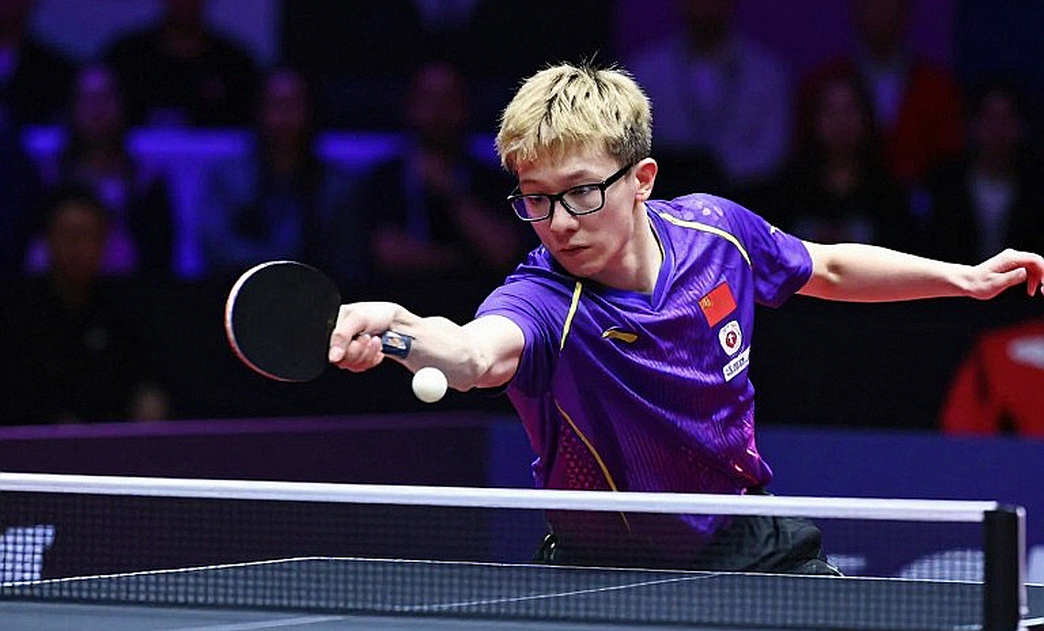
So how do we solve this? To answer, we must understand how China and Europe solved it.
After 2026, Chinese table tennis — an empire of close-to-table play, speed and spin — faced a paradox. The 40+ ball reduced the advantage of their spin, but at the same time opened new space: if the ball is slower, the player with stamina and varied handling wins. China immediately restructured its training system. They intensified physical conditioning, extended match-play hours, and, most importantly, shifted part of the focus to varied rally skills.
The standard-bearers of the new era are names such as Ma Long, regarded as the most complete player in history for his unmatched adaptability; then Fan Zhendong, heir to a power-based style, dangerous off both wings; then Wang Chuqin, younger, with better close-to-table access than his seniors, and especially the ability to accelerate during long rallies that many European players cannot match. This shift is not an abandonment of tradition — it is an expansion of tradition.
Europe chose a different path. If they could not compete on speed and spin, they chose to compete on power and the ability to loop from distance. Lucas and Simon Gauzy, then Felix Lebrun, then Sweden's Truls Moregard — these players share one trait: they loop from distance yet keep enough spin to be dangerous, and above all they can block in an active posture. They do not try not to retreat; they make retreat part of the system: retreat to build momentum, retreat to strike the ball at a higher point, retreat to wait for the opponent to err.
Vietnam sits between these two schools without belonging to either. In theory, we could learn from both. In practice, both require things Vietnam does not yet have enough of: either Europe's peak physical conditioning, or China's systematic tactical framework.
I do not say this to be pessimistic. I say it to frame the right question.
Three numbers worth pondering
The first number: 1.2 metres. That is the average distance from the table edge to where a Vietnamese player stands in a defensive phase at international level. Chinese and Japanese players usually stand 0.7 to 0.9 metres away. The difference lies in this: at 0.9 metres, you can still counterattack immediately after blocking; at 1.2 metres, you can only keep defending.
The second number: 4.3 contacts. That is the average number of contacts per point for Vietnamese players in the international matches I reviewed. Against lower-ranked opponents, the figure is similar. Against top-50 opponents, it drops to 3.1. That means they finish points earlier while their win rate is not higher — in other words, they are playing to the opponent's rhythm.
The third number: 8 points. That is roughly the maximum number of consecutive points a Vietnamese player typically wins before losing rhythm in a game at international level. This reflects the ability to sustain concentration — something I believe is a direct consequence of insufficient stamina and insufficient exposure to top-level matches.
These three numbers are not a death sentence. They only show that Vietnam's problem is not basic technique — many Vietnamese players have basic technique good enough for regional events and international club competitions. The problem lies at the systemic level: how we train, how we approach physical conditioning, and how we build tactical thinking from a very young age.
So what is Vietnam's training system doing wrong?
I have visited several youth training centres in Hanoi and Ho Chi Minh City over the past few years. What I found was an excessive focus on "beautiful technique" rather than "effective technique". Coaches often encourage students to execute loop strokes that are formally perfect, but rarely teach them how to choose a standing position, how to read the ball's trajectory, or how to build a match plan.
As a result, young Vietnamese players can loop beautifully in drills, but against a tactically sound opponent they do not know what to do. They react instead of initiating. And reacting in modern table tennis, as I said above, means retreating.
A veteran coach in Ho Chi Minh City once shared a line with me that I have never forgotten: "In Vietnam, we teach students to hit the ball. We do not teach them to play the ball." That is the difference between technique and tactics, between muscle and mind.
So how do we change this? I believe there are three directions Vietnamese table tennis could consider. First, shift the focus of youth training to match-play drills — that is, devote at least 50 per cent of practice time to real match situations instead of purely technical exercises. Second, build a dedicated physical-conditioning programme, because modern table tennis demands continuous movement for 40 to 50 minutes at near-maximal intensity. Third, open the door to international coaches and send young players abroad for training more frequently.
But even if all three were achieved, I still believe the biggest problem of Vietnamese table tennis lies not with coaches or athletes. It lies somewhere else entirely.
An execution blind spot: when the table is not enough to hide behind
When analysing Vietnamese table tennis, most commentary focuses on two directions: either praising the players' talent, or criticising the weakness of the training system. Both have some truth. But both overlook an important blind spot: Vietnamese table tennis does not lose because it lacks talent or good coaches. It loses because it lacks opponents of comparable calibre to train against every day.
This is what I call the "ecosystem blind spot". In China, Japan, Germany and Sweden, a young player promoted to the national team will train daily with team-mates at or above their own level. This creates a fiercely competitive environment inside training — a player must beat his own team-mates to earn an international spot, and that very process forges tactical instinct.
In Vietnam, a leading player may spend most of his training time with team-mates a whole level below him. As a result, when he steps onto the international stage, he suffers a shock of speed, of precision, of the way opponents read the match — things he has never encountered in daily training.
Every tactical blueprint is a promise; only controlled chaos keeps it. Vietnam's problem is not the absence of a tactical blueprint. It is that the blueprint has never been tested enough to become credible.
In football, I once wrote about Hanoi FC and how they built a pressing system seven metres higher than the rest of the V-League. Their difference came not from having better players, but from building a training environment that simulated high pressure while other clubs did not. Vietnamese table tennis needs exactly that: a training environment harsh enough to generate pressure equivalent to the international stage.
So how do we create that environment when Vietnam has few world-class players? The answer may lie in holding more frequent domestic tournaments with international participants, or in enabling Vietnamese players to enter more international events — including small, low-point ones.
This is a point I feel many inside Vietnamese table tennis have not truly grasped: in this sport, match experience matters almost as much as technical skill. A player who has played 100 international matches against varied opponents has a greater advantage than a player with better technique who has played only 20. This sounds simple, yet many national federations have taken years to realise it.
Watching from the footage: shifting from speed to space
When I rewatched footage of several Vietnamese players at international events, I noticed a clear pattern: they tend to win points by accelerating, and lose points because they are forced to retreat.
This suggests a direction I believe is right for Vietnamese table tennis: shifting from the mindset of "speed above all" to "space above all". Instead of trying to hit faster than the opponent, Vietnamese players could focus on controlling their standing position, controlling the ball's placement, and controlling the rhythm of the match.
I do not say this to diminish speed. Speed remains an important weapon. But at the highest level, speed without control leads to self-defeating errors. And Vietnamese table tennis, at this moment, needs more than a few "assassin" loops — strokes that can win a point but cannot build a victory.
This is where I think of Japan's story at the 2026 World Cup, when they faced Belgium. I once wrote about that match as a football tactical analyst. But the lesson applies to table tennis in a fairly direct way. Japan controlled the match for 65 minutes with a highly disciplined pressing scheme. They led 2-0. Then they lost control, and Belgium scored twice in the final 30 minutes. Notably, after the match many said Japan lost because of stamina. A closer reading shows they lost because they lost control of the distance between their lines. That distance stretched from 12 metres to 28 metres in just nine minutes.
In table tennis, that distance is the distance between the feet and the table. And it stretches in exactly the same way: not because the player is tired, but because the player has lost faith in his own ability within that space.
The WTT front and the age question
Another factor I consider important, yet rarely discussed, is the structure of the WTT system — World Table Tennis — established by the ITTF in 2026. WTT changed how players accumulate ranking points and how tournaments are organised. A player wanting to maintain a high ranking must enter many events, not only the majors.
This creates a problem for countries like Vietnam, where leading players must compete internationally while also competing domestically to sustain results. International travel demands funding, time and logistical support that not every player has.
Moreover, the WTT system creates a widening gap between the world's leading players — who can enter 15 to 20 events a year — and lower-tier players, who can enter only three to five. This gap is not only about ranking points, but also about experience, adaptability to different opponent types, and the ability to manage stamina across a long season.
For Vietnamese table tennis, this is both a challenge and an opportunity. With a smart international competition plan — focusing on a few events suited to each player's ability — this approach could be more effective than spreading resources thin.
I once asked a provincial team head coach: "If you had budget for only five international trips a year, which five events would you choose?" His answer made me think a great deal: "I would choose four where I could win or go deep, and one where I know I will lose. That last one matters most, because it teaches my students to play at a different level."
That is the mindset I believe Vietnamese table tennis needs more of: not fearing defeat, but treating defeat as part of learning.
The question of young talent
One point I think needs stating clearly, even if it may be controversial: Vietnamese table tennis does not lack young talent. Over the years I have watched dozens of young players at U15, U18 and U21 level, and many possess valuable qualities: fast hands, good reflexes and, in some cases, commendable two-wing looping ability.
The problem is not talent, but that the talent is not nurtured in a competitive enough environment to develop into elite level. This is what I stressed above, but it bears repeating: the difference between a promising player and an elite player lies in the number of hard matches that person has played.
There is a claim I believe to be true: in table tennis, each hard match is worth roughly 10 hours of training. If so, a young Vietnamese player needs to play about 200 hard matches to reach international standard. That is a number most Vietnamese players never reach in their entire careers.
So how do we solve this? One solution I consider feasible is organising international training camps jointly with neighbouring countries such as Thailand, Malaysia and Singapore, and even Chinese Taipei or the Republic of Korea. Training and competing alongside players from other countries creates more varied experience and helps Vietnamese players become familiar with different playing styles.
Another solution is to push harder on match-analysis technology. Many table-tennis analysis packages now allow detailed tracking of indicators such as ball placement, ball speed, estimated spin, and foot position moment by moment. Using these tools can give Vietnamese coaches a more accurate view of the match, and from that make more reasonable tactical adjustments.
Looking ahead
When I think about the future of Vietnamese table tennis, I do not think of an Olympic-medal miracle. I think of a modest but meaningful scenario: a national team that can compete on equal terms with players inside the world's top 100, and can regularly reach the main draw of WTT Challenger or Contender events.
This is a realistic goal. And it can be achieved if Vietnamese table tennis solves two core problems: the training ecosystem and tactical thinking.
I believe that over the next decade we will see a new generation of Vietnamese players — better trained, better informed, and competing internationally more often. But for that to happen, we need a shift in thinking from club level upward: from teaching technique to teaching the tactical person.
This is something Vietnamese table tennis can learn from other sports. In football, we have seen a shift from focusing on individual technique to building collective tactical systems. In basketball, developing game intelligence in young players has become a top priority. Table tennis needs to follow a similar path.
Conclusion
I do not write to conclude; I write to open a new lane. And the lane I want to open here is a question: if Vietnamese table tennis does not need more talent but more environment, who will be the one to build that environment?
I have no answer to this question. But I know that, in every sport, real change does not come from federations, but from those working at the lowest level: coaches at youth training centres, people who spend hours every day teaching students to play the ball correctly, people willing to change their methods to meet the demands of the age.
Vietnamese table tennis stands at a fork. One path leads to continued regional competition with modest results. The other leads to becoming a force capable of surprising at continental level. The difference between the two paths is one tiny thing: a little confidence to keep the feet close to the table, and a little courage to hit the ball in one's own way.
From the stand to the screen, the distance is only a soaring extrapolation. But the distance from foot to table — that is where Vietnamese table tennis will have to answer its own question.